
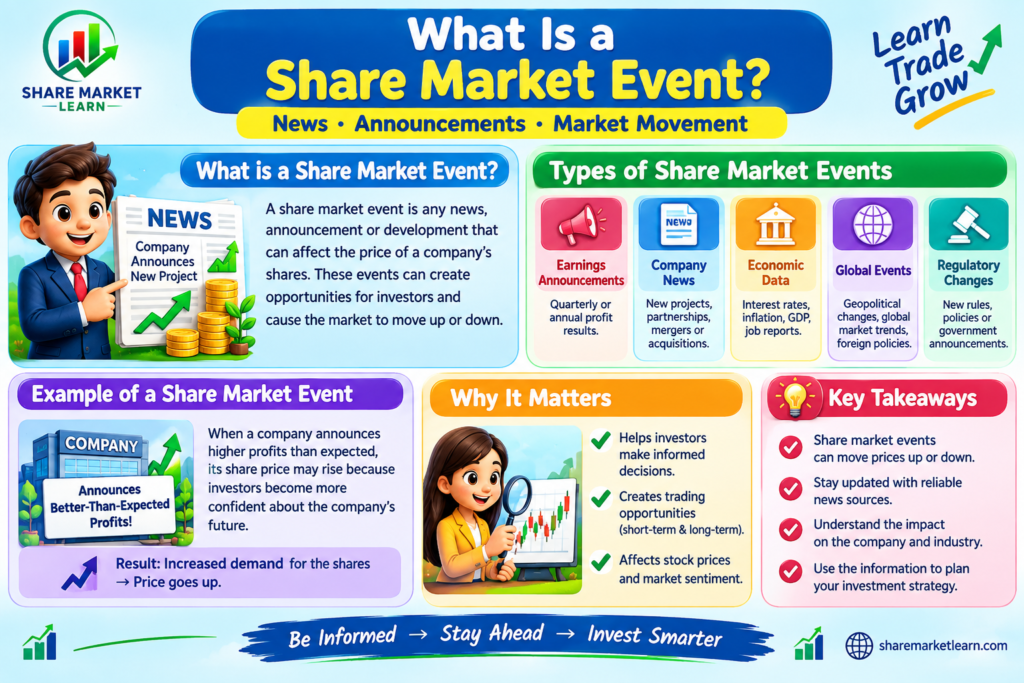
The share market is influenced by many factors, and one important factor is a share market event. If you are new to investing or trading, you may often hear terms such as earnings results, dividends, stock splits, IPOs, Union Budget, RBI policy, or company announcements. These are examples of events that can affect the share market.
But what exactly is a share market event? Why are these events important? And how can beginners understand their possible impact on stocks?
In this article, we will explain what a share market event is, the different types of events, how they can affect stock prices, and what investors should consider before making an investment decision.
What Is a Share Market Event?
A share market event is an important announcement, development, or scheduled activity that can influence a company, industry, or the overall stock market.
These events may provide new information to investors. When investors receive new information, they may decide to buy or sell shares. As a result, stock prices can move up or down.
For example, suppose a company announces that its quarterly profit has increased significantly. Investors may react positively to the news, although the actual market reaction depends on expectations and other factors.
Similarly, if a company reports lower-than-expected profits, investors may react negatively.
Share market events can be related to individual companies, sectors, the Indian economy, or global markets.
Why Are Share Market Events Important?
Share market events are important because they can create changes in investor expectations and market sentiment.
Before an event, investors may have certain expectations. When the actual information is announced, the market compares the result with those expectations.
For example:
- A company reports strong quarterly results.
- A company announces a dividend.
- A company declares a stock split.
- The Reserve Bank of India announces a change in monetary policy.
- The government presents the Union Budget.
- A company launches an IPO.
Any of these events can attract increased attention from investors and traders.
However, an important point to remember is that an event does not guarantee that a stock price will rise or fall. Market movements depend on several factors.
Common Types of Share Market Events
There are many different types of share market events. Let’s understand some of the most common ones.
1. Quarterly Results
Listed companies generally announce their financial results periodically. These results may include revenue, profit, expenses, earnings per share, and other financial information.
Investors use these results to understand how a company is performing.
For example, if a company’s revenue and profit increase, investors may consider the results positive. But the stock price may still fall if the results were below what the market expected.
2. Dividend Announcement
A dividend is a portion of a company’s profits that may be distributed to eligible shareholders.
When a company announces a dividend, investors usually pay attention to details such as:
- Dividend amount
- Record date
- Ex-dividend date
- Payment date
Dividend announcements are therefore important events for shareholders who focus on income from their investments.
3. Stock Split
A stock split happens when a company divides its existing shares into a larger number of shares.
For example, in a hypothetical 1:2 split, one existing share may be divided into two shares, subject to the company’s announced terms.
A stock split changes the number of shares and their face value according to the split ratio, but it does not automatically create additional company value.
Investors should therefore understand the reason and details of the split rather than assuming that a stock split automatically means the share price will increase.
4. Bonus Shares
A company may issue bonus shares to eligible existing shareholders without requiring them to pay an additional amount for those shares.
For example, a company may announce a 1:1 bonus issue, meaning an eligible shareholder could receive one additional share for every one share held, subject to the applicable record date and terms.
Bonus issues can attract significant market attention.
5. Initial Public Offering (IPO)
An Initial Public Offering, commonly called an IPO, is when a company offers its shares to the public for the first time and seeks listing on a stock exchange.
IPO-related events may include:
- IPO announcement
- Opening of subscription
- Closing of subscription
- Allotment
- Listing
- Post-listing trading
Many investors closely follow IPOs because they provide an opportunity to learn about new companies entering the public market.
6. Union Budget
The Union Budget is another major event followed by Indian investors.
Budget announcements can contain changes related to taxation, government spending, infrastructure, industries, and economic policies.
Different sectors may react differently to budget-related announcements. However, investors should look at the complete details rather than making decisions based only on headlines.
7. RBI Monetary Policy
The Reserve Bank of India, or RBI, announces monetary policy decisions at scheduled intervals.
Interest rates and other monetary policy measures can influence borrowing costs, liquidity, businesses, banks, consumers, and overall economic activity.
As a result, RBI policy announcements are closely watched by market participants.
8. Corporate Announcements
Companies regularly make announcements that may be important for shareholders.
Examples include:
- New business projects
- Mergers and acquisitions
- Fundraising
- Management changes
- New partnerships
- Expansion plans
- Share buybacks
- Regulatory developments
Such announcements can affect investor expectations about the company’s future.
How Can Share Market Events Affect Stock Prices?
A share market event can influence prices because investors react to new information.
There are generally three possible situations.
Positive Surprise
If the event is better than investors expected, buying interest may increase.
For example, if analysts expected moderate profit growth but the company reports much stronger growth, investors may react positively.
Negative Surprise
If the announcement is worse than expected, selling pressure may increase.
For example, disappointing financial results or reduced future guidance can affect investor sentiment.
Expected Result
Sometimes an event receives very little reaction because the information was already expected by the market.
This is why simply knowing that an event is happening is not enough. Investors also need to understand what the market is expecting.
What Is an Economic Event?
Not every important market event comes from a company.
An economic event is a development or scheduled announcement related to the economy that may influence financial markets.
Examples include:
- Inflation data
- Interest-rate decisions
- GDP data
- Employment data
- Government Budget
- Central bank announcements
- Major economic policy changes
These events can affect multiple sectors or the broader market.
Share Market Events for Traders
Traders often pay close attention to upcoming events because prices can become more active around important announcements.
However, event-based trading can involve significant uncertainty. Prices may move quickly after news is released.
For beginners, it is important not to trade simply because an event is happening.
Instead, understand:
- What is the event?
- When is it scheduled?
- What information is expected?
- What are investors expecting?
- What risks are involved?
- How could different outcomes affect the company or market?
Good preparation is more useful than simply reacting to market movements.
Where Can You Find Share Market Events?
Investors can find information about upcoming events through reliable sources such as:
- Stock exchange announcements
- Company investor-relations pages
- Official company filings
- RBI announcements
- Government websites
- Reputed financial news sources
- Financial calendars provided by market platforms
Always verify important information from an official or reliable source before making an investment decision.
Share Market Event vs News
A share market event and market news are related, but they are not exactly the same.
A share market event is often a specific scheduled or officially announced development, such as quarterly results, an IPO, dividend record date, or RBI policy announcement.
Market news can be broader and may include reports, opinions, developments, rum ours, or breaking information.
Understanding the difference can help investors avoid making decisions based on unverified information.
Important Things Beginners Should Remember
Share market events can provide useful information, but they should not be treated as automatic buy or sell signals.
Before making an investment decision, consider:
- The company’s financial performance
- Valuation
- Business model
- Industry conditions
- Future growth prospects
- Management
- Economic conditions
- Your investment goals
- Your risk tolerance
Most importantly, avoid making decisions based only on social media posts, rum ours, or headlines.
Conclusion
A share market event is an important announcement or development that can influence a company, sector, or the broader stock market. Quarterly results, dividends, stock splits, bonus issues, IPOs, corporate announcements, Union Budget decisions, and RBI policy announcements are some common examples.
For beginners, understanding these events is a useful part of learning how the stock market works. However, an event by itself does not tell you whether a stock will rise or fall.
The best approach is to understand the event, study the information behind it, compare the result with market expectations, and consider your overall investment strategy before taking action.
As you gain experience, following important share market events can help you better understand why prices sometimes move sharply and how new information can influence investor sentiment.
Frequently Asked Questions (FAQs)
1. What is a share market event?
A share market event is an important announcement or development that can influence a company, sector, or the overall stock market. Examples include quarterly results, dividends, IPOs, stock splits, and economic policy announcements.
2. Can a share market event change stock prices?
Yes. New information from an important event can influence buying and selling activity. However, the direction and size of the price movement cannot be guaranteed.
3. What are some common share market events?
Common events include quarterly results, dividend announcements, bonus issues, stock splits, IPOs, company announcements, Union Budget announcements, and RBI monetary policy decisions.
4. Are share market events important for beginners?
Yes. Understanding major events can help beginners understand why stock prices may change and how investors respond to new information.
5. Should I buy a stock because of a positive announcement?
Not necessarily. A positive announcement does not automatically mean a stock is suitable for investment. Investors should consider the company’s financial s, valuation, risks, and their own investment objectives.
6. Where can I check upcoming share market events?
You can check official stock exchange announcements, company investor-relations pages, RBI communications, government websites, and reputable financial market platforms.
7. What is an economic event in the share market?
An economic event is a major economic announcement or development, such as inflation data, GDP data, interest-rate decisions, or government policy announcements, that may influence financial markets.
8. Can beginners trade around market events?
Beginners should understand that trading around major events can involve significant uncertainty and rapid price movements. It is important to learn the risks before attempting event-based trading.