
If you are new to the stock market, you may have heard terms like options trading, call options, put options, option buying, and option premiums. These terms can sound complicated at first, but the basic idea of option buying is actually quite simple.
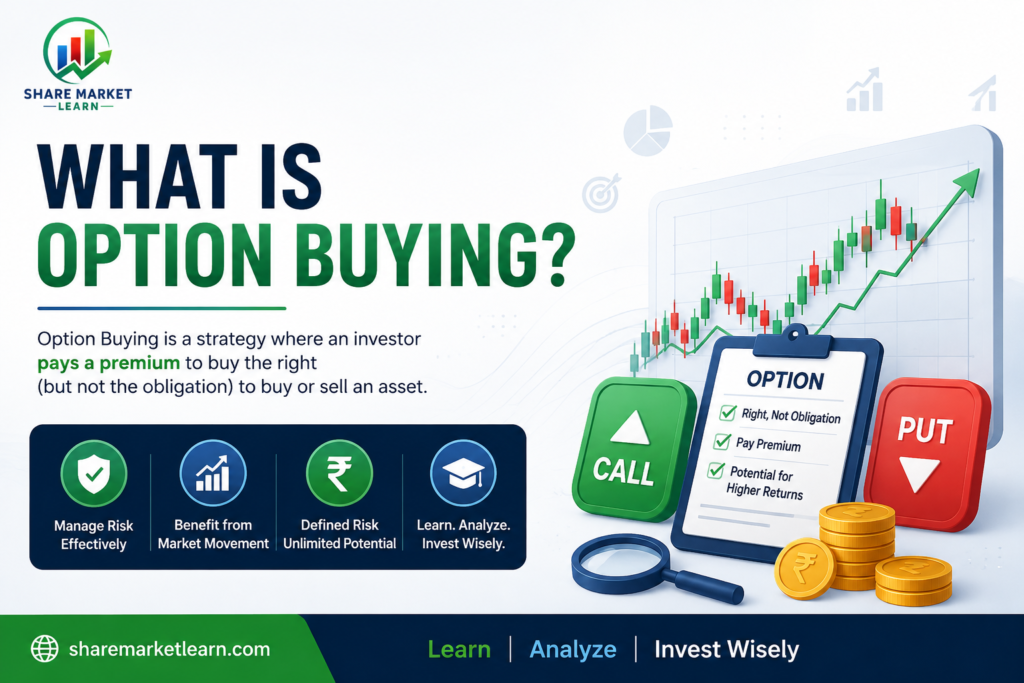
Option buying means purchasing an options contract by paying a premium. The buyer gets the right, but not the obligation, to buy or sell an underlying asset at a predetermined price within a specified period.
Options can provide opportunities to participate in market movements with a relatively small amount of capital. However, they are also risky because an option buyer can lose the entire premium paid if the expected market movement does not happen within the option’s lifetime.
In this guide, let’s understand what option buying is, how it works, the difference between call and put options, the advantages and risks, and some basic examples for beginners.
What Is Option Buying?
Option buying is a trading strategy where a trader purchases an options contract instead of directly buying the underlying stock or index.
For example, suppose you believe that the NIFTY index will rise. Instead of buying NIFTY directly, you could buy a NIFTY Call Option (CE).
You pay a premium for the option. If NIFTY moves strongly in your expected direction, the value of your option may increase, allowing you to potentially sell it for a profit.
Similarly, if you believe that the market will fall, you may buy a Put Option (PE).
The important point is that an option buyer pays a premium for the right associated with the contract. The buyer does not have the same obligation as an option seller.
How Does Option Buying Work?
To understand option buying, you need to know a few basic terms:
1. Underlying Asset
The underlying asset is the financial instrument on which the option is based.
Examples include:
- NIFTY
- BANK NIFTY
- Individual stocks
- Other eligible market instruments
2. Strike Price
The strike price is the predetermined price associated with the option contract.
For example, if you buy a NIFTY 25,000 Call Option, 25,000 is the strike price.
3. Premium
The premium is the price you pay to purchase the option.
If an option premium is ₹100 and the applicable lot size is 50, the contract cost would be:
₹100 × 50 = ₹5,000
The actual lot size can change according to the exchange’s rules, so traders should always check the current contract specifications.
4. Expiry Date
Every option has an expiry date. The option’s value is affected by how much time remains before expiry.
As expiry approaches, the option can lose value because of time decay, especially when the underlying asset does not move sufficiently in the expected direction.
Call Option vs Put Option
There are two basic types of options that beginners should understand.
What Is a Call Option?
A Call Option (CE) is generally purchased when a trader expects the underlying asset to rise.
For example:
You believe NIFTY may move significantly higher.
You buy a Call Option.
If NIFTY rises and other factors remain favorable, the call option’s premium may increase.
The trader can then potentially sell the option at a higher premium.
What Is a Put Option?
A Put Option (PE) is generally purchased when a trader expects the underlying asset to fall.
For example:
You believe NIFTY may decline.
You buy a Put Option.
If NIFTY falls sufficiently, the put option’s premium may increase.
Again, the trader may potentially sell the option at a higher price.
Simple Example of Option Buying
Let’s take a simplified example.
Suppose a stock is trading at ₹1,000.
You believe the stock could rise significantly over the coming weeks.
You purchase a Call Option with a strike price of ₹1,020 for a premium of ₹20.
If the option contract has a lot size of 100 shares:
Total premium paid = ₹20 × 100 = ₹2,000
Now suppose the stock rises strongly and the option premium increases from ₹20 to ₹35.
Your potential gross profit would be:
(₹35 − ₹20) × 100 = ₹1,500
This example is simplified and does not include brokerage, taxes, charges, slippage, or changes in implied volatility.
If the option premium instead falls to ₹5, the potential loss would be:
(₹20 − ₹5) × 100 = ₹1,500
If the option expires worthless, the buyer could lose the entire premium paid.
Why Do Traders Buy Options?
There are several reasons traders consider option buying.
Limited Initial Risk
One major attraction is that the maximum loss for a straightforward long option position is generally limited to the premium paid.
For example, if you pay ₹5,000 for an option, your maximum loss on that position is generally ₹5,000, excluding transaction costs.
This does not mean option buying is low-risk. Losing 100% of the premium can still be a significant loss.
Potential for High Returns
Options can sometimes generate large percentage returns when the underlying asset makes a strong and timely move.
However, higher potential returns come with higher risk.
Smaller Capital Requirement
An option buyer normally pays the premium rather than purchasing the entire underlying position.
This can make options attractive to traders with smaller amounts of capital.
However, the lower upfront cost should not be confused with lower overall risk.
What Are the Risks of Option Buying?
Option buying has several important risks.
1. Time Decay
Options have a limited lifespan.
As the expiry date approaches, the option may lose value because of time decay, even if the underlying asset does not move significantly against you.
2. Complete Loss of Premium
If the expected price movement does not happen before expiry, an option can become worthless.
In that situation, the buyer can lose the entire premium paid.
3. Wrong Market Direction
If you buy a Call expecting the market to rise but the market falls or remains weak, the option premium may decline.
Similarly, buying a Put when the market rises can result in losses.
4. Volatility Risk
Option premiums are influenced by implied volatility.
A sudden drop in implied volatility can reduce an option’s premium even when the underlying asset has moved in the expected direction.
Therefore, option pricing is not based only on whether the market goes up or down.
Option Buying vs Stock Buying
Option buying and stock investing are very different.
When you buy a stock, you generally own the shares and can hold them for an extended period.
An option has an expiry date.
For example, if you buy a stock and it takes six months to move in your expected direction, you may still hold the stock.
But if you buy an option that expires in a few weeks, waiting six months is not possible. The option may expire before your expected move happens.
This is why timing is extremely important in option buying.
Is Option Buying Good for Beginners?
Option buying can be attractive to beginners because of its relatively low upfront capital requirement and limited premium risk.
However, options are more complex than simply buying stocks.
Before trading real money, beginners should understand:
- Call and Put options
- Strike price
- Expiry
- Premium
- Intrinsic value
- Time value
- Implied volatility
- Time decay
- Position sizing
- Stop-loss and risk management
It is also sensible to practice with paper trading or a simulator before risking real capital.
Basic Tips for Option Buyers
If you are learning option buying, keep these principles in mind:
Start Small
Do not risk a large percentage of your trading capital on a single trade.
Understand the Option Before Buying
Know the strike price, expiry, premium, and lot size before entering a trade.
Have a Trading Plan
Decide your entry, exit, and maximum acceptable loss before placing the trade.
Avoid Blind Tips
Do not buy options simply because someone says that NIFTY or a stock will move up or down.
Learn why the trade is being taken.
Respect Expiry
Options are time-sensitive instruments. A trade can fail simply because the expected move happens too late.
Conclusion
Option buying means purchasing a Call or Put option by paying a premium. Traders generally buy Call Options when they expect an upward move and Put Options when they expect a downward move.
The biggest attraction of option buying is that the maximum loss on a basic long option position is generally limited to the premium paid. However, options can expire worthless, and traders can lose 100% of their premium.
For beginners, the most important lesson is to focus on education, risk management, position sizing, and understanding how options are priced rather than looking only for quick profits.
Options can be useful financial instruments, but they should be approached with knowledge and discipline.
Frequently Asked Questions (FAQs)
1. What is option buying in simple words?
Option buying means paying a premium to purchase an options contract that gives you the right associated with buying or selling the underlying asset, depending on the type of option.
2. What is a Call Option?
A Call Option is generally purchased when a trader expects the price of the underlying asset to rise.
3. What is a Put Option?
A Put Option is generally purchased when a trader expects the price of the underlying asset to fall.
4. Can an option buyer lose all the money?
Yes. If an option expires worthless, the buyer can lose the entire premium paid, excluding transaction costs.
5. Is option buying risky?
Yes. Although the maximum loss on a basic long option position is generally limited to the premium paid, that premium can be lost completely.
6. What is option premium?
The option premium is the price paid by the buyer to purchase an option contract.
7. Is option buying better than stock investing?
Neither is universally better. Stocks and options have different characteristics, risks, time horizons, and uses. Beginners should understand both before deciding which suits their goals and risk tolerance.
8. Can beginners learn option buying?
Yes. Beginners can learn option buying by understanding the basic concepts, studying option pricing and risk management, and practicing with paper trades before using real money.