
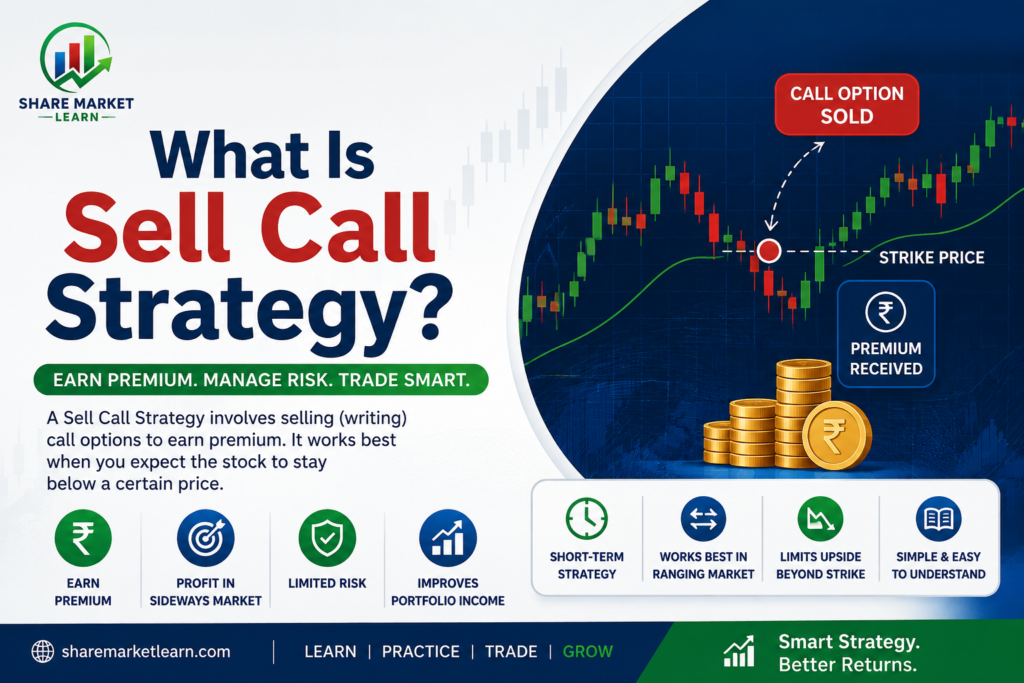
If you are learning about options trading, you may have come across terms such as Call Option, Put Option, Buy Call, and Sell Call. Among these, the Sell Call strategy is an important options strategy that traders use when they expect an underlying asset to remain below a certain price or decline.
But what exactly does selling a call mean? How does it work? What are the profits and risks involved?
In simple terms, when you sell a call option, you receive a premium from the option buyer. In return, you take on an obligation that can require you to sell the underlying asset at the agreed strike price if the option is exercised.
The strategy can generate income from the premium received, but it can also carry significant risk—especially when a call is sold without owning the underlying asset.
Let’s understand the Sell Call strategy step by step.
What Is a Sell Call Strategy?
A Sell Call strategy, also called a Short Call, involves selling a call option instead of buying one.
When you sell a call option, you receive an upfront premium.
For example, suppose a stock is trading at ₹1,000. You believe the stock is unlikely to rise above ₹1,100 before expiry.
You sell a ₹1,100 Call option for a premium of ₹30.
You receive ₹30 per share as premium.
If the stock remains below ₹1,100 at expiry, the call may expire worthless. In that situation, you generally keep the premium as your profit, before applicable charges.
However, if the stock rises significantly above ₹1,100, your potential loss can become substantial.
How Does Selling a Call Work?
A call option gives its buyer the right to buy the underlying asset at a specific strike price.
The seller receives the premium and takes on the corresponding obligation.
Consider this example:
- Current stock price: ₹1,000
- Call strike price: ₹1,100
- Premium received: ₹30
- Expiry: 30 days
You sell the ₹1,100 Call and receive ₹30.
If the Stock Remains Below ₹1,100
Suppose the stock closes at ₹1,050 at expiry.
Because the market price is below the strike price, the call has no intrinsic value at expiry.
The option may expire worthless, allowing the seller to retain the ₹30 premium, before trading costs.
If the Stock Rises to ₹1,150
Now the call has an intrinsic value of:
₹1,150 − ₹1,100 = ₹50
You received ₹30 as premium but face ₹50 of intrinsic loss.
Approximate net result:
₹30 − ₹50 = −₹20 per share
If the Stock Rises to ₹1,300
The intrinsic value becomes:
₹1,300 − ₹1,100 = ₹200
After receiving ₹30 premium:
₹30 − ₹200 = −₹170 per share
This demonstrates why an uncovered or naked short call can be a high-risk strategy.
What Is the Maximum Profit in a Sell Call Strategy?
The maximum profit from selling a call is generally limited to the premium received.
Using our example:
- Premium received = ₹30 per share
If the option expires worthless, the seller’s maximum gross profit is approximately ₹30 per share, before transaction costs.
This is an important difference between buying and selling options.
When buying an option, you pay a premium and hope the option increases in value.
When selling an option, you receive the premium and generally hope the option loses value or expires worthless.
What Is the Maximum Loss?
This depends on whether the call is covered or uncovered.
Naked or Uncovered Call
With an uncovered call, the potential loss can be extremely large because the underlying asset can theoretically continue rising.
For example, if a stock rises dramatically above the strike price, the short call can generate increasingly large losses.
This is why naked call selling is generally considered a high-risk strategy.
Covered Call
A covered call is different.
In a covered call, the trader owns the underlying shares and sells a call against them.
For example, suppose you own 100 shares of a stock and sell a call option against those shares.
If the stock rises above the strike price, your shares may be called away according to the applicable contract and exercise rules. You still receive the option premium, but your upside on the shares is limited by the strike price.
A covered call can therefore be used as an income-oriented strategy, although it also has risks and trade-offs.
What Is the Breakeven Point for a Sell Call?
For a simple short call, the breakeven price at expiry is:
Breakeven Price = Strike Price + Premium Received
Using our example:
- Strike price = ₹1,100
- Premium received = ₹30
Therefore:
Breakeven = ₹1,130
At expiry:
- Below ₹1,100 → maximum gross profit of ₹30
- At ₹1,130 → approximately breakeven
- Above ₹1,130 → potential loss
Transaction costs and other charges can change the actual breakeven.
When Do Traders Use a Sell Call Strategy?
A trader may consider selling a call when they have a neutral to bearish view of the underlying asset.
For example, they may believe:
- The stock will remain below a particular level.
- The stock may move sideways.
- The stock may decline.
- The option premium is relatively attractive.
- They want to generate potential income from an existing stock position through a covered call.
However, selling a call simply because the premium looks attractive can be dangerous. Traders need to understand the possible loss before entering the position.
Sell Call vs Buy Call
Sell Call and Buy Call are opposite strategies.
| Feature | Buy Call | Sell Call |
|---|---|---|
| Market view | Bullish | Neutral to bearish |
| Premium | Paid | Received |
| Maximum profit | Potentially very large | Limited to premium |
| Maximum loss | Premium paid | Potentially very large for naked call |
| Time decay | Usually negative | Usually beneficial, all else equal |
| Main objective | Profit from a rise | Profit from option losing value or expiring worthless |
The actual result can also be influenced by implied volatility and other option pricing factors.
Sell Call and Time Decay
Time decay, commonly represented by theta, is an important concept for option sellers.
As an option gets closer to expiry, its time value generally decreases, assuming other factors remain unchanged.
For a call seller, this can work in their favor.
For example, imagine you sell a call for ₹30. If the underlying does not move significantly and the option’s value gradually falls to ₹10, you may potentially buy it back for ₹10 and keep the difference.
Approximate profit:
₹30 − ₹10 = ₹20 per share
However, time decay does not guarantee a profit. Changes in the underlying price and implied volatility can have a much larger effect on the option’s value.
Sell Call and Implied Volatility
Implied volatility (IV) reflects the market’s expectations about potential future price movement and is an important component of option pricing.
When implied volatility falls, option premiums can decrease, which can benefit option sellers.
When implied volatility rises, option premiums can increase, potentially hurting short option positions.
Therefore, an option seller needs to consider more than just the direction of the underlying asset.
Advantages of Sell Call Strategy
Premium Income
The seller receives premium immediately after entering the trade, subject to the applicable settlement and trading mechanism.
Time Decay Can Help
If other factors remain unchanged, decreasing time value can benefit the call seller.
Useful in Covered Call Strategies
Investors holding shares may use covered calls to potentially generate additional income.
Can Work in Sideways Markets
A call seller can potentially profit even when the underlying asset moves sideways, provided the option expires or is closed at a favorable value.
Disadvantages and Risks
Potentially Large Losses
A naked short call can face very large losses if the underlying price rises sharply.
Margin Requirements
Selling options generally requires margin. The exact requirement depends on the market, broker, contract, and position.
Sudden Market Moves
Unexpected news, earnings announcements, economic events, or other catalysts can cause sharp price movements.
Assignment Risk
Depending on the option contract and market, an option seller may face exercise or assignment obligations. Traders should understand the specific rules applicable to their contract.
Is Sell Call Suitable for Beginners?
Selling calls can look simple because the trader receives premium upfront. However, simple does not mean low-risk.
Beginners should understand:
- Strike price
- Premium
- Expiry
- Breakeven
- Margin
- Time decay
- Implied volatility
- Assignment/exercise
- Risk management
A covered call is generally easier to understand from a risk perspective than an uncovered call, but it still involves the risk of losses on the underlying shares and limits upside beyond the strike price.
Before trading options with real money, beginners should study the contract specifications and practice understanding profit-and-loss scenarios.
Frequently Asked Questions
What is a Sell Call strategy?
A Sell Call strategy involves selling a call option and receiving a premium. The seller generally expects the underlying asset to stay below the strike price or not rise significantly.
Is Sell Call bullish or bearish?
A naked Sell Call is generally considered neutral to bearish. A covered call is often used when an investor is neutral to moderately bullish on the underlying asset.
What is the maximum profit from selling a call?
The maximum profit is generally limited to the premium received.
Can selling a call result in unlimited loss?
Yes. An uncovered or naked short call can have theoretically unlimited loss because the underlying asset’s price can continue rising.
What is a covered call?
A covered call involves owning the underlying asset while selling a call option against it. The premium provides potential income, but the strategy can limit upside if the asset rises above the strike price.
How does time decay affect a call seller?
All else being equal, declining time value can benefit a call seller because the option may become less valuable as expiry approaches.
Is Sell Call safe for beginners?
Selling a naked call can be very risky and is generally not a beginner-friendly strategy. Anyone considering options should understand the potential losses, margin requirements, and contract rules first.
Conclusion
The Sell Call strategy is an options strategy where a trader sells a call option and receives a premium. The strategy can potentially generate profit when the underlying asset stays below the strike price, falls, or the option’s value declines sufficiently.
The biggest advantage is that the seller receives premium upfront. However, the risk profile can be very different depending on whether the call is covered or uncovered.
A covered call can be useful for investors who already own shares and want to generate potential additional income, while a naked call carries significant risk because losses can become extremely large if the underlying asset rises sharply.
Before using a Sell Call strategy, always understand the strike price, premium, breakeven, expiry, margin requirements, volatility, and maximum possible loss. Good risk management is more important than simply collecting option premium.