
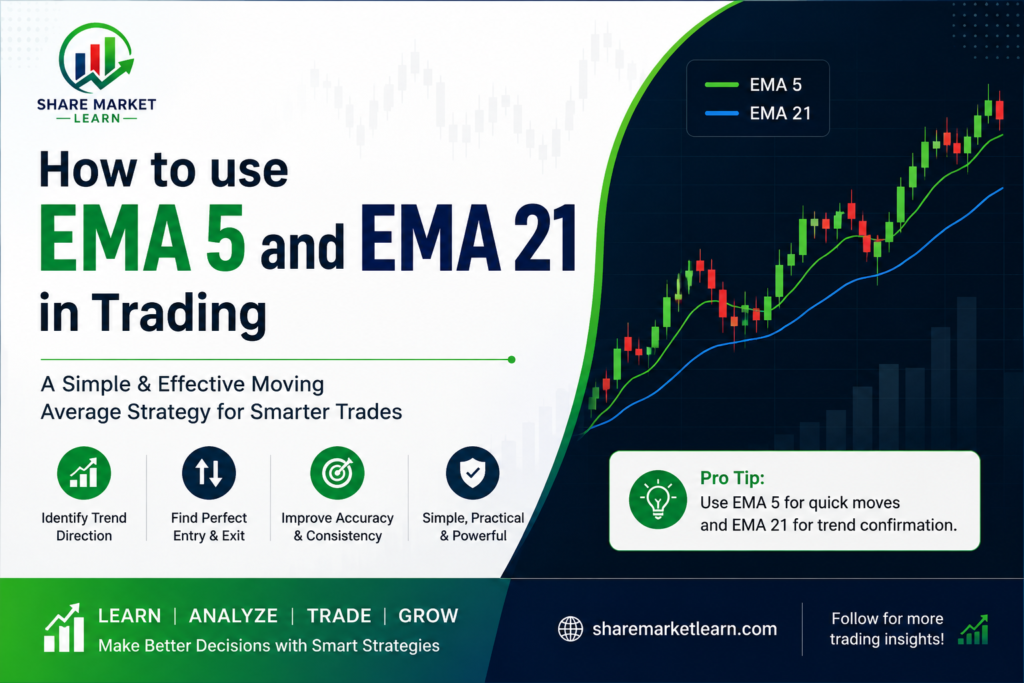
The Exponential Moving Average (EMA) is one of the most popular technical indicators used by traders across the world. Whether you trade stocks, forex, commodities, or cryptocurrencies, EMA helps identify market trends and potential buy or sell opportunities.
Among the many EMA combinations, EMA 5 and EMA 21 are widely used because they provide quick trading signals while still filtering out a lot of market noise.
In this guide, you’ll learn everything about using EMA 5 and EMA 21, including how they work, trading strategies, entry rules, exit rules, risk management, and common mistakes to avoid.
What is EMA?
EMA stands for Exponential Moving Average.
It is a moving average that gives more importance to recent prices compared to older prices. Because of this, EMA reacts faster to price changes than a Simple Moving Average (SMA).
This makes EMA especially useful for traders who want quicker trading signals.
What is EMA 5?
EMA 5 represents the average price of the last five candles while giving more weight to the latest price.
Since it uses only five candles, it reacts very quickly to market movements.
Best for:
- Scalping
- Intraday trading
- Short-term momentum
What is EMA 21?
EMA 21 is a slower moving average that represents the average price of the last twenty-one candles.
It responds more slowly than EMA 5 and helps identify the overall trend.
Best for:
- Swing trading
- Trend confirmation
- Support and resistance
Why Use EMA 5 and EMA 21 Together?
Using both EMAs gives traders two important pieces of information:
- EMA 5 shows short-term momentum.
- EMA 21 shows the overall trend.
When both work together, traders can identify higher-probability trading opportunities.
EMA 5 and EMA 21 Buy Signal
A buy signal occurs when:
- EMA 5 crosses above EMA 21.
- Price closes above both EMAs.
- Volume increases (optional but helpful).
- The market is making higher highs and higher lows.
Entry
Buy after the candle closes above both EMAs.
Stop Loss
Place the stop loss below:
- EMA 21, or
- The most recent swing low.
Target
- Risk-to-reward ratio of at least 1:2.
- Or trail the stop-loss using EMA 21.
EMA 5 and EMA 21 Sell Signal
A sell signal occurs when:
- EMA 5 crosses below EMA 21.
- Price closes below both EMAs.
- The market is making lower highs and lower lows.
Entry
Sell after confirmation from the closing candle.
Stop Loss
Place the stop loss:
- Above EMA 21, or
- Above the recent swing high.
Target
Use:
- 1:2 or 1:3 Risk Reward
- Or trail profits using EMA 21.
Best Timeframes
Different traders use different chart timeframes.
Scalping
- 1 Minute
- 3 Minute
- 5 Minute
Intraday Trading
- 5 Minute
- 15 Minute
- 30 Minute
Swing Trading
- 1 Hour
- 4 Hour
- Daily Chart
Step-by-Step EMA 5 and EMA 21 Strategy
Step 1
Open your trading platform.
Step 2
Add:
- EMA 5
- EMA 21
Step 3
Wait for a crossover.
Step 4
Check if the overall trend supports the signal.
Step 5
Enter only after the candle closes.
Step 6
Place a stop-loss.
Step 7
Book profits using a predefined target or trailing stop.
Example of a Buy Trade
Imagine a stock is trading around ₹500.
- EMA 5 crosses above EMA 21.
- Price closes at ₹503.
- Volume increases.
You buy at ₹503.
Stop-loss: ₹497
Target: ₹515
If the trend continues, you can trail your stop-loss using EMA 21.
Example of a Sell Trade
Suppose a stock is trading at ₹820.
EMA 5 crosses below EMA 21.
Price closes below both EMAs.
You sell at ₹818.
Stop-loss: ₹825
Target: ₹800
Benefits of EMA 5 and EMA 21
- Easy to understand.
- Suitable for beginners.
- Works across multiple markets.
- Helps identify trends early.
- Provides clear entry and exit signals.
- Reduces emotional trading.
Limitations
No trading strategy is perfect.
EMA crossovers may produce false signals in:
- Sideways markets
- Low-volume conditions
- Highly volatile news events
That’s why traders should combine EMA with:
- Price Action
- Volume
- Support & Resistance
- Candlestick patterns
Risk Management Tips
Never risk more than 1–2% of your trading capital on a single trade.
Always:
- Use a stop-loss.
- Follow a risk-reward ratio of at least 1:2.
- Avoid overtrading.
- Wait for confirmation before entering.
- Maintain a trading journal to review your performance.
Common Mistakes Beginners Make
Many new traders lose money because they:
- Enter trades before the candle closes.
- Ignore the overall market trend.
- Trade during sideways markets.
- Remove their stop-loss.
- Risk too much on one trade.
- Chase every crossover without confirmation.
Avoiding these mistakes can significantly improve consistency.
Pro Tips
- Trade only in the direction of the larger trend.
- Combine EMA 5 & EMA 21 with RSI or MACD for extra confirmation.
- Avoid taking crossover trades during major news announcements.
- Practice on a demo account before risking real money.
- Focus on quality setups rather than frequent trades.
Conclusion
EMA 5 and EMA 21 are among the simplest and most effective moving average combinations for beginners. EMA 5 captures short-term momentum, while EMA 21 helps identify the broader trend. By waiting for confirmed crossovers, using proper stop-loss placement, and managing risk wisely, traders can make more disciplined decisions.
Remember, no indicator guarantees success. Consistent profitability comes from combining a well-tested strategy with patience, practice, and sound risk management. Start with a demo account, review your trades regularly, and refine your approach over time.
Frequently Asked Questions (FAQs)
1. Is EMA better than SMA?
EMA reacts faster to price changes because it gives more weight to recent prices, making it popular for short-term trading.
2. Which timeframe is best for EMA 5 and EMA 21?
For intraday trading, many traders use the 5-minute and 15-minute charts. Swing traders often prefer the 1-hour, 4-hour, or daily charts.
3. Can beginners use EMA 5 and EMA 21?
Yes. This combination is simple to understand and is suitable for beginners when combined with good risk management.
4. Does this strategy work in all markets?
It can be applied to stocks, forex, commodities, indices, and cryptocurrencies. However, it performs best in trending markets.
5. Should I use only EMA crossovers?
No. It’s better to combine EMA crossovers with price action, support and resistance, volume, or another confirmation indicator to improve the quality of your trades.