
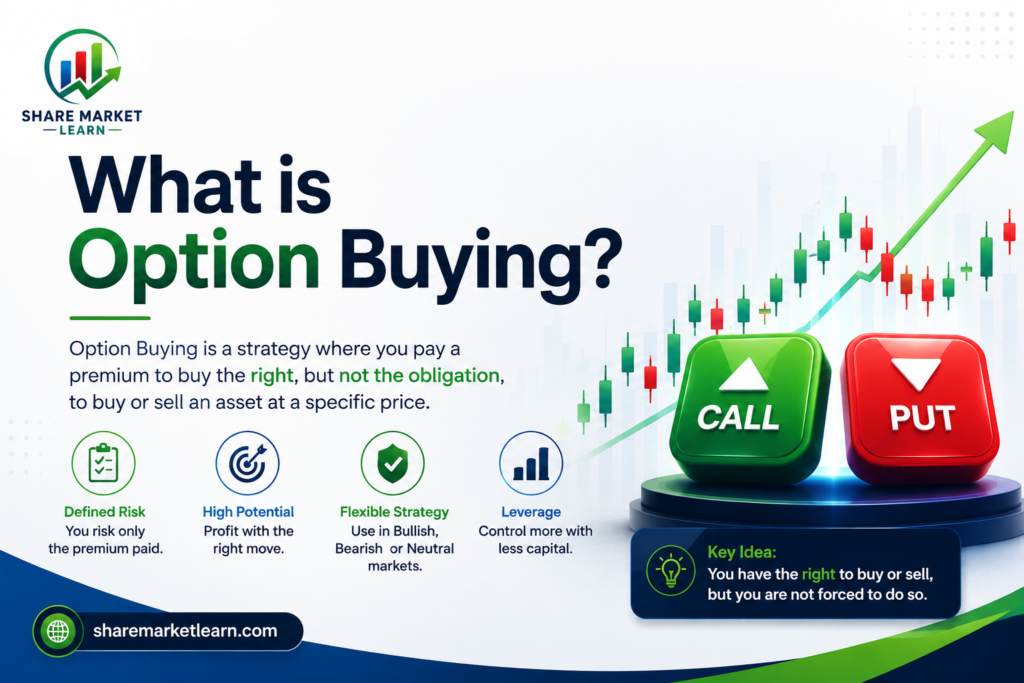
Option buying is one of the most popular ways to participate in the stock market with limited capital. It allows traders to benefit from market movements without purchasing the actual stock or index. While option buying can offer significant profit potential, it also comes with risks that every beginner should understand.
If you’ve ever wondered what option buying is, how it works, or whether it’s suitable for beginners, this guide will explain everything in simple language.
What Is Option Buying?
Option Buying is the process of purchasing an Options Contract that gives the buyer the right, but not the obligation, to buy or sell an underlying asset at a predetermined price (called the Strike Price) before or on the contract’s expiry date.
When buying an option, you pay a premium to the seller. This premium is the maximum amount you can lose if the trade does not go in your favor.
Unlike option sellers, option buyers have limited risk and unlimited (or potentially substantial) profit potential, depending on the strategy and market movement.
Types of Option Buying
There are two main types of options:
1. Call Option Buying
A Call Option is purchased when you expect the price of a stock or index to rise.
Example
Suppose Nifty is trading at 25,000.
You believe it will rise over the next few days.
You buy a 25,100 Call Option by paying a premium of ₹120.
If Nifty moves above your strike price and the option gains value, you can sell the option for a profit.
If Nifty falls or remains below the strike price until expiry, your maximum loss is limited to the premium paid.
2. Put Option Buying
A Put Option is purchased when you expect the market to fall.
Example
Suppose Bank Nifty is trading at 56,000.
You expect a decline.
You buy a 55,800 Put Option for a premium of ₹150.
If the market falls significantly, the Put Option increases in value, allowing you to earn a profit.
If the market rises instead, your maximum loss is limited to the premium.
How Does Option Buying Work?
Option buying involves four simple steps:
Step 1: Analyze the Market
Study price action, chart patterns, indicators, support and resistance levels, and market sentiment.
Step 2: Choose the Right Option
Decide whether to buy:
- A Call Option (bullish view)
- A Put Option (bearish view)
Select the appropriate strike price and expiry date.
Step 3: Pay the Premium
The premium is the price of the option contract. It depends on factors such as:
- Current market price
- Time remaining until expiry
- Market volatility
- Demand and supply
- Interest rates
Step 4: Exit the Trade
You can:
- Sell the option before expiry to book a profit or limit a loss.
- Let the option expire if it becomes worthless (resulting in the loss of the premium paid).
Why Do Traders Prefer Option Buying?
Many traders choose option buying because:
- Limited risk (maximum loss is the premium).
- Lower capital requirement compared to buying stocks or futures.
- Opportunity to benefit from both rising and falling markets.
- Potential for high returns if the market moves strongly.
- Easy access through most trading platforms.
Advantages of Option Buying
1. Limited Risk
The biggest advantage is that your loss is capped at the premium you pay.
2. High Profit Potential
A strong move in the underlying asset can generate significant percentage returns on the premium invested.
3. Leverage
Options provide exposure to larger market positions with relatively small capital.
4. Flexibility
You can trade bullish or bearish views using Call and Put Options.
5. Suitable for Hedging
Option buying can also help protect an investment portfolio against adverse market movements.
Risks of Option Buying
Although option buying offers attractive opportunities, it also has risks.
Time Decay (Theta)
Option premiums lose value as the expiry date approaches. Even if the market doesn’t move, the option’s value can decline.
Wrong Market Direction
If the market moves opposite to your expectation, the option premium may fall.
Low Volatility
Options generally perform better when the market makes strong moves. Low volatility can reduce option prices.
Expiry Risk
An option can expire worthless if the expected move does not occur before expiry.
Best Strategies for Option Buyers
1. Buy Call in an Uptrend
Purchase Call Options when technical analysis indicates a strong bullish trend.
2. Buy Put in a Downtrend
Purchase Put Options when the market shows clear bearish momentum.
3. Trade After Breakouts
Buying options after confirmed breakouts from support or resistance levels can improve the probability of success.
4. Use Technical Indicators
Combine option buying with indicators such as:
- RSI (Relative Strength Index)
- EMA (Exponential Moving Average)
- MACD
- Volume Analysis
- Pivot Points
These tools can help confirm trade setups.
Common Mistakes Beginners Make
Avoid these common errors:
- Buying options without a clear trading plan.
- Holding options until expiry despite unfavorable price action.
- Ignoring time decay.
- Trading without a stop-loss or exit strategy.
- Purchasing out-of-the-money options solely because they appear inexpensive.
- Risking too much capital on a single trade.
Learning from these mistakes can improve long-term performance.
Tips for Successful Option Buying
- Trade in the direction of the overall market trend.
- Focus on liquid option contracts with good trading volume.
- Use proper risk management.
- Avoid emotional decision-making.
- Book profits according to your trading plan.
- Continue learning and practicing before increasing your position size.
Option Buying vs Option Selling
| Feature | Option Buying | Option Selling |
|---|---|---|
| Risk | Limited to premium | Can be very high or unlimited |
| Profit Potential | High | Limited to premium received |
| Capital Required | Lower | Higher |
| Suitable For | Beginners | Experienced traders |
| Time Decay | Works against the buyer | Works in favor of the seller |
Is Option Buying Good for Beginners?
Yes, option buying is generally more beginner-friendly than option selling because the maximum possible loss is limited to the premium paid.
However, beginners should first understand:
- Option pricing
- Strike prices
- Expiry dates
- Volatility
- Risk management
- Position sizing
Practicing with small positions and focusing on education can help build confidence over time.
Conclusion
Option buying is an effective way to participate in the financial markets with limited capital and defined risk. By purchasing Call or Put Options, traders can benefit from upward or downward market movements while keeping their maximum loss limited to the premium paid.
Success in option buying depends on market analysis, timing, discipline, and risk management. Instead of relying on luck, focus on learning technical analysis, understanding option pricing, and following a consistent trading strategy. With patience and practice, option buying can become a valuable part of your trading journey.
Frequently Asked Questions (FAQs)
1. What is option buying?
Option buying involves purchasing an options contract that gives the buyer the right, but not the obligation, to buy or sell an underlying asset at a specific strike price before or on expiry.
2. What is the maximum loss in option buying?
The maximum loss is limited to the premium paid for the option contract.
3. What is the difference between Call and Put Options?
A Call Option is generally bought when expecting prices to rise, while a Put Option is bought when expecting prices to fall.
4. Is option buying safe for beginners?
Option buying is considered less risky than option selling because losses are limited to the premium. However, beginners should still learn proper risk management and trading strategies.
5. Can I earn a profit with a small investment?
Yes. Options provide leverage, allowing traders to control larger positions with a relatively small investment, though profits are never guaranteed.
6. Which indicators are best for option buying?
Many traders use RSI, EMA, MACD, Pivot Points, Volume Analysis, and support and resistance levels to identify higher-probability trading opportunities.