
The Bearish Marubozu Candle is one of the strongest bearish candlestick patterns in technical analysis. It represents intense selling pressure throughout the trading session and often signals that sellers are firmly in control of the market. Because of its simple appearance and powerful message, this pattern is widely used by traders to identify potential trend reversals or the continuation of a downtrend.
Whether you trade stocks, forex, commodities, or cryptocurrencies, understanding the Bearish Marubozu Candle can help you recognize strong bearish momentum and improve your trading decisions.
In this guide, you’ll learn what the Bearish Marubozu Candle is, how it forms, the psychology behind it, how to trade it, its advantages and limitations, and the common mistakes traders should avoid.
What Is a Bearish Marubozu Candle?
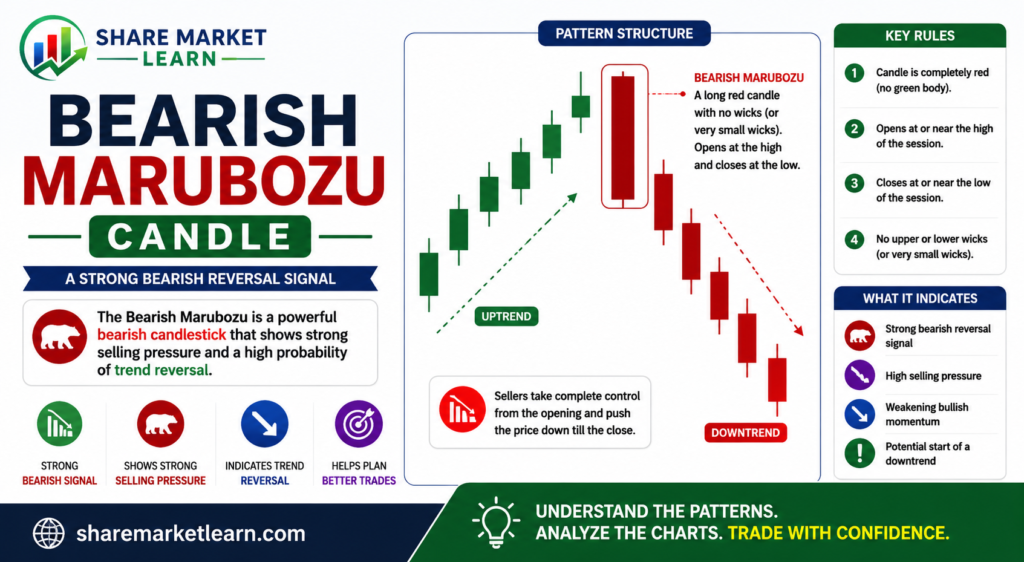
A Bearish Marubozu Candle is a single bearish candlestick with a long body and either no upper or lower shadow, or only very small shadows. The candle opens near its highest price and closes near its lowest price.
This indicates that sellers controlled the market from the opening bell until the close, leaving buyers with little or no opportunity to push prices higher.
The word “Marubozu” comes from Japanese and means “bald” or “shaved head,” referring to the candle’s lack of noticeable wicks.
Structure of a Bearish Marubozu Candle
The Bearish Marubozu has a simple but powerful structure:
- A long bearish (red) body.
- Opens at or very close to the day’s high.
- Closes at or very close to the day’s low.
- Little or no upper shadow.
- Little or no lower shadow.
The longer the candle body, the stronger the selling pressure.
How Does the Bearish Marubozu Form?
The pattern forms when sellers dominate the entire trading session.
Stage 1: Market Opens
The market opens near the highest price of the session.
Stage 2: Continuous Selling
Sellers immediately begin pushing prices lower. Buyers fail to create any meaningful recovery throughout the trading session.
Stage 3: Market Closes
The price closes near the day’s lowest point, confirming that sellers remained in control until the end of the session.
This uninterrupted selling activity creates the long bearish body that defines the Marubozu.
Psychology Behind the Bearish Marubozu Candle
Understanding the psychology behind this pattern helps traders interpret its significance.
At the start of the trading session, prices open at a relatively high level. However, sellers quickly gain control and continue selling throughout the day. Buyers are unable to regain momentum, and the price steadily declines.
This behavior reflects strong bearish sentiment and often encourages additional selling from traders who recognize the shift in momentum.
When a Bearish Marubozu appears after an uptrend, it may indicate the beginning of a bearish reversal. When it appears during a downtrend, it often confirms that the existing bearish trend is likely to continue.
How to Identify a Bearish Marubozu Candle
Use this checklist to identify the pattern correctly:
- Long bearish candle.
- Opens near the session high.
- Closes near the session low.
- Very small or no upper shadow.
- Very small or no lower shadow.
- Strong trading volume adds confirmation.
The cleaner the candle, the stronger the signal.
How to Trade the Bearish Marubozu Candle
Step 1: Identify the Market Trend
Determine whether the candle appears:
- After an uptrend (possible bearish reversal).
- During a downtrend (trend continuation).
Understanding the market context is essential before taking a trade.
Step 2: Wait for Confirmation
Although the Bearish Marubozu is a strong signal, many traders wait for the next candle to confirm continued selling before entering a trade.
Step 3: Enter the Trade
Common entry methods include:
- Entering a sell trade after confirmation.
- Selling below the low of the Bearish Marubozu for additional confirmation.
Step 4: Place a Stop Loss
To manage risk, place your stop loss:
- Above the high of the Bearish Marubozu.
- Above the nearest resistance level if appropriate.
Step 5: Set a Profit Target
Profit targets can be based on:
- Previous support levels.
- A risk-to-reward ratio of at least 1:2.
- A trailing stop-loss strategy.
Example of a Bearish Marubozu Candle
Imagine a stock has been rising steadily and is trading around ₹1,800.
- The stock opens at ₹1,810.
- Selling pressure begins immediately.
- Throughout the day, buyers fail to push the price higher.
- The stock closes at ₹1,740 with almost no upper or lower shadow.
This creates a Bearish Marubozu Candle, indicating that sellers controlled the session from start to finish.
Best Indicators to Use with the Bearish Marubozu
While the pattern is effective on its own, combining it with technical indicators can improve reliability.
1. Volume
High trading volume strengthens the bearish signal.
2. Relative Strength Index (RSI)
If RSI is above 70 before the pattern appears, it suggests the market may be overbought and more likely to reverse.
3. Moving Averages
A Bearish Marubozu forming below or near important moving averages can strengthen the bearish outlook.
4. Support and Resistance
The pattern becomes more reliable when it appears near a major resistance level.
5. MACD
A bearish MACD crossover after the pattern provides additional confirmation.
Advantages of the Bearish Marubozu Candle
- Easy to recognize.
- Shows strong bearish momentum.
- Useful for both reversals and trend continuation.
- Suitable for stocks, forex, commodities, and cryptocurrencies.
- Works across multiple timeframes.
- Can help traders identify strong selling pressure quickly.
Limitations of the Bearish Marubozu Candle
Despite its strength, the pattern has some limitations:
- False signals can occur during volatile markets.
- Less reliable without volume confirmation.
- Should not be used in isolation.
- News events can quickly change market direction.
- Requires proper risk management.
Understanding these limitations helps traders avoid unnecessary losses.
Common Mistakes Beginners Make
Many traders make avoidable mistakes when using the Bearish Marubozu.
Common mistakes include:
- Entering a trade without confirmation.
- Ignoring the overall market trend.
- Trading without a stop loss.
- Ignoring support and resistance levels.
- Relying only on one candlestick pattern.
- Forgetting to check trading volume.
Avoiding these mistakes can improve trading consistency.
Risk Management Tips
Successful traders always protect their capital.
Keep these rules in mind:
- Never risk more than 1–2% of your trading capital on a single trade.
- Always use a stop loss.
- Maintain a favorable risk-to-reward ratio.
- Avoid emotional trading.
- Stick to your trading plan.
Long-term success comes from consistency and discipline rather than chasing quick profits.
Is the Bearish Marubozu Candle Reliable?
The Bearish Marubozu Candle is one of the strongest bearish candlestick patterns because it reflects continuous selling pressure throughout the trading session. However, no candlestick pattern guarantees future price movements.
Its reliability improves when:
- It appears after an extended uptrend.
- It forms near an important resistance level.
- Trading volume is above average.
- Other technical indicators confirm the signal.
Using multiple technical analysis tools together can significantly improve trading accuracy.
Conclusion
The Bearish Marubozu Candle is a powerful bearish candlestick pattern that reflects strong selling pressure and a decisive shift in market sentiment. Its simple structure makes it easy to identify, while its strong message makes it valuable for traders looking to spot bearish reversals or trend continuation opportunities.
However, successful trading requires more than recognizing candlestick patterns. Always combine the Bearish Marubozu with volume analysis, support and resistance levels, technical indicators, and proper risk management. With practice and discipline, this pattern can become an important part of your trading strategy.
Frequently Asked Questions (FAQs)
1. What is a Bearish Marubozu Candle?
It is a single bearish candlestick with a long body and little or no shadows, indicating strong selling pressure throughout the trading session.
2. Is the Bearish Marubozu suitable for beginners?
Yes. Its simple structure makes it one of the easiest bearish candlestick patterns to recognize.
3. Does the Bearish Marubozu always indicate a market reversal?
No. It can indicate either a bearish reversal after an uptrend or a continuation of an existing downtrend. Confirmation is recommended.
4. Which timeframe is best for the Bearish Marubozu?
The pattern works on all timeframes, but daily and 4-hour charts generally provide more reliable signals.
5. Can intraday traders use the Bearish Marubozu?
Yes. Intraday traders often use it on lower timeframes with additional confirmation from volume and technical indicators.
6. Which indicators work best with the Bearish Marubozu?
Volume, RSI, MACD, Moving Averages, and Support & Resistance levels are commonly used to confirm the pattern.
7. What is the biggest mistake traders make with this pattern?
The most common mistake is entering a trade without confirmation or failing to use a proper stop loss.