
Introduction
The stock market offers investors an opportunity to become part-owners of companies through shares. When you buy shares of a company, you own a small portion of that business and may benefit from its growth and profits. However, many beginners are surprised to learn that not all shares are the same. Companies can issue different types of shares, each with its own features, benefits, and risks. Understanding the various types of shares is important for making informed investment decisions. In this article, we will explain the major types of shares in simple language so that beginners can easily understand them.
What Are Shares?
Shares represent ownership in a company. When a company needs money for expansion, operations, or new projects, it can raise capital by issuing shares to investors. Shareholders become partial owners of the company and may receive dividends and capital appreciation if the company performs well.
For example, if a company has 1,00,000 shares and you own 1,000 shares, you own 1% of the company.
Why Do Companies Issue Shares?
Companies issue shares for several reasons:
- To raise capital for business expansion.
- To fund new projects and investments.
- To reduce dependence on loans.
- To improve financial stability.
Investors purchase these shares with the expectation of earning returns through dividends and share price appreciation.
Main Types of Shares
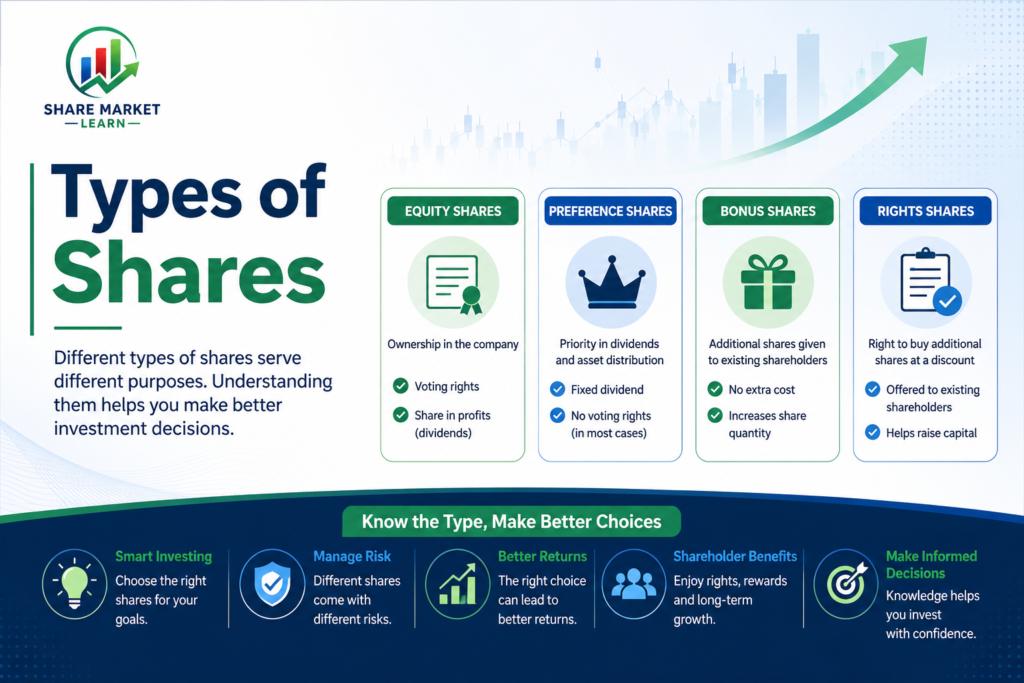
Broadly, shares can be classified into two major categories:
1. Equity Shares
2. Preference Shares
Let’s understand each type in detail.
Equity Shares
Equity shares are the most common type of shares traded in the stock market. When people talk about investing in stocks, they are usually referring to equity shares.
Equity shareholders are considered the real owners of the company.
Features of Equity Shares
- Voting rights in company decisions.
- Potential for higher returns.
- Eligible to receive dividends.
- Benefit from share price appreciation.
- Higher risk compared to preference shares.
Advantages of Equity Shares
Ownership Rights
Shareholders can vote on important company matters.
High Growth Potential
Investors can earn substantial returns if the company grows successfully.
Liquidity
Equity shares can be bought and sold easily on stock exchanges.
Dividend Income
Companies may distribute profits to shareholders through dividends.
Disadvantages of Equity Shares
- Dividends are not guaranteed.
- Share prices can be volatile.
- Investors bear higher risks during market downturns.
Preference Shares
Preference shares are a special type of share that provides shareholders with priority over equity shareholders in certain matters.
Features of Preference Shares
- Fixed dividend payments.
- Priority in dividend distribution.
- Priority during company liquidation.
- Generally limited or no voting rights.
Advantages of Preference Shares
Fixed Income
Investors receive dividends at a predetermined rate.
Lower Risk
Preference shareholders have a higher claim on company assets than equity shareholders.
Stable Returns
Returns are generally more predictable.
Disadvantages of Preference Shares
- Limited growth potential.
- Usually no voting rights.
- Dividend payments may still depend on company profitability.
Types of Equity Shares
Equity shares can also be classified into different categories.
Authorized Share Capital
This is the maximum amount of share capital a company is legally allowed to issue according to its official documents.
Issued Share Capital
These are the shares that a company has actually offered to investors.
Subscribed Share Capital
These are shares that investors have agreed to purchase.
Paid-Up Share Capital
This represents the amount investors have fully paid for the shares they purchased.
Types of Preference Shares
Cumulative Preference Shares
If the company cannot pay dividends in a particular year, the unpaid dividends accumulate and are paid in future years.
Non-Cumulative Preference Shares
Unpaid dividends do not accumulate. If a dividend is missed, shareholders lose that payment.
Participating Preference Shares
These shareholders receive fixed dividends and may also participate in additional profits under certain conditions.
Non-Participating Preference Shares
Shareholders receive only the fixed dividend and do not participate in additional profits.
Convertible Preference Shares
These shares can be converted into equity shares after a specified period.
Non-Convertible Preference Shares
These shares cannot be converted into equity shares.
Redeemable Preference Shares
The company can buy back these shares after a predetermined period.
Irredeemable Preference Shares
These shares remain outstanding throughout the company’s life, although they are uncommon in modern markets.
Shares Based on Market Capitalization
Investors often categorize shares based on the size of the company.
Large-Cap Shares
These belong to large, established companies with strong market value.
Characteristics
- More stable.
- Lower risk.
- Consistent performance.
- Suitable for conservative investors.
Mid-Cap Shares
These belong to medium-sized companies with growth potential.
Characteristics
- Moderate risk.
- Good growth opportunities.
- Balanced investment option.
Small-Cap Shares
These belong to smaller companies.
Characteristics
- High growth potential.
- Higher risk.
- Greater price volatility.
Shares Based on Dividend Payments
Growth Shares
Companies reinvest most of their profits into business expansion rather than paying dividends.
Suitable For
Investors seeking long-term capital appreciation.
Dividend Shares
Companies regularly distribute profits to shareholders through dividends.
Suitable For
Investors seeking regular income.
Shares Based on Ownership
Common Shares
These are standard equity shares available to the public.
Bonus Shares
Companies issue additional shares to existing shareholders without extra cost.
Rights Shares
Existing shareholders receive the opportunity to buy additional shares at a discounted price before the public.
Which Type of Shares Should Beginners Choose?
For most beginners, equity shares of fundamentally strong large-cap companies are often a good starting point.
Reasons include:
- Easier to understand.
- Lower business risk.
- Better liquidity.
- Long-term growth opportunities.
Investors looking for stable income may consider preference shares, while those seeking higher growth may focus on equity shares.
Important Factors Before Buying Shares
Before investing in any type of share, consider:
Company Fundamentals
Check revenue, profits, debt levels, and business performance.
Conclusion
Understanding the different types of shares is an essential step for every investor. Equity shares offer ownership, voting rights, and growth potential, while preference shares provide priority dividends and lower risk. Shares can also be categorized based on market capitalization, dividend policies, and ownership structure. By learning how each type works, investors can make smarter decisions and build a portfolio that aligns with their financial goals. For beginners, starting with quality equity shares and gradually expanding knowledge about other share categories can provide a strong foundation for long-term investing success.