
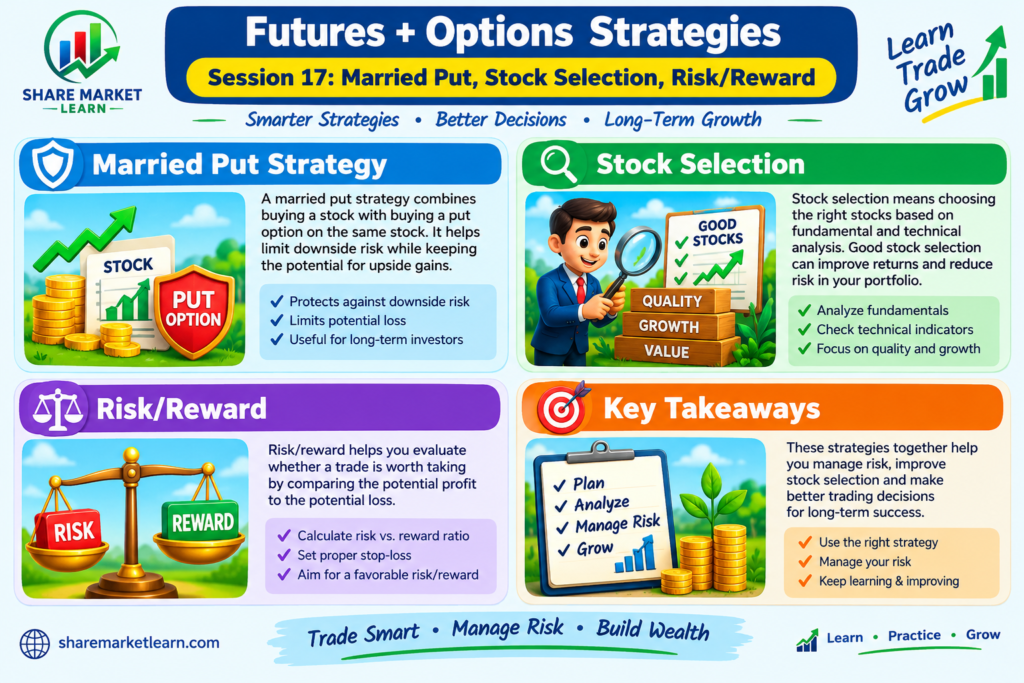
Options trading can provide several ways to manage risk while participating in the stock market. One such strategy is the Married Put, which combines buying a stock with buying a Put Option on the same stock. It is often described as a form of downside protection because the Put can help limit the loss if the stock price falls sharply.
In this Session 17, we will understand the Married Put strategy in simple language, including stock selection, risk/reward, and back testing.
Note: This article is for educational purposes only and should not be considered financial advice.
What Is a Married Put Strategy?
A Married Put involves two transactions:
- Buying shares of a stock.
- Buying a Put Option on the same stock.
The Put Option gives the buyer the right, but not the obligation, to sell the underlying stock at the selected strike price before or at expiry, depending on the option contract.
For example, suppose you buy a stock at ₹1,000 and also buy a Put Option with a strike price of ₹980.
If the stock rises, you can participate in the upside of the shares.
If the stock falls significantly, the Put Option may increase in value and can provide downside protection.
This makes the strategy similar to purchasing insurance for a stock position.
How Does a Married Put Work?
Let’s consider a simple example.
Suppose:
- Stock price = ₹1,000
- Shares purchased = 100
- Put strike price = ₹980
- Put premium = ₹20 per share
The stock investment is:
₹1,000 × 100 = ₹1,00,000
The Put premium is:
₹20 × 100 = ₹2,000
Therefore, the total initial investment is approximately:
₹1,02,000
If the stock price increases to ₹1,100, the shares gain value. The Put may expire worthless, but the profit from the stock can outweigh the premium paid for protection.
If the stock falls sharply, the Put can become more valuable. The exact result depends on the strike price, premium, expiry, and market movement.
Why Is Stock Selection Important?
Stock selection is an important part of any options strategy. Buying a Put does not automatically make a poor stock selection into a good trade.
When studying a Married Put, traders may examine factors such as:
1. Liquidity
Stocks and options with higher trading activity generally have better liquidity. Good liquidity can make entering and exiting positions easier.
2. Volatility
Volatility affects option premiums. A highly volatile stock may have relatively expensive options.
3. Fundamental and Technical Factors
A trader may study the company’s financial position, earnings, sector conditions, price trends, support and resistance levels, and other relevant information.
4. Option Chain
The option chain can provide information about available strikes, premiums, open interest, and other market data.
Stock selection should therefore be based on a defined process rather than simply choosing a stock because its price is moving.
Understanding Risk and Reward
One of the main advantages of a Married Put is that the downside risk can be structured in advance.
Without a Put, if you purchase a stock at ₹1,000 and it falls to ₹800, the stock position has an unrealized loss of ₹200 per share.
With a Put, the option can provide protection below its strike price.
However, this protection comes at a cost: the Put premium.
This means the trader must consider:
- Stock purchase price
- Put strike price
- Put premium
- Expiry date
- Brokerage and other applicable charges
- Expected stock movement
Maximum Risk
A simplified way to think about the potential downside is:
Maximum loss ≈ Stock purchase price − Put strike price + Put premium
For example:
Stock purchase price = ₹1,000
Put strike price = ₹980
Put premium = ₹20
Potential protected loss per share is approximately:
₹1,000 − ₹980 + ₹20 = ₹40
The actual result can vary because of transaction costs and contract specifications.
Profit Potential
The stock can continue to rise, so the upside is generally not capped by the Put itself.
However, the Put premium reduces the overall profit compared with simply holding the stock.
When Might Traders Consider a Married Put?
A trader or investor might consider this strategy when they want to hold a stock but are concerned about a possible short-term decline.
For example, an investor may have a bullish or long-term view on a stock but wants temporary downside protection around an uncertain event.
The Put acts as a protective position.
However, buying protection repeatedly can become expensive. Therefore, traders should understand how the premium affects the overall return.
Married Put vs. Simple Stock Investment
Let’s compare the basic structure.
| Feature | Stock Only | Married Put |
|---|---|---|
| Stock ownership | Yes | Yes |
| Put protection | No | Yes |
| Downside protection | No predefined option protection | Yes, based on Put |
| Premium cost | No | Yes |
| Upside participation | Yes | Yes, less Put premium |
| Strategy complexity | Lower | Higher |
The key difference is the additional cost of the Put.
What Is Back-testing?
Back-testing means testing a trading strategy using historical market data to see how it would have performed under previously observed conditions.
For a Married Put strategy, a back test might examine:
- Stock entry price
- Put strike selection
- Option premium
- Entry date
- Expiry date
- Exit rules
- Transaction costs
- Profit and loss
- Maximum draw down
- Number of winning and losing trades
Back-testing can help traders understand how a strategy behaved historically.
However, historical performance does not guarantee future results.
How to Back test a Married Put
A simple back testing process can be:
Step 1: Define the Rules
Decide exactly when you will buy the stock and Put.
Step 2: Select the Stocks
Create objective stock-selection criteria instead of choosing stocks randomly.
Step 3: Select the Put
Define the strike-price relationship and expiry period.
Step 4: Record Historical Results
Calculate the combined profit or loss of the stock and Put position.
Step 5: Include Costs
Consider brokerage, taxes, exchange charges, and other applicable costs where relevant.
Step 6: Analyze the Results
Look at total return, average return, maximum loss, draw down, and consistency.
The objective is not simply to find the highest historical return. A good back test should help you understand the behavior and risks of the strategy.
Common Mistakes to Avoid
Beginners may make several mistakes when learning Married Puts.
Ignoring the Put premium: Protection is not free. The premium directly affects returns.
Choosing strikes randomly: Strike selection should be part of a predefined strategy.
Ignoring expiry: Options lose time value as expiry approaches, all else equal.
Using limited historical data: A strategy should ideally be tested across different market conditions.
Overlooking transaction costs: Small costs can become significant when trading frequently.
Assuming back testing guarantees success: Historical results cannot predict future market behavior with certainty.
Final Thoughts
The Married Put strategy combines a long stock position with a protective Put Option. Its basic purpose is to participate in potential stock upside while creating a predefined layer of downside protection.
For beginners, the most important concepts to understand are stock selection, risk/reward, option premium, strike selection, expiry, and back testing.
Before using the strategy with real money, it can be useful to study the payoff structure and test clearly defined rules using historical data. Understanding both the benefits and costs of the strategy is essential for responsible options trading.
Frequently Asked Questions
1. What is a Married Put?
A Married Put is an options strategy where an investor buys shares of a stock and simultaneously buys a Put Option on the same stock.
2. Why buy a Put with a stock?
The Put can provide downside protection if the stock price falls below the relevant strike price.
3. Is a Married Put risk-free?
No. The strategy still involves risk. The Put premium, stock price movement, time value, and transaction costs can affect the final result.
4. How does stock selection affect the strategy?
The stock’s price behavior, liquidity, volatility, and option-market characteristics can influence the outcome of a Married Put.
5. What is back testing in options trading?
Back-testing is the process of applying defined trading rules to historical data to study how the strategy would have performed in the past.
6. Does successful back testing guarantee future profits?
No. Historical performance does not guarantee future results. Market conditions can change significantly.
7. Is a Married Put suitable for beginners?
It can be useful as a learning strategy because it demonstrates how stock ownership and Put protection work together. Beginners should understand the risks and mechanics before trading.