
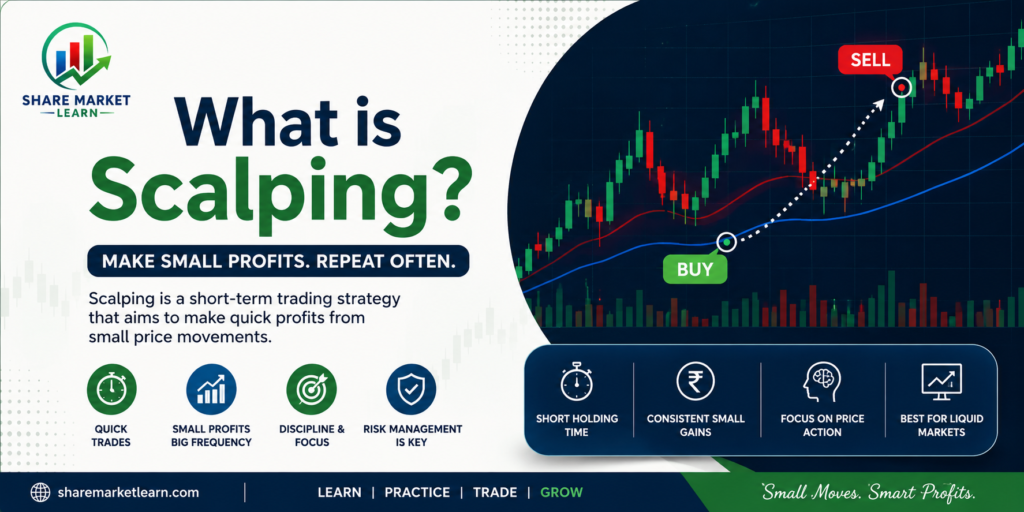
If you have ever watched traders buy and sell stocks within a few minutes, you may have wondered how they make money from such small price movements. This short-term trading approach is known as scalping.
Scalping is a trading strategy where traders try to make small profits from frequent trades. Instead of holding a stock, currency, or other financial instrument for hours, days, or weeks, a scalper may hold a position for only a few seconds or minutes.
The goal is simple: make small profits repeatedly while limiting the time spent in each trade.
In this article, we will explain what scalping is, how it works, its advantages and disadvantages, common scalping strategies, and what beginners should know before trying it.
What Is Scalping in Trading?
Scalping is a short-term trading strategy that focuses on making small profits from small price movements.
A scalper may enter and exit several trades during a single trading session. For example, a trader might buy a stock at ₹100 and sell it at ₹100.30, making a small profit. The trader may then look for another opportunity.
The individual profit from each trade can be small, but scalpers aim to repeat this process multiple times.
Scalping can be used in different markets, including:
- Stock markets
- Futures
- Options
- Forex
- Cryptocurrencies
However, scalping is not simply about making as many trades as possible. Successful scalping requires a clear strategy, quick decision-making, proper risk management, and discipline.
How Does Scalping Work?
Scalping works by taking advantage of small price movements.
Imagine a stock is trading at ₹500. A scalper believes the price may move slightly higher in the next few minutes. The trader buys the stock at ₹500 and sells it at ₹501.
The profit is only ₹1 per share. But if the trader buys 1,000 shares, the gross profit would be ₹1,000 before brokerage, taxes, and other trading costs.
The trader then looks for another setup.
This process may happen several times during the trading session.
The key idea behind scalping is:
Small profit + repeated opportunities + strict risk management = scalping approach
However, losses can also occur quickly. If a trader repeatedly takes losing trades, those small losses can add up.
Scalping vs. Other Trading Styles
Scalping is different from other popular trading styles.
Scalping
Scalpers usually hold positions for seconds or minutes. They focus on very small price movements and may execute many trades in one day.
Intraday Trading
Intraday traders generally open and close positions on the same trading day. Their trades may last several minutes or hours.
Swing Trading
Swing traders typically hold positions for several days or sometimes weeks. They try to benefit from larger price movements.
Position Trading
Position traders hold investments for weeks, months, or even longer. They usually focus on broader market trends.
So, the major difference is the holding period and size of the expected price movement.
Common Scalping Strategies
There is no single method that every scalper uses. Traders choose strategies based on their experience, market, and trading style.
1. Trend Scalping
In trend scalping, traders attempt to trade in the direction of the short-term trend.
For example, if a stock is consistently making higher highs and higher lows, a scalper may look for short-term buying opportunities.
The idea is to follow momentum rather than trade against it.
2. Breakout Scalping
A breakout happens when the price moves above resistance or below support.
A scalper may enter a trade when the price breaks an important level and shows strong momentum.
Because breakouts can sometimes fail, traders often use stop-loss orders to control risk.
3. Moving Average Scalping
Moving averages can help traders identify short-term trends.
For example, a trader may use two moving averages and look for situations where a shorter-term moving average crosses above or below a longer-term moving average.
Moving averages should not be treated as guaranteed buy or sell signals. They are tools that traders may combine with price action and other indicators.
4. Support and Resistance Scalping
Support is a price area where buying interest may appear, while resistance is an area where selling pressure may increase.
A scalper may look for opportunities around these levels and attempt to capture a small price movement.
Advantages of Scalping
Scalping has several potential advantages.
Quick Results
Scalpers usually do not have to wait days or weeks to find out whether a trade worked.
No Overnight Position Risk
Many scalpers close their trades before the trading session ends. This can reduce exposure to overnight price gaps, although it does not eliminate trading risk.
Frequent Opportunities
Markets can provide multiple short-term price movements during a trading session, creating opportunities for traders who have a suitable strategy.
Less Dependence on Long-Term Market Direction
A scalper may potentially profit from short-term upward or downward movements without needing to predict a long-term trend.
Disadvantages of Scalping
Scalping also comes with significant challenges.
High Number of Trades
Scalpers may execute many trades, which can increase brokerage, transaction costs, and other charges.
High Stress
Scalping requires traders to make decisions quickly. Watching charts continuously can be mentally demanding.
Small Mistakes Can Become Expensive
A few poorly managed trades can quickly reduce profits.
Requires Discipline
Scalpers need to follow their trading rules. Emotional decisions such as revenge trading or increasing position size after a loss can create serious problems.
What Tools Do Scalpers Use?
Scalpers commonly use real-time market data and charting tools.
Some commonly used tools include:
- Candlestick charts
- Volume indicators
- Moving averages
- Support and resistance levels
- Momentum indicators
- Real-time price data
- Stop-loss orders
- Trading platforms
The exact combination depends on the trader’s strategy.
A fast and reliable internet connection and a suitable trading platform can also be important because scalping depends heavily on timely order execution.
Is Scalping Suitable for Beginners?
Scalping can look attractive because traders may see quick profits. However, it is not necessarily an easy strategy for beginners.
New traders may struggle with:
- Fast decision-making
- Emotional control
- Trading costs
- Risk management
- Understanding market movements
- Following a trading plan
Before attempting scalping with real money, beginners should consider learning the basics of technical analysis, practicing with a demo or paper-trading environment where available, and understanding the risks involved.
Most importantly, traders should never risk money they cannot afford to lose.
Risk Management in Scalping
Risk management is one of the most important parts of scalping.
A trader should decide in advance:
- How much capital to risk on a trade
- Where to place a stop-loss
- When to take profit
- Maximum daily loss
- Maximum number of trades
- Position size
For example, if a trader has a rule that they will stop trading after reaching a specific daily loss limit, they should follow that rule instead of trying to recover losses through additional emotional trades.
The objective should not be to win every trade. The objective is to manage risk and maintain consistency.
Final Thoughts
Scalping is a fast-paced trading strategy that attempts to generate small profits from short-term price movements. Traders may hold positions for seconds or minutes and can execute multiple trades during a single session.
While scalping can provide frequent trading opportunities, it also carries considerable risk. Transaction costs, rapid price movements, emotional pressure, and poor risk management can quickly turn small losses into larger losses.
If you are interested in scalping, take time to understand how markets work, develop a clear trading plan, practice your strategy, and focus strongly on risk management.
Remember, scalping is not about making money quickly; it is about executing a well-defined strategy with discipline and controlled risk.
Frequently Asked Questions About Scalping
1. What is scalping in trading?
Scalping is a short-term trading strategy where traders attempt to make small profits from small price movements. Positions may be held for seconds or minutes.
2. Is scalping good for beginners?
Scalping can be challenging for beginners because it requires quick decisions, discipline, market knowledge, and strong risk management. Beginners should learn and practice before using real money.
3. How long does a scalping trade last?
A scalping trade can last from a few seconds to several minutes. The exact duration depends on the trader’s strategy and market conditions.
4. How many trades do scalpers make in a day?
There is no fixed number. Some scalpers may make only a few trades, while others may execute dozens of trades during a trading session.
5. Can scalping be profitable?
Scalping can potentially be profitable, but there is no guarantee of profits. Trading costs, losses, market volatility, and poor risk management can significantly affect results.
6. What is the biggest risk of scalping?
One major risk is that losses can accumulate quickly because scalpers take many trades and operate in short timeframes. Emotional trading and transaction costs can also reduce profitability.
7. Do scalpers use stop-loss orders?
Many scalpers use stop-loss orders or other risk-management methods to limit potential losses. The specific approach depends on the trader and strategy.
8. Is scalping the same as intraday trading?
No. Scalping is a type of very short-term trading where positions are often held for seconds or minutes. Intraday trades can remain open for much longer during the same trading session.
9. Which markets can be used for scalping?
Scalping can be used in markets such as stocks, futures, forex, options, and cryptocurrencies, depending on market liquidity, trading rules, costs, and the trader’s strategy.
10. What is the most important skill for a scalper?
Risk management and discipline are among the most important skills. A trader needs to follow a strategy rather than making emotional decisions.