
If you are learning candlestick patterns, you may have come across the Gravestone Doji candle. It is one of the most interesting candlestick patterns in technical analysis because it can show a sudden shift in market sentiment.
The Gravestone Doji often appears when buyers push the price significantly higher during a trading session, but sellers eventually take control and push the price back toward the opening level.
For beginners, understanding this pattern can help make price charts easier to read. However, a Gravestone Doji should not be treated as a guaranteed signal that the market will fall. Traders generally look for confirmation from the next candle, trading volume, support and resistance, and other technical indicators.
In this article, we will explain what a Gravestone Doji candle is, how it forms, what it means, how traders use it, and the common mistakes beginners should avoid.
What Is a Gravestone Doji Candle?
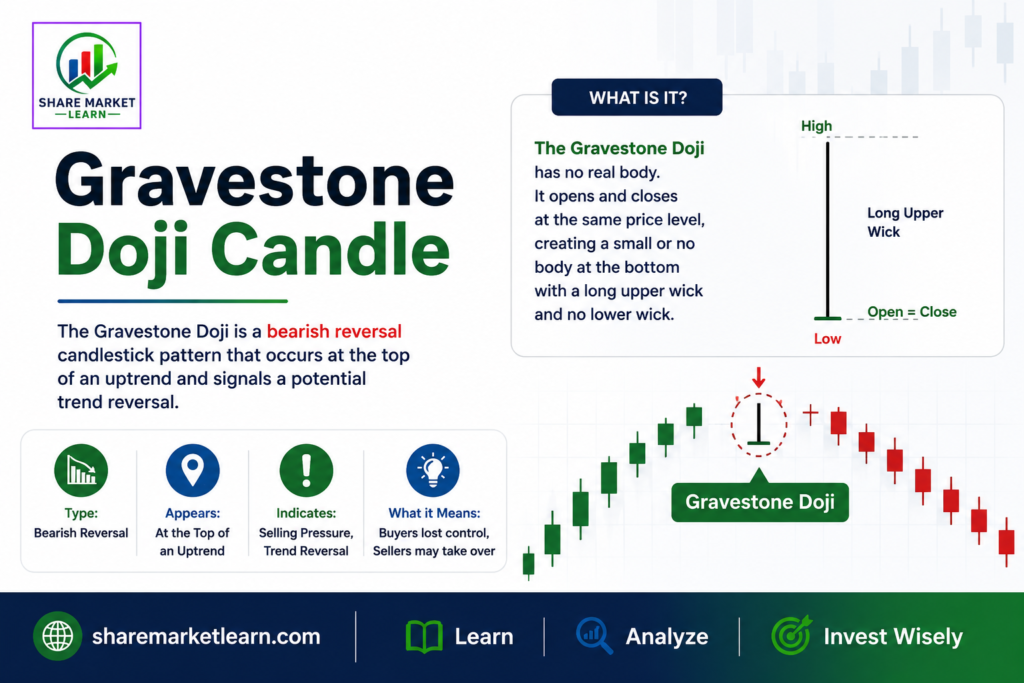
A Gravestone Doji is a candlestick pattern in which the opening price, closing price, and low price are very close to each other, while the candle has a long upper shadow.
The pattern typically looks like a T-shaped candle turned upside down.
Its main characteristics are:
- Open and close are near the same price.
- There is a long upper wick.
- The lower shadow is very small or absent.
- The price moved significantly higher during the session.
- The price eventually returned close to the opening level.
The name “Gravestone Doji” comes from the appearance of the candle, which can resemble a gravestone.
How Does a Gravestone Doji Form?
Let’s understand the formation with a simple example.
Imagine a stock opens at ₹500.
During the trading session, strong buying pushes the price to ₹530. This shows that buyers are in control.
However, sellers then enter the market and push the price back down.
By the end of the session, the stock closes around ₹500.
The result is:
Open = ₹500
High = ₹530
Close = ₹500
Low = around ₹500
This creates a long upper wick with almost no body.
The important message is that buyers tried to push the price higher, but sellers rejected those higher prices.
What Does a Gravestone Doji Mean?
The Gravestone Doji generally indicates indecision or potential bearish pressure.
When it appears after a strong uptrend, it can suggest that buyers may be losing control.
The long upper wick is particularly important. It shows that the market reached much higher prices but could not maintain them.
However, the pattern itself does not guarantee a bearish reversal.
For example, if the next candle moves strongly upward and breaks above the Gravestone Doji’s high, the bearish signal may fail.
This is why experienced traders usually wait for confirmation.
Gravestone Doji After an Uptrend
The Gravestone Doji is often considered more meaningful when it appears after an extended upward movement.
Suppose a stock moves:
₹400 → ₹420 → ₹440 → ₹460 → ₹480
Then a Gravestone Doji forms around ₹480.
This may indicate that buyers attempted to continue the rally but faced strong selling pressure.
If the following candle is strongly bearish and breaks below an important support level, traders may consider the possibility of a trend reversal.
The location of the pattern is therefore extremely important.
Gravestone Doji in a Downtrend
A Gravestone Doji can also appear during a downtrend.
In this situation, its meaning may be less straightforward.
The candle still shows rejection of higher prices, but it does not necessarily indicate a major bearish reversal because the market is already moving downward.
This is why traders should always consider the overall trend before interpreting a candlestick pattern.
Gravestone Doji vs Dragonfly Doji
The Gravestone Doji and Dragonfly Doji are often compared because their structures are opposite.
Gravestone Doji
- Long upper shadow
- Open and close near the low
- Shows rejection of higher prices
- Can provide a bearish warning after an uptrend
Dragonfly Doji
- Long lower shadow
- Open and close near the high
- Shows rejection of lower prices
- Can provide a bullish warning after a downtrend
A simple way to remember them is:
Gravestone = rejection of higher prices
Dragonfly = rejection of lower prices
Gravestone Doji vs Shooting Star
The Gravestone Doji can also look similar to a Shooting Star.
Both have a long upper wick and can appear after an uptrend.
The main difference is the size of the real body.
A Gravestone Doji has an opening and closing price that are almost identical.
A Shooting Star has a small but visible real body.
Both patterns can indicate selling pressure, but traders should examine the complete price structure before making a decision.
How to Trade the Gravestone Doji
There is no single method that works for every trader or market. However, beginners can follow a simple confirmation-based approach.
Step 1: Identify the Trend
First, determine whether the market is in an uptrend, downtrend, or sideways movement.
A Gravestone Doji after a strong uptrend is generally more interesting to bearish traders.
Step 2: Identify the Pattern
Look for:
- Very small real body
- Long upper shadow
- Open and close near the low
- Little or no lower shadow
Step 3: Wait for Confirmation
Do not automatically sell just because you see a Gravestone Doji.
A subsequent bearish candle can provide additional confirmation.
For example, if the next candle moves below the Gravestone Doji’s low, it may suggest that sellers are becoming stronger.
Step 4: Check Support and Resistance
Suppose the Gravestone Doji appears near a major resistance level.
That can make the rejection of higher prices more significant.
However, if there is no meaningful resistance nearby, the signal may require more confirmation.
Step 5: Use Risk Management
Technical analysis does not guarantee the outcome of a trade.
Traders should consider appropriate position sizing and define their risk before entering a trade.
Gravestone Doji and Trading Volume
Volume can provide useful additional information.
If a Gravestone Doji appears with unusually high volume, it may indicate that there was strong participation during the session.
High volume combined with a clear rejection of higher prices can make the pattern more interesting.
However, volume should not be used alone. It should be considered alongside price action and the broader market structure.
Common Mistakes Beginners Make
1. Treating Every Gravestone Doji as a Sell Signal
A Gravestone Doji is not a guaranteed sell signal.
It is better viewed as a warning that selling pressure may be increasing.
2. Ignoring the Trend
The same candle can have different significance depending on where it appears.
Always examine the surrounding price action.
3. Entering Too Early
Entering immediately after the candle forms can expose traders to false signals.
Waiting for confirmation may provide a more reliable setup.
4. Ignoring Resistance
A Gravestone Doji near a major resistance level can have greater significance than one appearing randomly in the middle of a trend.
5. Forgetting Risk Management
Even strong-looking candlestick patterns can fail.
A proper risk-management plan is essential.
Is the Gravestone Doji a Bearish Pattern?
Yes, the Gravestone Doji is generally considered a potentially bearish pattern, particularly when it forms after an uptrend.
Its long upper shadow indicates that buyers pushed prices higher but were unable to maintain those levels.
However, traders should remember that the pattern is a potential reversal signal, not a guaranteed reversal.
Confirmation from subsequent price action can make the interpretation stronger.
Example of a Gravestone Doji
Imagine a stock is trading at ₹1,000 after a strong upward move.
During the session:
- Open: ₹1,000
- High: ₹1,080
- Low: ₹998
- Close: ₹1,001
The opening and closing prices are almost identical, while the stock reached ₹1,080 during the session.
This creates a long upper shadow.
If the stock then produces a strong bearish candle and falls below nearby support, traders may interpret the Gravestone Doji as an early warning of a possible reversal.
If instead the price breaks above ₹1,080 and continues higher, the bearish interpretation would have failed.
Final Thoughts
The Gravestone Doji candle is a useful candlestick pattern for understanding rejection of higher prices.
Its most important feature is the long upper shadow combined with an open and close near the low of the trading range.
When the pattern appears after a strong uptrend, it can warn traders that buying momentum may be weakening and selling pressure could be increasing.
But remember: one candle should never be treated as a complete trading strategy.
For better analysis, combine the Gravestone Doji with trend analysis, support and resistance, volume, and confirmation from subsequent candles.
A simple rule for beginners is:
“Gravestone Doji after an uptrend = possible bearish warning; wait for confirmation.”
With regular practice, you can become more comfortable identifying this pattern and understanding what the market may be communicating through price action.
Frequently Asked Questions
1. What is a Gravestone Doji candle?
A Gravestone Doji is a candlestick pattern with a long upper shadow and an opening and closing price that are nearly the same.
2. Is a Gravestone Doji bullish or bearish?
It is generally considered a bearish warning pattern, especially when it appears after an uptrend.
3. Does a Gravestone Doji guarantee a price decline?
No. It does not guarantee a decline. Traders generally wait for confirmation before making a trading decision.
4. What does the long upper wick indicate?
The long upper wick indicates that buyers pushed the price significantly higher, but sellers rejected those higher prices and brought the price back down.
5. What is the difference between a Gravestone Doji and a Shooting Star?
Both can have long upper shadows. A Gravestone Doji has almost no real body because the open and close are nearly identical, while a Shooting Star has a small real body.
6. What is the opposite of a Gravestone Doji?
The Dragonfly Doji is commonly considered its opposite because it has a long lower shadow and shows rejection of lower prices.
7. Should beginners trade the Gravestone Doji?
Beginners should first learn how the pattern works and practice identifying it on charts. Any live trading decision should include a clear risk-management plan.
8. Which indicators can be combined with a Gravestone Doji?
Traders may combine it with support and resistance, trendlines, moving averages, RSI, volume, and other price-action signals for additional confirmation.