
The Three Outside Down Candle is one of the most reliable bearish reversal candlestick patterns in technical analysis. It signals that an existing uptrend may be losing strength and that sellers are beginning to take control. Because of its three-candle structure and strong confirmation, many traders use this pattern to identify potential selling opportunities or to exit long positions before a larger price decline.
Whether you’re new to candlestick trading or looking to improve your chart-reading skills, understanding the Three Outside Down pattern can help you make more informed trading decisions. In this guide, you’ll learn what the pattern is, how it forms, why it works, how to trade it, and the common mistakes to avoid.
What Is a Three Outside Down Candle?
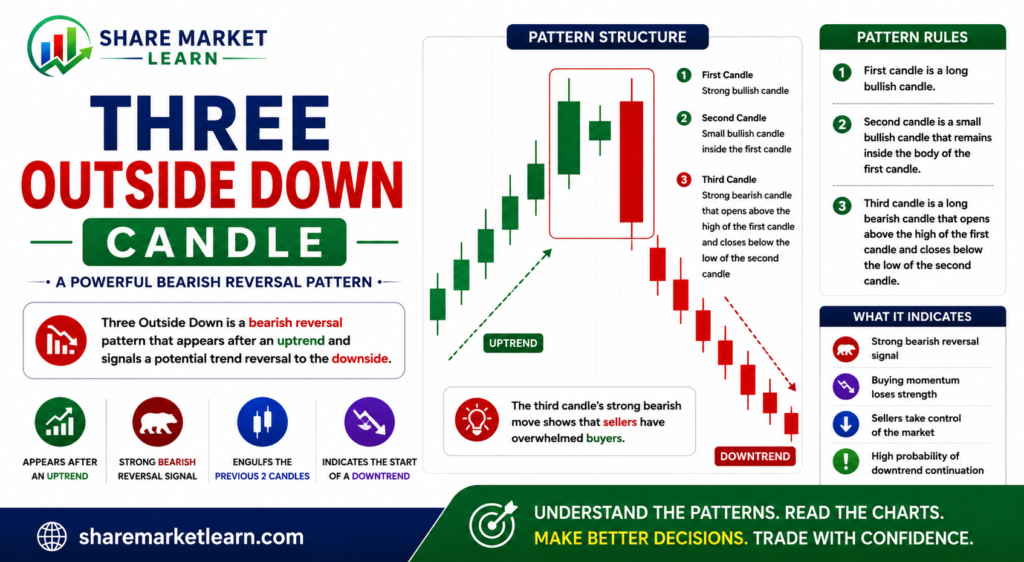
The Three Outside Down Candle is a three-candlestick bearish reversal pattern that typically appears after an uptrend. It indicates a shift in market sentiment from bullish to bearish.
The pattern begins with a small bullish candle, followed by a large bearish candle that completely engulfs the first candle’s body. The third candle closes even lower, confirming that sellers have taken control of the market.
Because the pattern includes a confirmation candle, it is generally considered more reliable than many two-candle reversal patterns.
Structure of the Three Outside Down Pattern
The pattern consists of three candles:
First Candle
- A small bullish (green) candle.
- Appears during an existing uptrend.
- Shows that buyers are still active.
Second Candle
- A large bearish (red) candle.
- Completely engulfs the body of the first candle.
- Indicates that sellers have suddenly gained strength.
Third Candle
- Another bearish candle.
- Closes below the second candle’s closing price.
- Confirms the bearish reversal.
This third candle is what makes the pattern particularly powerful, as it validates the shift in momentum.
How Does the Three Outside Down Pattern Form?
The formation happens in three stages:
Stage 1: Strong Uptrend
The market has been moving higher, and buyers remain confident.
Stage 2: Sellers Enter the Market
A large bearish candle appears and completely engulfs the previous bullish candle, showing that selling pressure has overcome buying pressure.
Stage 3: Bearish Confirmation
The third bearish candle closes even lower, confirming that sellers are now in control and increasing the probability of a downward trend.
Psychology Behind the Three Outside Down Candle
Understanding the psychology behind this pattern makes it easier to trust its signal.
Initially, buyers are optimistic because the market has been rising. The first bullish candle reinforces this confidence.
However, the second candle changes everything. Sellers step in aggressively and erase the gains of the previous candle, catching many buyers off guard.
The third bearish candle confirms that the selling pressure is genuine rather than temporary. Buyers begin closing their positions, while more sellers enter the market, increasing downward momentum.
This shift in sentiment is why the Three Outside Down pattern is considered a strong bearish reversal signal.
How to Identify a Three Outside Down Candle
Use this checklist to identify the pattern correctly:
- The market is in a clear uptrend.
- The first candle is bullish.
- The second candle is bearish and completely engulfs the first candle’s body.
- The third candle is bearish.
- The third candle closes below the second candle’s close.
- Trading volume is preferably higher than average during the second or third candle.
When these conditions are present, the pattern becomes more reliable.
How to Trade the Three Outside Down Pattern
Step 1: Wait for Confirmation
Do not enter a trade before the third candle closes. Waiting for confirmation helps reduce false signals.
Step 2: Enter the Trade
Many traders consider entering a sell trade:
- After the third candle closes.
- Or below the low of the third candle for additional confirmation.
Step 3: Place a Stop Loss
To manage risk, place your stop loss:
- Above the high of the second candle.
- Or above the recent swing high if you want extra protection.
Step 4: Set a Profit Target
You can choose profit targets based on:
- Previous support levels.
- A risk-to-reward ratio of at least 1:2.
- A trailing stop to capture larger price moves.
Example of a Three Outside Down Candle
Imagine a stock has been rising steadily and is trading around ₹2,000.
- Day 1: The stock forms a small bullish candle and closes at ₹2,020.
- Day 2: A large bearish candle opens slightly higher but closes at ₹1,990, completely engulfing the first candle’s body.
- Day 3: Another bearish candle closes at ₹1,965.
This sequence indicates that buyers have lost control and sellers are likely to continue pushing prices lower.
Best Indicators to Use with the Three Outside Down Pattern
While the pattern is effective on its own, combining it with technical indicators can improve trading accuracy.
1. Volume
Higher trading volume during the second or third candle strengthens the reversal signal.
2. Relative Strength Index (RSI)
If the RSI is above 70 (overbought) before the pattern appears, it increases the likelihood of a bearish reversal.
3. Moving Averages
A Three Outside Down pattern forming near a major moving average can provide stronger confirmation.
4. Resistance Levels
Patterns that appear near key resistance zones often produce more reliable signals.
5. MACD
A bearish MACD crossover after the pattern offers additional confirmation.
Advantages of the Three Outside Down Pattern
- Easy to identify on price charts.
- Strong bearish reversal signal.
- Includes a built-in confirmation candle.
- Suitable for stocks, forex, commodities, and cryptocurrencies.
- Works across multiple timeframes.
- Helps traders identify early trend reversals.
Limitations of the Three Outside Down Pattern
Despite its reliability, no pattern is perfect.
Some limitations include:
- False signals in sideways or choppy markets.
- Lower accuracy without volume confirmation.
- Less effective during strong bullish trends.
- Should not be used without proper risk management.
- Better results when combined with technical indicators.
Common Mistakes Beginners Make
Avoid these common trading mistakes:
- Entering before the third candle closes.
- Ignoring the overall market trend.
- Trading without a stop loss.
- Overlooking trading volume.
- Depending only on the candlestick pattern.
- Ignoring major news or economic events.
Avoiding these mistakes can improve your chances of making better trading decisions.
Risk Management Tips
Good risk management is essential for long-term success.
Follow these simple rules:
- Never risk more than 1–2% of your trading capital on a single trade.
- Always place a stop loss.
- Aim for a favorable risk-to-reward ratio.
- Avoid emotional trading.
- Follow your trading plan consistently.
Remember, preserving your capital is just as important as making profits.
Is the Three Outside Down Pattern Reliable?
The Three Outside Down pattern is widely regarded as one of the more reliable bearish reversal patterns because it includes a confirmation candle. However, like all technical analysis tools, it does not guarantee future price movements.
Its reliability improves when:
- It appears after a strong uptrend.
- It forms near a significant resistance level.
- It is supported by high trading volume.
- Other technical indicators confirm the signal.
Using multiple forms of analysis can help improve the quality of your trading decisions.
Conclusion
The Three Outside Down Candle is a powerful bearish reversal pattern that can help traders recognize when an uptrend may be coming to an end. Its three-candle structure provides stronger confirmation than many other reversal patterns, making it a valuable addition to any trader’s toolkit.
While the pattern can offer excellent trading opportunities, it should always be used alongside other technical indicators, proper risk management, and a well-defined trading plan. With regular practice and disciplined execution, the Three Outside Down pattern can become a dependable part of your trading strategy.
Frequently Asked Questions (FAQs)
1. What is a Three Outside Down Candle?
It is a three-candlestick bearish reversal pattern that signals a possible shift from an uptrend to a downtrend.
2. Is the Three Outside Down pattern suitable for beginners?
Yes. Its clear three-candle structure makes it relatively easy for beginners to identify and understand.
3. Does the Three Outside Down pattern always predict a market reversal?
No. While it is a strong bearish signal, confirmation from volume, support and resistance, and technical indicators is recommended.
4. Which timeframe is best for the Three Outside Down pattern?
The pattern works on all timeframes, but daily and 4-hour charts generally provide more reliable signals than very short timeframes.
5. Can this pattern be used in intraday trading?
Yes. Intraday traders can use it on lower timeframes, but should wait for confirmation and manage risk carefully.
6. Which indicators work best with the Three Outside Down pattern?
Volume, RSI, MACD, Moving Averages, and Support & Resistance levels are among the most effective confirmation tools.
7. What is the biggest mistake traders make when using this pattern?
The most common mistake is entering a trade before the third candle closes or ignoring proper stop-loss placement.