
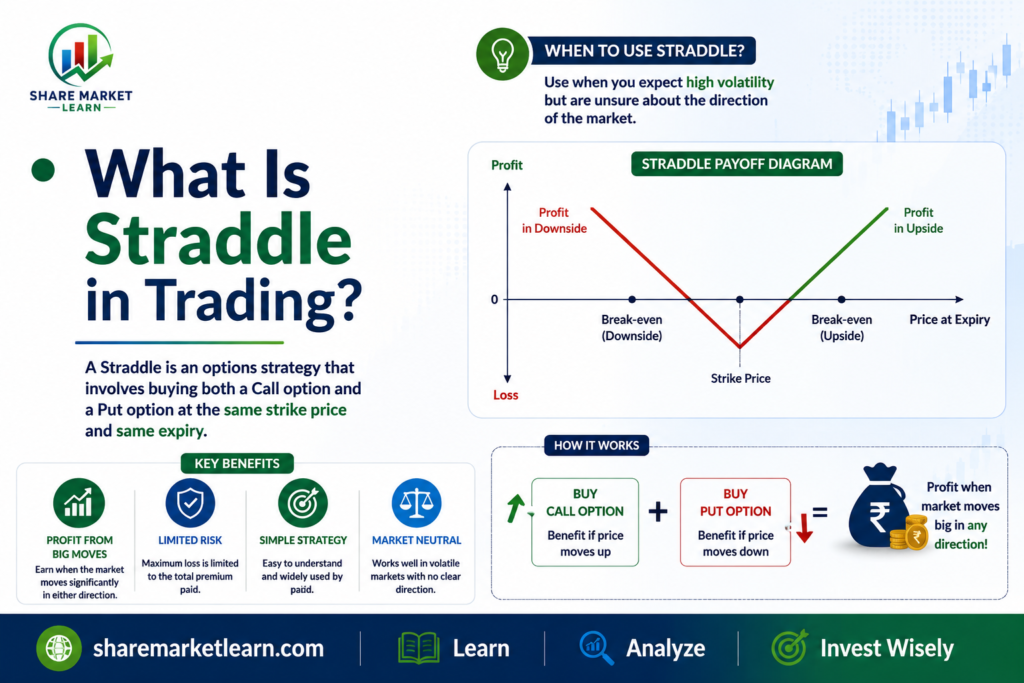
If you are learning about options trading, you may have come across the term straddle. A straddle is one of the most popular options strategies because it allows traders to potentially benefit from a large price movement in either direction.
But how does it work? When should a trader use it? And what are the risks?
In simple terms, a straddle in trading involves buying a call option and a put option on the same underlying asset, with the same strike price and the same expiry date. The strategy can potentially benefit when the underlying asset makes a significant move upward or downward.
Let’s understand the straddle strategy step by step.
What Is a Straddle in Trading?
A straddle is an options trading strategy where a trader buys:
- One call option
- One put option
- Same underlying asset
- Same strike price
- Same expiry date
The most common form is called a long straddle.
The trader using a long straddle generally expects the asset to make a big move, but does not know whether the price will move up or down.
For example, suppose a stock is trading at ₹1,000.
A trader could buy:
- ₹1,000 Call Option
- ₹1,000 Put Option
- Same expiry
If the stock moves substantially above ₹1,000, the call option may gain value.
If the stock moves substantially below ₹1,000, the put option may gain value.
However, if the stock stays close to ₹1,000, both options can lose value, particularly as the expiry date approaches.
How Does a Long Straddle Work?
The idea behind a long straddle is quite simple.
You are effectively saying:
“I expect a big price movement, but I don’t know which direction it will take.”
Suppose a stock is trading at ₹1,000.
You purchase:
- Call option premium = ₹30
- Put option premium = ₹25
Your total cost is:
₹30 + ₹25 = ₹55
This ₹55 is the total premium paid for the straddle, ignoring brokerage, taxes, and other charges.
For the strategy to become profitable at expiry, the underlying price generally needs to move far enough in either direction to cover the total premium paid.
The approximate break-even levels are:
Upper break-even = Strike price + Total premium
Lower break-even = Strike price − Total premium
In this example:
- Upper break-even = ₹1,000 + ₹55 = ₹1,055
- Lower break-even = ₹1,000 − ₹55 = ₹945
So, at expiry, a significant move above ₹1,055 or below ₹945 could potentially make the overall strategy profitable before transaction costs.
What Happens If the Market Goes Up?
Suppose the stock rises sharply from ₹1,000 to ₹1,100.
The call option could gain significant value because the stock is now above the strike price.
The put option may lose most or all of its value.
The trader can potentially make a profit if the gain from the call is greater than the total premiums paid.
The important point is that only one side needs to make a sufficiently large move for a long straddle to potentially become profitable.
What Happens If the Market Goes Down?
Now imagine the stock falls from ₹1,000 to ₹900.
The put option could gain significant value because the stock has moved below the strike price.
The call option may lose most or all of its value.
Again, if the gain from the put is greater than the total cost of both options, the trader may make a profit.
This is one of the major attractions of a long straddle: the trader does not have to predict whether the market will go up or down.
What Happens If the Market Does Not Move?
This is where the straddle strategy becomes challenging.
Suppose the stock remains around ₹1,000 until expiry.
Both the call and put options could lose their value.
The trader may lose the premiums paid for both options.
This is why a long straddle is generally more suitable when a trader expects significant volatility rather than a quiet market.
What Is a Short Straddle?
A short straddle is the opposite of a long straddle.
Instead of buying both options, the trader sells:
- One call option
- One put option
- Same strike price
- Same expiry date
The trader receives premiums from selling the options.
A short straddle generally benefits when the underlying asset remains relatively close to the strike price.
However, it can carry very high risk.
If the underlying price rises sharply, the short call can create potentially unlimited losses.
If the underlying price falls sharply, the short put can create substantial losses.
Therefore, short straddles are considerably more complex and should not be treated as a beginner-friendly strategy.
Long Straddle vs. Short Straddle
| Feature | Long Straddle | Short Straddle |
|---|---|---|
| Call | Buy | Sell |
| Put | Buy | Sell |
| Main expectation | Large price movement | Limited price movement |
| Direction prediction | Not required | Not required |
| Maximum loss | Generally limited to premiums paid | Potentially very large |
| Profit potential | Potentially large | Limited to premiums received |
| Main risk | Time decay and insufficient movement | Large market movement |
When Do Traders Use a Straddle?
A long straddle may be considered when a trader expects high volatility.
For example, significant price movements can sometimes occur around:
- Company earnings announcements
- Major economic announcements
- Central bank decisions
- Important government policies
- Election-related uncertainty
- Major corporate events
- Unexpected market news
However, traders should remember that an expected event does not automatically mean a profitable straddle.
Sometimes the market has already priced the expected event into option premiums.
What Is Implied Volatility in a Straddle?
Implied volatility (IV) is an important concept when trading options.
Option prices are influenced by expectations of future volatility. When implied volatility is high, option premiums can become more expensive.
This matters because a long straddle requires the underlying asset to move enough to compensate for the premiums paid.
For example, imagine you buy a straddle before a major event because you expect a huge movement. If the event occurs but the actual price movement is smaller than the market expected, both options could lose value.
Therefore, simply expecting volatility is not enough. The movement needs to be large enough relative to the cost of the options.
What Is Time Decay?
Another important concept is time decay, also known as theta.
Options generally lose time value as they approach expiry, assuming other factors remain unchanged.
For a long straddle, time decay can work against the trader.
Every day that passes without a sufficiently large price movement can reduce the value of the options.
This is why timing can be very important when using a long straddle.
Advantages of a Long Straddle
1. No Directional Prediction Required
You don’t have to correctly predict whether the market will rise or fall.
2. Potential to Benefit From a Large Move
A strong movement in either direction can potentially create a profitable opportunity.
3. Defined Maximum Loss
For a basic long straddle, the maximum loss is generally limited to the premiums paid, assuming the options are purchased outright and ignoring transaction costs.
4. Useful for Volatility Strategies
The strategy can be useful for traders who have a strong view that volatility may increase.
Disadvantages of a Long Straddle
1. It Can Be Expensive
You have to pay premiums for both the call and put options.
2. Time Decay Works Against You
If the market does not move quickly enough, the value of the options may decline.
3. Volatility Can Fall
A decline in implied volatility can reduce option prices even if the underlying asset does not move much.
4. Transaction Costs
Brokerage, taxes, exchange charges, and bid-ask spreads can affect the final result.
Is Straddle Suitable for Beginners?
A long straddle is easier to understand than many advanced options strategies, but that does not mean it is risk-free.
Before trading a straddle, beginners should understand:
- Call options
- Put options
- Strike price
- Expiry
- Option premium
- Intrinsic value
- Time value
- Implied volatility
- Theta
- Break-even price
It is also important to understand that buying options can result in losing the entire premium paid if the expected price movement does not occur.
Simple Example of a Straddle
Let’s put everything together.
Suppose:
Stock price: ₹1,000
You buy:
₹1,000 Call: ₹30 premium
₹1,000 Put: ₹25 premium
Total premium: ₹55
Your approximate expiry break-even points are:
- ₹1,055 on the upside
- ₹945 on the downside
If the stock finishes significantly above ₹1,055, the call may generate enough value to cover the total premium.
If the stock finishes significantly below ₹945, the put may generate enough value to cover the total premium.
If the stock finishes between these levels, the overall strategy could result in a loss at expiry.
Actual profitability will depend on the option contract specifications and transaction costs.
Frequently Asked Questions About Straddle Trading
What is a straddle in trading?
A straddle is an options strategy involving a call and a put with the same underlying asset, strike price, and expiry.
Is a straddle bullish or bearish?
A long straddle is neither specifically bullish nor bearish. It is generally a non-directional strategy that benefits from a sufficiently large move in either direction.
What is a long straddle?
A long straddle means buying a call option and a put option with the same strike price and expiry.
What is a short straddle?
A short straddle means selling a call option and a put option with the same strike price and expiry. It generally benefits when the underlying remains near the strike price but can involve significant risk.
Can you lose money with a straddle?
Yes. With a long straddle, you can lose the premiums paid if the underlying does not move enough. With a short straddle, losses can be very large if the underlying makes a major move.
When is a long straddle profitable?
At expiry, a long straddle can potentially be profitable when the underlying asset moves sufficiently far above or below the strike price to cover the total premiums paid, before transaction costs.
Conclusion
A straddle in trading is an options strategy designed to benefit from a significant price movement without requiring the trader to predict the direction of that movement.
A long straddle involves buying a call and a put with the same strike price and expiry. It can be useful when a trader expects substantial volatility, but the strategy has costs, including option premiums and time decay.
The key lesson is simple:
A straddle needs movement.
If the market moves strongly in either direction, the strategy can potentially benefit. If the market stays quiet, the premiums paid can gradually lose value.
Before using a straddle with real money, make sure you understand option pricing, volatility, expiry, break-even levels, and the maximum possible risk.