
If you are new to the share market, you may have heard terms like derivatives, futures, options, contracts, and hedging. These words can sound complicated at first, but the basic idea of derivatives is actually quite simple.
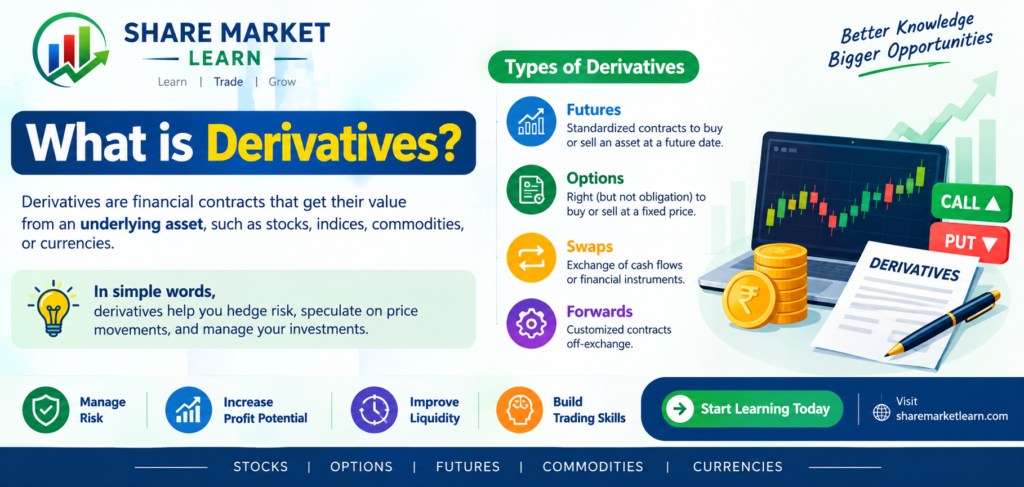
A derivative is a financial contract whose value comes from another asset, such as a stock, index, currency, commodity, or interest rate. The asset on which the derivative is based is called the underlying asset.
Derivatives are widely used by traders and investors for different purposes, including managing risk, protecting investments, and trying to earn profits from price movements.
In this article, we will understand what derivatives are, how derivatives work, their types, advantages, risks, and some simple examples.
What Is a Derivative?
A derivative is a financial instrument or contract whose value depends on the price of an underlying asset.
The underlying asset could be:
- Shares
- Stock market indices
- Commodities such as gold or crude oil
- Currencies
- Interest rates
- Other financial instruments
For example, suppose you are trading a derivative based on the NIFTY 50 index. The derivative itself does not represent ownership of the companies in the index. Instead, its value changes according to movements in the NIFTY 50.
In simple words:
Underlying asset → Price changes → Derivative value changes
This is why derivatives are called “derivatives” — their value is derived from something else.
How Do Derivatives Work?
Let’s understand with a simple example.
Suppose a company’s share is currently trading at ₹1,000.
You believe that the share price may increase in the coming month. Instead of directly buying the share, you enter into a derivative contract based on that share.
If the share price increases to ₹1,100, the value of your derivative may increase depending on the type of contract you purchased.
If the share price falls, however, your derivative position could lose value.
This is why understanding price movements and risk management is very important when trading derivatives.
Main Types of Derivatives
There are several types of derivatives, but the most commonly discussed ones are futures and options.
1. Futures
A futures contract is an agreement to buy or sell an underlying asset at a predetermined price on a specified future date.
For example, imagine a stock is trading at ₹500.
You enter into a futures contract at ₹510.
If the price later rises to ₹550, the contract may generate a profit for a buyer of the futures contract.
However, if the price falls to ₹470, the position can result in a loss.
Futures generally involve an obligation for both parties to fulfill the contract according to its terms.
2. Options
An option gives the buyer the right, but not the obligation, to buy or sell an underlying asset at a specified price within a particular period or on a particular date, depending on the contract.
There are two main types of options:
- Call Option
- Put Option
Call Option
A call option generally gives the buyer the right to buy an underlying asset at a specified price.
Traders may consider call options when they expect the price of the underlying asset to rise.
Put Option
A put option generally gives the buyer the right to sell an underlying asset at a specified price.
Traders may consider put options when they expect the price to fall or when they want to protect an existing position.
What Is the Difference Between Futures and Options?
Although both are derivatives, futures and options work differently.
With a futures contract, both parties generally have an obligation under the contract.
With an option, the buyer has a right but generally does not have an obligation to exercise that right.
For purchasing an option, the buyer normally pays a price known as the premium.
For example, if you buy an option for a premium of ₹20, that ₹20 is the cost paid for the option contract.
Why Are Derivatives Used?
Derivatives are used for several reasons.
1. Hedging
One of the most important uses of derivatives is hedging.
Hedging means taking a position to reduce the potential impact of an unfavorable price movement.
For example, an investor who owns shares may use certain derivative strategies to protect against a possible fall in prices.
2. Speculation
Traders can also use derivatives to speculate on whether an asset’s price will rise or fall.
For example, if a trader believes an index will increase, they may take a suitable derivatives position based on that expectation.
However, speculation can involve significant risk.
3. Leverage
Derivatives can provide leverage, meaning traders may control a relatively large position with a smaller amount of capital than would be required to purchase the underlying asset outright.
While leverage can increase potential returns, it can also increase potential losses.
Therefore, beginners should be particularly careful when using leveraged products.
4. Portfolio Management
Professional investors and institutions may use derivatives as part of portfolio management and risk-management strategies.
They can help investors manage exposure to different markets and assets.
What Is the Derivatives Market?
The derivatives market is a marketplace where derivative contracts are traded.
In India, exchange-traded derivatives are available on recognized stock exchanges. Equity derivatives commonly include contracts based on stocks and market indices.
The derivatives market allows participants to take positions based on expected price movements while also providing tools for managing financial risk.
Simple Example of Derivatives
Let’s take a simple example.
Suppose the NIFTY 50 is currently at 25,000.
You believe that the index may rise in the near future.
You take a suitable derivatives position based on your expectation.
If the index moves upward as expected, your position may generate a profit.
But if the index moves in the opposite direction, your position may lose money.
The actual profit or loss depends on the specific derivative contract, entry price, exit price, contract size, premium where applicable, and other factors.
This example shows why derivatives should not be treated as a guaranteed way to make money.
Advantages of Derivatives
Some major advantages of derivatives include:
- Risk management: They can help manage exposure to price changes.
- Hedging: Investors can use them to protect against certain market risks.
- Leverage: Traders can take larger market exposure with less initial capital.
- Flexibility: Futures and options provide different strategies for different market views.
- Price discovery: Derivatives markets can contribute to efficient price discovery.
Risks of Derivatives
Although derivatives can be useful, they also carry substantial risks.
High Risk
Derivative prices can change quickly. A small movement in the underlying asset can sometimes result in a significant gain or loss.
Leverage Risk
Leverage can increase both profits and losses.
Complexity
Options and advanced derivatives strategies can be difficult for beginners to understand.
Expiry Risk
Many derivatives contracts have expiry dates. The value of a contract can change significantly as the expiry approaches.
Emotional Trading
Fear, greed, and overconfidence can lead traders to take larger positions than they can comfortably manage.
For these reasons, beginners should learn the basics and understand the risks before trading derivatives.
Derivatives vs Shares
Buying shares generally means purchasing an ownership interest in a company.
Derivatives, on the other hand, are contracts whose value is linked to an underlying asset.
For example:
Shares: You purchase shares of a company.
Derivatives: You purchase or sell a contract based on the price of shares, an index, or another underlying asset.
Both can be used in financial markets, but they have different characteristics, risks, and purposes.
Are Derivatives Suitable for Beginners?
Derivatives can be useful, but they are not necessarily suitable for every beginner.
Before trading derivatives, it is important to understand:
- How futures work
- How options work
- Margin requirements
- Option premiums
- Expiry dates
- Contract sizes
- Profit and loss calculations
- Risk management
- Leverage
A beginner should focus on education and practice before putting significant money into derivatives.
Conclusion
Derivatives are financial contracts whose value is derived from an underlying asset such as a stock, index, commodity, or currency.
The two most common types are futures and options. Derivatives can be used for hedging, speculation, portfolio management, and gaining market exposure.
However, derivatives also involve significant risks, especially because of leverage and rapid price movements.
If you are new to the market, don’t focus only on the profit potential. First understand how derivatives work, how much you can lose, and how risk management works.
A strong understanding of the basics can help you make more informed decisions in the financial market.
Frequently Asked Questions (FAQs)
1. What is a derivative in simple words?
A derivative is a financial contract whose value depends on another asset, such as a stock, index, commodity, or currency.
2. What are the main types of derivatives?
The main types include futures and options. Other forms include forwards and swaps.
3. What is an underlying asset?
An underlying asset is the asset on which a derivative contract is based. It can be a stock, index, commodity, currency, or another financial instrument.
4. Are derivatives risky?
Yes. Derivatives can involve significant risk because prices can move quickly and leverage can increase both potential profits and losses.
5. What is a futures contract?
A futures contract is an agreement to buy or sell an underlying asset at a predetermined price according to specified contract terms.
6. What is an option?
An option generally gives the buyer the right, but not the obligation, to buy or sell an underlying asset at a specified price according to the contract terms.
7. What is a call option?
A call option generally gives the buyer the right to buy the underlying asset at a specified price.
8. What is a put option?
A put option generally gives the buyer the right to sell the underlying asset at a specified price.
9. Why do investors use derivatives?
Investors and traders may use derivatives for hedging, speculation, portfolio management, and managing exposure to price movements.
10. Can beginners trade derivatives?
Beginners can learn about derivatives, but they should understand the risks, contract structure, leverage, margin, and potential losses before trading them.