
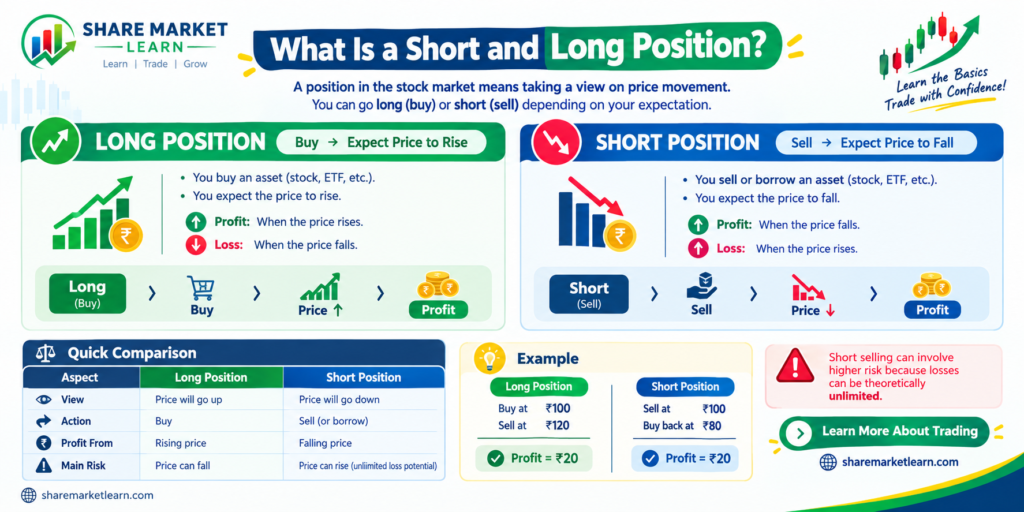
If you are learning about the stock market, you will often hear traders say, “I am long on this stock” or “I have taken a short position.” These terms may sound complicated at first, but the basic concept is quite simple.
A long position generally means you are expecting the price of an asset to rise, while a short position generally means you are expecting the price to fall.
Understanding long and short positions is important for anyone who wants to learn about stock market trading, futures and options, intraday trading, and derivatives.
In this article, we will explain what long and short positions mean, how they work, their differences, examples, risks, and some frequently asked questions.
What Is a Long Position?
A long position means taking a position with the expectation that the price of an asset will increase.
The asset could be:
- A stock
- An index
- A commodity
- A currency
- A futures contract
- Another financial instrument
The basic idea is:
Buy first → Price rises → Sell later → Potential profit
For example, suppose you buy 100 shares of a company at ₹500 per share.
Your total purchase value is:
100 × ₹500 = ₹50,000
Now suppose the share price increases to ₹550.
If you sell your shares at ₹550, your gross profit would be:
100 × (₹550 − ₹500) = ₹5,000
This is a simple example of a long position.
However, if the share price falls to ₹450, you would have an unrealized loss of ₹5,000 if you continued to hold the shares.
What Is a Short Position?
A short position means taking a position with the expectation that the price of an asset will decline.
The basic idea is:
Sell first → Price falls → Buy back later → Potential profit
This can sound confusing because people are used to buying first and selling later.
Let’s understand with an example.
Suppose a trader takes a short position when a stock is trading at ₹500.
Later, the price falls to ₹450.
If the trader closes the position at ₹450, the difference is ₹50 per share.
For 100 shares, the potential gross profit would be:
100 × (₹500 − ₹450) = ₹5,000
But if the stock instead rises from ₹500 to ₹550, the short position would face a loss.
In actual trading, the exact mechanics depend on the product being traded, such as cash-market short selling or derivatives.
Long Position vs Short Position
The easiest way to remember the difference is:
| Long Position | Short Position |
|---|---|
| Expect price to rise | Expect price to fall |
| Generally buy first | Generally sell first |
| Profit if price rises | Profit if price falls |
| Loss if price falls | Loss if price rises |
Simple Formula
For a basic long position:
Profit/Loss = Selling Price − Buying Price
For a basic short position:
Profit/Loss = Selling Price − Buying Price, where the position is opened by selling and later closed by buying.
The actual calculation can be more complicated after considering brokerage, taxes, charges, margin, premiums, and other costs.
Simple Example of a Long Position
Let’s say you believe ABC Ltd. will increase in price.
Current price: ₹1,000
You buy 50 shares.
Total value:
50 × ₹1,000 = ₹50,000
Later, the share price reaches ₹1,100.
Your gross profit would be:
50 × ₹100 = ₹5,000
This is a long position.
But if the price falls to ₹900, the gross loss would be:
50 × ₹100 = ₹5,000
Therefore, being bullish does not guarantee a profit.
Simple Example of a Short Position
Now suppose you believe another stock is likely to fall.
Current price: ₹1,000
You take a short position for 50 shares.
Later, the price falls to ₹900.
Potential gross profit:
50 × (₹1,000 − ₹900) = ₹5,000
But suppose the stock rises to ₹1,100 instead.
Potential gross loss:
50 × (₹1,100 − ₹1,000) = ₹5,000
This demonstrates an important point: short positions can lose money when the market moves against you.
Long and Short Positions in Futures
Long and short positions are especially common in the futures market.
Suppose you expect an index to rise. You may take a long futures position.
If the index rises, the futures position may generate a profit, depending on the contract and entry and exit prices.
If you expect the index to fall, you may take a short futures position.
If the index falls as expected, the position may generate a profit.
However, futures trading involves margin and leverage, which can make both profits and losses larger relative to the amount of capital deposited.
Long and Short Positions in Options
The terms long and short are also used in options trading, but their meaning requires more attention.
A long option position generally means buying an option.
For example:
- Long Call = Buy a Call option
- Long Put = Buy a Put option
A short option position generally means selling or writing an option.
For example:
- Short Call = Sell a Call option
- Short Put = Sell a Put option
Option buyers pay a premium, while option sellers receive a premium initially but may have significant obligations and risks depending on the strategy.
Therefore, beginners should understand the specific option strategy before taking a position.
What Does “Going Long” Mean?
When a trader says:
“I am going long on this stock.”
It generally means the trader expects the price to increase.
For example:
Current price: ₹800
Expected price: ₹900
The trader may take a long position based on this expectation.
The trader’s view is bullish.
What Does “Going Short” Mean?
When a trader says:
“I am going short on this stock.”
It generally means the trader expects the price to decrease.
For example:
Current price: ₹800
Expected price: ₹700
The trader may take a short position based on this expectation.
The trader’s view is bearish.
Bullish vs Bearish
Long and short positions are closely connected to the terms bullish and bearish.
Bullish
A bullish trader expects prices to rise.
A bullish view is commonly associated with taking a long position.
Bearish
A bearish trader expects prices to fall.
A bearish view is commonly associated with taking a short position.
However, being bullish or bearish is simply a market view. Whether the trade becomes profitable depends on how the market actually moves.
Risks of Long Positions
A long position is not risk-free.
If you buy a stock and its price falls, you can lose money.
For example:
Buy price: ₹1,000
Current price: ₹700
Loss per share: ₹300
If the investment was 100 shares, the unrealized loss would be ₹30,000.
For a conventional long stock investment, the loss cannot normally exceed the amount invested in that stock if the shares are fully paid for, although leveraged products can behave differently.
Risks of Short Positions
Short positions can carry significant risks.
If you short a stock at ₹500 and it falls to ₹400, you may profit.
But if it rises to ₹600, you may lose ₹100 per share.
Unlike a fully paid long stock position, the potential loss on a conventional short position can theoretically be very large because there is no fixed upper limit to how high a stock’s price can rise.
This is one reason short selling requires careful risk management.
Why Do Traders Use Long and Short Positions?
Traders may use long and short positions for different reasons:
- To benefit from expected price movements
- To hedge existing investments
- To trade during rising or falling markets
- To implement specific trading strategies
- To manage portfolio risk
Professional traders and institutions may use sophisticated strategies involving both long and short positions.
Important Things Beginners Should Remember
Before taking a long or short position, consider:
1. Have a Trading Plan
Know why you are entering the trade and under what conditions you will exit.
2. Understand Risk
Never assume that a trade will definitely be profitable.
3. Use Proper Position Size
Taking a position that is too large can create unnecessary financial pressure.
4. Understand Leverage
Leverage can increase both profits and losses.
5. Learn Before Trading
Understand the product you are trading, especially if you are dealing with futures and options.
Conclusion
A long position generally means expecting an asset’s price to rise, while a short position generally means expecting its price to fall.
The simplest way to remember it is:
Long = Expect prices to go up.
Short = Expect prices to go down.
Both positions can be useful in different market conditions. However, both also involve risk, and short positions can carry particularly large losses if prices rise sharply.
If you are a beginner, focus first on understanding how trades work, how profits and losses are calculated, and how risk management can help protect your capital. Once you understand these basics, concepts such as futures, options, hedging, leverage, and derivatives become much easier to understand.
Frequently Asked Questions (FAQs)
1. What is a long position?
A long position generally means buying an asset or taking a position with the expectation that its price will increase.
2. What is a short position?
A short position generally means selling or taking a position with the expectation that the price of an asset will decrease.
3. Is long bullish or bearish?
A long position is generally associated with a bullish view because the trader expects prices to rise.
4. Is short bullish or bearish?
A short position is generally associated with a bearish view because the trader expects prices to fall.
5. Can you make money when a stock falls?
Yes. Certain short positions can potentially generate profits when the underlying asset’s price falls, subject to the product’s rules and costs.
6. Is short selling risky?
Yes. Short selling can involve substantial risk because the asset’s price can theoretically rise without a fixed upper limit.
7. What is a long position in futures?
A long futures position generally means entering a futures contract with the expectation that the underlying asset’s price will rise.
8. What is a short position in futures?
A short futures position generally means entering a futures contract with the expectation that the underlying asset’s price will fall.
9. What is a long call option?
A long call means buying a call option. The buyer generally expects the underlying asset’s price to rise.
10. What is a long put option?
A long put means buying a put option. The buyer generally benefits if the underlying asset’s price falls, subject to the option’s strike price, premium, expiry, and other factors.