
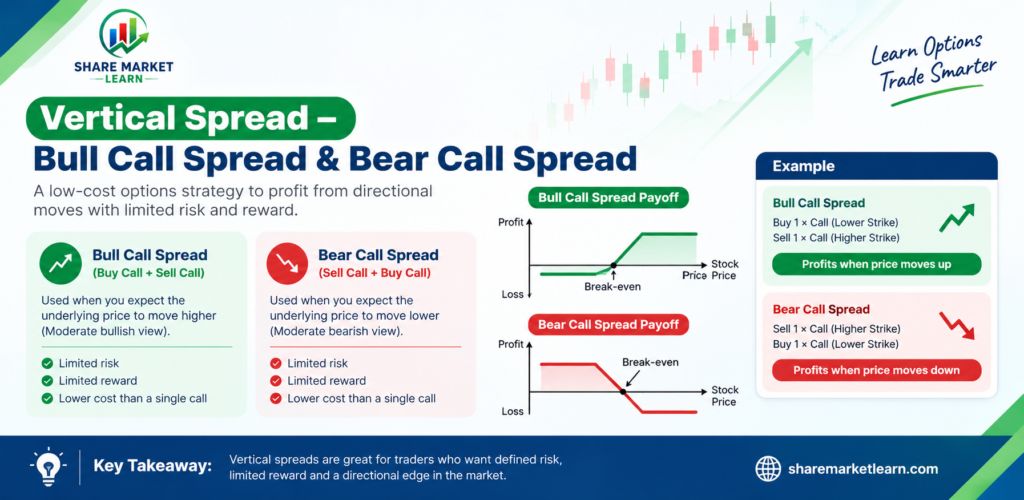
Options trading can look complicated when you first come across terms such as vertical spread, Bull Call Spread, and Bear Call Spread. However, once you understand the basic structure, these strategies become much easier to follow.
A vertical spread involves buying and selling two options of the same type and same expiry, but with different strike prices. Traders use vertical spreads to create a defined risk and defined reward structure.
Two commonly discussed vertical spread strategies are the Bull Call Spread and the Bear Call Spread.
The Bull Call Spread is generally used when a trader expects the underlying asset to move higher, while the Bear Call Spread is generally used when a trader expects the price to remain below a particular level or move lower.
In this article, we will understand vertical spreads, how Bull Call Spreads and Bear Call Spreads work, their profit and loss structure, examples, and important points beginners should know.
What Is a Vertical Spread?
A vertical spread is an options strategy involving two options with:
- The same underlying asset
- The same expiry date
- The same option type
- Different strike prices
The two options are combined into one strategy.
For example, a trader could use two call options:
- Buy 100 Call
- Sell 110 Call
Both options have the same expiry, but their strike prices are different.
The difference between the strike prices creates a defined range for the potential profit or loss.
Vertical spreads can be constructed using calls or puts and can be designed for bullish or bearish market views.
Why Do Traders Use Vertical Spreads?
One reason traders consider vertical spreads is that they can provide defined risk.
Instead of simply buying an option and being exposed to the option premium paid, a spread combines two option positions.
Depending on the strategy, the trader may:
- Pay a net premium
- Receive a net premium
- Have a predefined maximum profit
- Have a predefined maximum loss
This makes it important to calculate the risk and reward before entering the trade.
What Is a Bull Call Spread?
A Bull Call Spread is a bullish vertical spread using call options.
The basic structure is:
Buy a lower-strike Call + Sell a higher-strike Call
Both calls have the same expiry.
The trader generally pays a net premium to establish the position.
The strategy is typically used when the trader expects the underlying asset to rise, but the trader does not necessarily expect an unlimited upside move.
Bull Call Spread Example
Suppose a stock is trading around ₹100.
A trader creates the following spread:
- Buy ₹100 Call for ₹8
- Sell ₹110 Call for ₹3
Net premium paid:
₹8 − ₹3 = ₹5
Assuming the option contract multiplier is 1 for simplicity, the maximum loss is ₹5 per unit.
The difference between the strikes is:
₹110 − ₹100 = ₹10
Maximum profit:
₹10 − ₹5 = ₹5
So, in this simplified example:
- Maximum loss = ₹5
- Maximum profit = ₹5
- Break even = ₹105
Actual option contracts have lot sizes, so the rupee profit or loss would depend on the applicable contract quantity.
How Does a Bull Call Spread Make Money?
The Bull Call Spread benefits when the underlying price rises sufficiently.
At expiry:
If the stock is below ₹100
Both calls expire worthless.
The trader loses the net premium paid.
Maximum loss = ₹5
If the stock is between ₹100 and ₹110
The lower-strike call gains value while the higher-strike call may remain out of the money.
The spread can generate a partial profit depending on the final price.
If the stock is at or above ₹110
The spread reaches its maximum value.
The maximum profit is limited to the difference between the strikes minus the net premium paid.
Maximum profit = ₹5
This is why the Bull Call Spread has both limited risk and limited reward.
What Is a Bear Call Spread?
A Bear Call Spread is a bearish-to-neutral vertical spread that uses call options.
The basic structure is:
Sell a lower-strike Call + Buy a higher-strike Call
Both options have the same expiry.
The trader receives a net premium when establishing the position.
The strategy is generally used when the trader expects the underlying asset to stay below the lower strike or decline.
Bear Call Spread Example
Suppose a stock is trading around ₹100.
A trader creates:
- Sell ₹100 Call for ₹8
- Buy ₹110 Call for ₹3
Net premium received:
₹8 − ₹3 = ₹5
The difference between the strikes is ₹10.
Therefore:
- Maximum profit = ₹5
- Maximum loss = ₹5
- Break even = ₹105
Again, this is a simplified example assuming a contract multiplier of 1.
How Does a Bear Call Spread Make Money?
The Bear Call Spread generally benefits when the underlying price remains below the lower strike.
If the stock is below ₹100
Both calls expire worthless.
The trader keeps the net premium received.
Maximum profit = ₹5
If the stock is between ₹100 and ₹110
The short ₹100 call starts gaining intrinsic value against the trader.
The position may still be profitable, but the profit decreases as the underlying price rises.
If the stock is at or above ₹110
The spread reaches its maximum loss.
The difference between the strikes is ₹10, while the trader received ₹5 initially.
Therefore:
Maximum loss = ₹10 − ₹5 = ₹5
Bull Call Spread vs Bear Call Spread
The two strategies have opposite directional views.
| Feature | Bull Call Spread | Bear Call Spread |
|---|---|---|
| Market view | Bullish | Bearish to neutral |
| Lower strike | Buy Call | Sell Call |
| Higher strike | Sell Call | Buy Call |
| Initial cash flow | Net debit | Net credit |
| Maximum profit | Limited | Limited |
| Maximum loss | Limited | Limited |
| Same expiry | Yes | Yes |
| Same option type | Calls | Calls |
Understanding the construction is more important than simply memorizing the names.
Bull Call Spread vs Buying a Call
A trader buying a single call has the opportunity to benefit from a strong upward movement, but pays the entire option premium.
A Bull Call Spread reduces the initial cost by selling another call at a higher strike.
However, this also limits the maximum profit.
For example, if a trader buys a ₹100 Call and sells a ₹110 Call, gains above the higher strike are capped by the structure of the spread.
Therefore, a spread involves a trade-off:
Lower initial cost in exchange for limited upside.
Bear Call Spread vs Selling a Call
Selling a naked call can involve substantial risk if the underlying price rises significantly.
A Bear Call Spread adds a higher-strike long call to the position.
The purchased call helps limit the potential loss.
This creates a defined-risk structure.
However, the maximum profit is limited to the premium received.
Understanding Maximum Profit and Maximum Loss
Before entering any vertical spread, traders should calculate three important numbers:
1. Maximum Profit
This is the highest possible profit under the strategy’s defined expiry conditions.
2. Maximum Loss
This is the largest possible loss based on the spread structure.
3. Break even Point
The break-even is the underlying price at which the strategy reaches approximately zero profit or loss at expiry, before considering applicable transaction costs and other factors.
Knowing these numbers before entering a trade can help traders understand the potential outcome.
Advantages of Vertical Spreads
Vertical spreads can offer several structural benefits.
Defined Risk
The maximum loss can generally be calculated before entering the trade.
Defined Reward
The maximum potential profit can also be calculated in advance.
Lower Initial Cost
Some debit spreads can cost less than purchasing a single option outright.
Flexible Market Views
Different vertical spreads can be used for bullish, bearish, or neutral-to-directional views.
Structured Strategy
The trader knows which options are being bought and sold and how they interact.
Risks and Limitations
Vertical spreads are not risk-free.
Important considerations include:
Limited Profit
The maximum reward is capped.
Limited Risk Does Not Mean No Risk
A trader can still lose the entire net premium paid in a debit spread or experience the maximum defined loss in a credit spread.
Time Decay
Options lose time value as expiry approaches, although the effect depends on the complete position.
Volatility Changes
Changes in implied volatility can affect option prices and therefore the value of the spread before expiry.
Liquidity
Bid-ask spreads and liquidity can affect execution costs.
Expiry Risk
Options near expiry can behave differently as prices move around strike levels.
A Simple Way to Remember These Strategies
You can remember the two strategies like this:
Bull Call Spread
Buy lower Call → Sell higher Call → Bullish view
Bear Call Spread
Sell lower Call → Buy higher Call → Bearish-to-neutral view
The strike prices and premiums determine the exact profit, loss, and break-even calculations.
Final Thoughts
A vertical spread is an options strategy that combines two options of the same type and expiry but with different strike prices.
The Bull Call Spread generally suits a bullish market view. It involves buying a lower-strike call and selling a higher-strike call.
The Bear Call Spread generally suits a bearish-to-neutral view. It involves selling a lower-strike call and buying a higher-strike call.
Both strategies have defined profit and loss characteristics, making them useful concepts for options traders to understand.
However, options trading involves significant risk, and a strategy should not be used simply because its maximum loss is defined. Traders should understand the payoff structure, position sizing, liquidity, transaction costs, expiry behavior, and their own risk tolerance before trading.
The key is to understand why the strategy is being used, what market condition it is designed for, and what happens if the market moves differently from expectations.
Frequently Asked Questions (FAQs)
1. What is a vertical spread in options trading?
A vertical spread involves two options of the same type and expiry but with different strike prices. One option is bought and the other is sold.
2. What is a Bull Call Spread?
A Bull Call Spread involves buying a lower-strike call and selling a higher-strike call with the same expiry. It is generally used for a bullish market view.
3. What is a Bear Call Spread?
A Bear Call Spread involves selling a lower-strike call and buying a higher-strike call with the same expiry. It is generally used for a bearish-to-neutral market view.
4. Is the risk limited in a Bull Call Spread?
Yes, the maximum loss of a standard Bull Call Spread is generally limited to the net premium paid, excluding applicable transaction costs.
5. Is the risk limited in a Bear Call Spread?
Yes, the higher-strike long call limits the potential loss. The maximum loss is generally the strike-price difference minus the net premium received, excluding applicable costs.
6. Which is bullish: Bull Call Spread or Bear Call Spread?
A Bull Call Spread is the bullish strategy. A Bear Call Spread is generally used for a bearish-to-neutral market view.
7. Do vertical spreads have unlimited profit?
No. Standard vertical spreads have limited maximum profit because the two strike prices create a defined payoff range.
8. What is the main benefit of a vertical spread?
One key benefit is that the trader can define the maximum potential profit and maximum potential loss before entering the position, based on the spread structure.
9. Can beginners trade vertical spreads?
Beginners should first understand options, strike prices, premiums, expiry, intrinsic value, time value, risk management, and the complete payoff structure before using spreads with real money.