
Introduction
Candlestick patterns are among the most popular tools used in technical analysis to identify potential market reversals and trading opportunities. One such powerful bullish reversal pattern is the Three Outside Up Candle Pattern.
The Three Outside Up pattern helps traders recognize when a downtrend may be coming to an end and a new uptrend could begin. It provides confirmation that buyers are gaining strength and sellers are losing control of the market.
Whether you’re a beginner learning chart patterns or an experienced trader looking to refine your strategy, understanding the Three Outside Up pattern can improve your market analysis and decision-making.
In this article, you’ll learn what the Three Outside Up Candle Pattern is, how it forms, the psychology behind it, its advantages and limitations, and practical ways to trade it effectively.
What Is the Three Outside Up Candle Pattern?
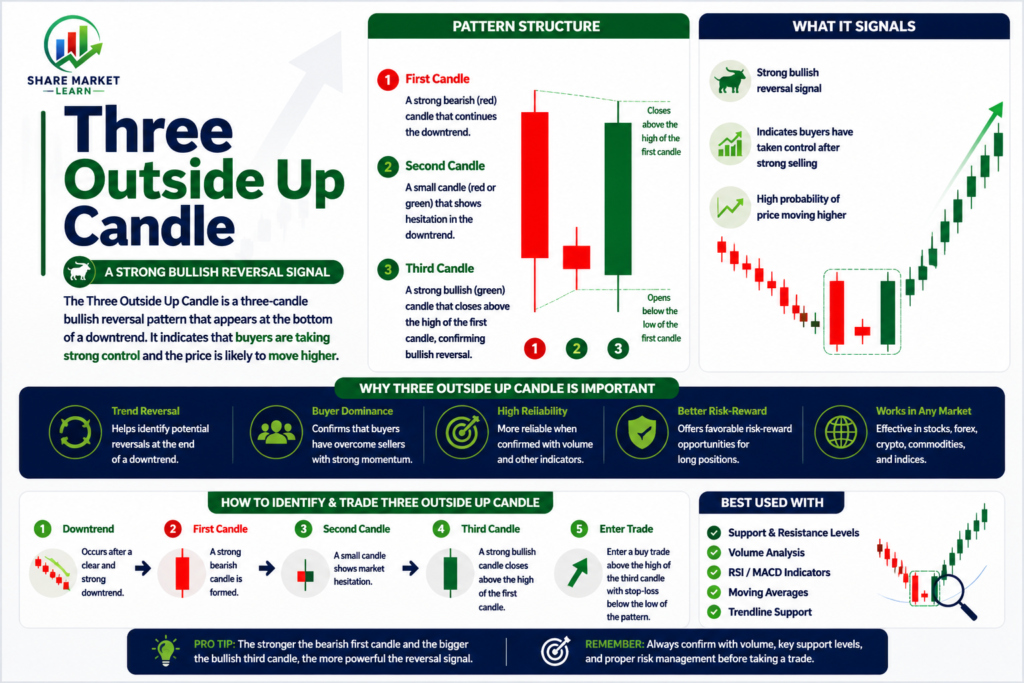
The Three Outside Up Candle Pattern is a three-candlestick bullish reversal pattern that typically appears after a downtrend. It signals a possible shift from bearish sentiment to bullish momentum.
The pattern consists of:
- A bearish first candle.
- A bullish second candle that completely engulfs the body of the first candle.
- A third bullish candle that closes above the second candle’s closing price.
The pattern builds upon the Bullish Engulfing Pattern by adding a third candle for confirmation, making it a more reliable reversal signal.
Structure of the Three Outside Up Pattern
To identify this pattern accurately, traders should understand its three-candle structure.
First Candle
- A bearish candle appearing during a downtrend.
- Reflects ongoing selling pressure.
Second Candle
- A bullish candle.
- Completely engulfs the body of the first bearish candle.
- Indicates that buyers are beginning to overpower sellers.
Third Candle
- Another bullish candle.
- Closes above the second candle’s close.
- Confirms the continuation of bullish momentum.
The third candle serves as confirmation that the reversal is likely genuine.
Psychology Behind the Three Outside Up Pattern
Understanding the psychology behind the pattern helps traders appreciate its significance.
During the first candle, sellers remain in control and continue driving prices lower.
However, during the second session, buyers step into the market aggressively. Their strength is sufficient to erase the previous candle’s losses and push prices higher.
By the third session, buying pressure continues. This additional confirmation suggests that bullish sentiment is strengthening and that a trend reversal may be underway.
The transition from fear and pessimism to confidence and optimism makes this pattern an effective bullish signal.
How to Identify the Three Outside Up Pattern
Follow these steps to recognize the pattern on a chart.
Step 1: Identify a Downtrend
The pattern should occur after a clear bearish move.
Step 2: Locate the First Bearish Candle
The first candle should support the existing downtrend.
Step 3: Find a Bullish Engulfing Candle
The second candle should completely engulf the first candle’s body.
Step 4: Confirm with the Third Candle
The third bullish candle should close above the second candle’s close.
Step 5: Assess Market Conditions
Check whether other technical factors support the bullish reversal.
Example of a Three Outside Up Pattern
Imagine a stock has been declining for several trading sessions.
- Day 1 closes with a bearish candle.
- Day 2 forms a bullish candle that completely engulfs Day 1’s body.
- Day 3 closes higher than Day 2, confirming buyer strength.
This sequence forms the Three Outside Up Pattern and suggests that a bullish reversal may occur.
Traders often view this setup as an opportunity to consider long positions.
Why Is the Three Outside Up Pattern Important?
The Three Outside Up Pattern is valued because it offers confirmation.
Many reversal patterns can generate false signals. However, the third candle in this pattern provides additional evidence that buyers are maintaining control.
This extra confirmation can help traders reduce emotional decisions and improve trade selection.
Because of its reliability, it is widely followed by technical analysts around the world.
Advantages of the Three Outside Up Pattern
Strong Confirmation
The third candle adds confidence to the reversal signal.
Easy to Identify
The three-candle structure is straightforward and beginner-friendly.
Works Across Multiple Markets
The pattern can be used in:
- Stocks
- Forex
- Commodities
- Cryptocurrencies
- Indices
Suitable for Different Time Frames
It can be applied to:
- Intraday trading
- Daily charts
- Weekly charts
- Swing trading strategies
Limitations of the Three Outside Up Pattern
Despite its strengths, the pattern has limitations.
False Signals Can Occur
No pattern guarantees a successful trade.
Confirmation May Delay Entry
Waiting for the third candle may reduce potential profits.
Broader Market Conditions Matter
The overall trend can affect the pattern’s reliability.
Requires Additional Analysis
Combining the pattern with other tools can improve accuracy.
Best Indicators to Use with the Three Outside Up Pattern
Technical indicators can strengthen the effectiveness of this pattern.
Relative Strength Index (RSI)
An oversold RSI reading may support the possibility of a reversal.
Support Levels
Patterns appearing near major support zones often have higher reliability.
Volume Analysis
Increasing volume during the pattern formation suggests strong buyer participation.
Moving Averages
A move above important moving averages can provide additional confirmation.
Trading Strategy Using the Three Outside Up Pattern
Entry Point
Many traders enter after the third candle closes.
Others wait for a small pullback before initiating a trade.
Stop Loss Placement
Place the stop loss below the low of the pattern or below a nearby support level.
Profit Targets
Profit targets can be based on:
- Previous resistance levels
- Risk-reward ratios such as 1:2 or 1:3
- Trend-following techniques
Risk Management
Never risk more than a small percentage of your trading capital on a single trade.
Consistent risk management is essential for long-term success.
Common Mistakes Traders Make
Ignoring the Prior Downtrend
The pattern is designed as a bullish reversal signal.
Trading Without Additional Confirmation
Using indicators can improve reliability.
Overlooking Volume
Volume often validates the strength of the reversal.
Skipping Stop Losses
Protecting capital should always remain a priority.
Tips for Beginners
- Practice identifying the pattern using historical charts.
- Combine it with support and resistance analysis.
- Use RSI and volume for confirmation.
- Develop a trading plan before entering positions.
- Focus on disciplined risk management.
- Avoid emotional decision-making.
Three Outside Up vs Bullish Engulfing Pattern
Although they are related, these patterns differ.
Three Outside Up Pattern
- Consists of three candles.
- Includes confirmation through the third candle.
- Generally considered more reliable.
Bullish Engulfing Pattern
- Consists of two candles.
- The second candle engulfs the first.
- Offers an earlier but less confirmed signal.
Understanding the differences can help traders choose the setup that best matches their trading style.
Conclusion
The Three Outside Up Candle Pattern is one of the most dependable bullish reversal patterns in technical analysis. By combining the strength of a Bullish Engulfing Pattern with a confirming third candle, it provides traders with additional confidence that market sentiment is shifting in favor of buyers.
However, even strong patterns should not be used in isolation. Combining the Three Outside Up Pattern with support levels, RSI, volume analysis, moving averages, and sound risk management can significantly improve trading decisions.
By learning to recognize and apply this pattern correctly, traders can enhance their ability to identify potential trend reversals and make more informed decisions in the financial markets.