
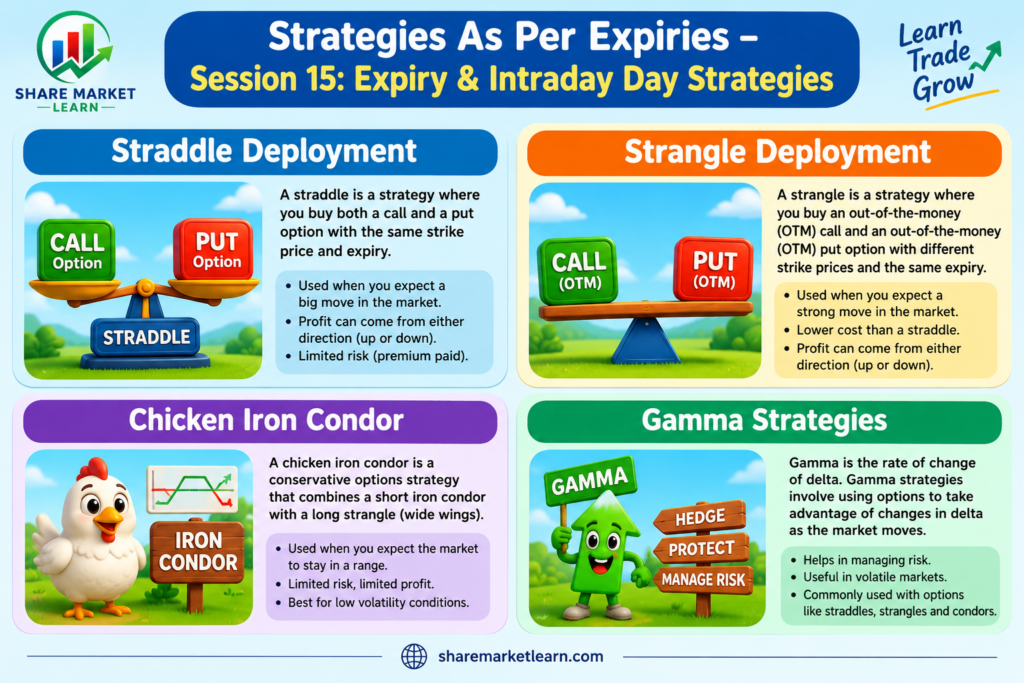
Expiry day is one of the most active periods in the options market. Prices can move quickly, implied volatility can change sharply, and option premiums may decay faster as the contract approaches expiry. Because of this, traders often use specific expiry and intraday options strategies rather than applying the same approach used on ordinary trading days.
In this Session 15, we will understand four commonly discussed strategies: Straddle Deployment, Strangle Deployment, Chicken Iron Condor, and Gamma Strategies. The goal is to understand how these strategies work, when traders typically consider them, and what risks they carry.
Important: Options trading involves substantial risk. The examples below are educational and simplified. Actual results depend on market movement, volatility, liquidity, brokerage, taxes, and execution.
What Makes Expiry Day Different?
On expiry day, the time remaining for an option contract becomes very small. This causes time decay (theta) to accelerate, while the option’s sensitivity to price movement, particularly near the strike, can become significant.
Another important factor is gamma. Gamma measures how quickly an option’s delta changes when the underlying price moves. Near expiry, at-the-money options can have particularly high gamma.
This combination can create a market environment where a relatively small movement in the underlying can have a large impact on option prices.
For this reason, expiry strategies should be planned carefully rather than traded simply because it is expiry day.
1. Straddle Deployment
A straddle involves using the same strike price for both a call and a put.
Long Straddle
A long straddle generally consists of:
- Buying one Call option
- Buying one Put option
- Using the same strike price
- Using the same expiry
For example, suppose an index is trading around 25,000. A trader could consider buying:
- 25,000 Call
- 25,000 Put
The trader is expecting a sufficiently large move in either direction.
When Is a Long Straddle Considered?
A trader may consider a long straddle when expecting significant volatility but being uncertain about the direction.
For example:
Large upward move → Call can gain value
Large downward move → Put can gain value
However, if the underlying remains close to the strike, both options can lose value because the trader has paid premiums for both.
Short Straddle
A short straddle is the opposite approach:
- Sell one Call
- Sell one Put
- Same strike
- Same expiry
The strategy generally benefits when the underlying remains within a relatively narrow range.
However, short straddles can carry very high risk, particularly if the market makes a strong move. Traders should understand margin requirements and risk management before considering such positions.
2. Strangle Deployment
A strangle is similar to a straddle, but the call and put use different strike prices.
A typical long strangle consists of:
- Buying an out-of-the-money Call
- Buying an out-of-the-money Put
- Same expiry
For example, if an index is trading around 25,000, a trader might use:
- 25,100 Call
- 24,900 Put
The exact strikes depend on the underlying, volatility, liquidity, and trading plan.
Long Strangle
A long strangle is generally used when a trader expects a substantial move but does not know the direction.
One advantage compared with a long straddle is that the premiums can be lower because the options are further away from the current price.
However, the underlying generally needs to make a larger move before the position becomes profitable after considering the premiums paid.
Short Strangle
A short strangle involves:
- Selling an out-of-the-money Call
- Selling an out-of-the-money Put
The strategy generally benefits when the underlying remains between the selected strikes.
The major concern is risk. A strong move beyond either side can produce significant losses, particularly without appropriate risk controls.
3. Chicken Iron Condor
The Iron Condor is a defined-risk options strategy that combines a bull put spread and a bear call spread.
A simplified structure contains four options:
- Buy a lower-strike Put
- Sell a higher-strike Put
- Sell a lower-strike Call
- Buy a higher-strike Call
The two purchased options provide protection against large moves.
Why Is It Called “Chicken” Iron Condor?
The term Chicken Iron Condor is an informal trading expression rather than a universally standardized options strategy. Traders may use the term for a more conservative or defensive variation of an iron condor, depending on the particular trading methodology.
The basic idea is to create a defined-risk position around an expected trading range.
Example
Suppose an index is trading near 25,000. A trader expecting relatively limited movement might construct an iron condor with:
- Put spread below the market
- Call spread above the market
If the underlying stays within the central range at expiry, the strategy may retain much of its potential profit.
The important point is that defined risk does not mean no risk. The maximum loss is limited by the spread structure, but it can still be meaningful relative to the capital allocated.
4. Gamma Strategies
Gamma becomes particularly important during expiry.
Gamma measures the rate at which an option’s delta changes when the underlying price changes.
Consider an at-the-money option close to expiry. A relatively small movement in the underlying can cause its delta to change rapidly.
Long Gamma
Buying options generally creates positive gamma.
For example, a long straddle can provide exposure to positive gamma. If the underlying moves strongly, the position’s delta can change rapidly.
This is one reason traders sometimes use long options around expected high-volatility events.
However, long gamma positions generally involve paying option premium, and if the expected movement does not occur, time decay can work against the position.
Short Gamma
Selling options generally creates negative gamma.
Short option strategies can benefit from time decay when the market behaves as expected, but sudden movements can cause losses to increase quickly.
This makes risk management especially important on expiry day.
Expiry-Day Strategy Selection
There is no single strategy that works in every expiry market. Traders generally consider factors such as:
Market Direction
Is the market showing a strong directional trend or staying range-bound?
Implied Volatility
Are option premiums relatively expensive or inexpensive compared with the trader’s expectations of future movement?
Time Remaining
On expiry day, there is very little time for a position to recover from an adverse movement.
Support and Resistance
Important price levels can influence where traders choose strikes and risk limits.
Position Size
A strategy should be sized according to the trader’s risk tolerance and available capital rather than simply the maximum margin requirement.
Straddle vs Strangle vs Iron Condor
| Strategy | Basic View | Risk Characteristics |
|---|---|---|
| Long Straddle | Expect large movement, direction uncertain | Premium paid can be lost |
| Short Straddle | Expect limited movement | Potentially very high risk |
| Long Strangle | Expect large movement | Premium paid can be lost |
| Short Strangle | Expect range-bound market | Significant risk on strong moves |
| Iron Condor | Expect price to remain in a range | Defined maximum risk |
This table is a simplified comparison. Actual payoff and risk depend on strike selection, premiums, expiry, and adjustments.
Risk Management on Expiry Day
Expiry trading can move very quickly, so risk management should be part of the strategy itself.
Consider:
- Defining maximum acceptable loss before entering.
- Avoiding over sized positions.
- Understanding the complete payoff structure.
- Checking liquidity and bid-ask spreads.
- Using predetermined exit rules.
- Avoiding impulsive averaging of losing option positions.
- Understanding the effect of sudden volatility changes.
- Considering brokerage, taxes, and other transaction costs.
Most importantly, traders should not assume that an option becoming cheaper automatically makes it a good opportunity.
FAQs
1. What is an expiry-day strategy?
An expiry-day strategy is an options trading approach specifically designed around the characteristics of an option contract approaching expiry, including rapid time decay and changing gamma exposure.
2. What is a straddle in options trading?
A straddle generally involves buying or selling a call and put with the same strike price and expiry. A long straddle is commonly used when expecting a significant move without having a strong directional view.
3. What is the difference between a straddle and a strangle?
A straddle uses the same strike for the call and put, while a strangle uses different strikes. Strangles can have lower upfront premiums but generally require a larger price movement to become profitable.
4. Is an iron condor suitable for expiry trading?
An iron condor can be used when a trader expects the underlying to remain within a defined range. Its four-leg structure can provide defined maximum risk, but the position still carries the possibility of loss.
5. Why is gamma important on expiry day?
Gamma describes how quickly an option’s delta changes when the underlying moves. Near expiry, gamma can become particularly important, meaning small underlying-price movements can have a significant effect on an option position.
6. Is expiry-day options trading risky?
Yes. Expiry-day options can experience rapid price changes, widening spreads, and significant sensitivity to underlying movements. Traders should understand the strategy and its maximum potential loss before entering a position.
Conclusion
Expiry and intraday options trading require a clear understanding of time decay, volatility, gamma, strike selection, and risk management. Straddles and strangles can be used to express views about volatility and movement, while iron condors can provide a defined-risk structure for range-based expectations. Gamma strategies focus more closely on how quickly an option’s sensitivity changes as the underlying moves.
The key is not simply choosing a strategy but understanding why the strategy is being used, what market condition it assumes, and what can happen if that assumption is wrong.
With proper education, position sizing, and disciplined risk management, traders can better understand the mechanics of expiry-day strategies. However, no options strategy guarantees profits, and every position should be evaluated according to its potential risk as well as its potential reward.