
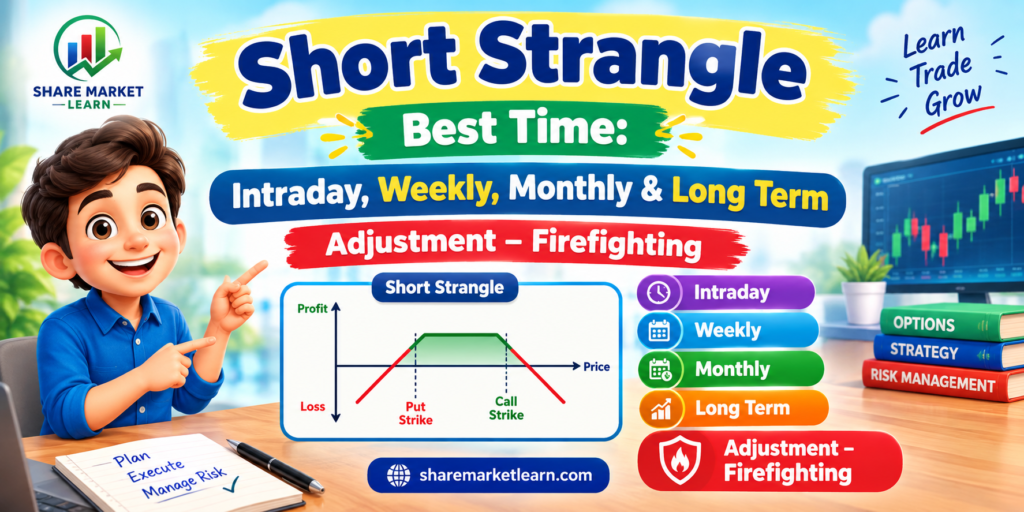
Options trading can look complicated at first, especially when traders come across strategies with names such as Short Strangle, Iron Condor, Straddle, and Spreads. But once you understand the basic structure, these strategies become much easier to study.
A Short Strangle is an options strategy designed around the expectation that the underlying asset will remain within a particular range. It involves selling an out-of-the-money Call and an out-of-the-money Put with the same expiry.
The strategy can generate a premium when the options expire worthless or lose enough value. However, because the options are sold, the strategy can carry significant risk if the underlying price makes a large move.
This is why adjustment is an important part of studying a Short Strangle.
In this article, we’ll explain the Short Strangle in simple language, discuss its possible use in intraday, weekly, monthly, and longer-term trading, and introduce the concept of “firefighting” adjustments.
Educational note: Options selling involves substantial risk and is not suitable for every trader. The examples below are hypothetical and are intended for educational purposes, not as trading recommendations.
What Is a Short Strangle?
A Short Strangle generally consists of:
- Selling an out-of-the-money Call
- Selling an out-of-the-money Put
- Using the same expiry
Suppose an index is trading at 22,000.
A hypothetical Short Strangle could involve:
- Sell 22,500 Call
- Sell 21,500 Put
The trader receives premiums from both options.
The basic expectation is that the underlying price will remain between the two short strikes, subject to the premiums received and the position’s risk profile.
Simple Example
Imagine:
- Index = 22,000
- 22,500 Call premium = ₹80
- 21,500 Put premium = ₹70
Total premium received:
₹80 + ₹70 = ₹150
Ignoring transaction costs and other factors, the position has a combined premium of ₹150.
The approximate break even levels at expiry would be:
Upper break even: 22,500 + ₹150 = 22,650
Lower break even: 21,500 − ₹150 = 21,350
This is only a simplified example. Actual option pricing, margin requirements, volatility, and transaction costs can significantly affect the trade.
How Does a Short Strangle Make Money?
A Short Strangle generally benefits when:
- The underlying remains within the expected range.
- Time passes and option time value decreases.
- Implied volatility decreases, all else being equal.
The strategy is therefore often associated with time decay and range-bound market expectations.
However, the trader should remember that time decay does not mean the position is automatically safe.
A large market move can create substantial losses.
What Is the Risk of a Short Strangle?
The biggest concern with an uncovered Short Strangle is the possibility of a large move.
The short Call has theoretically unlimited loss potential as the underlying price rises, while the short Put can experience very large losses if the underlying falls sharply.
This makes risk management extremely important.
Before entering a Short Strangle, a trader should understand:
- Maximum theoretical risk
- Margin requirements
- Position size
- Volatility
- Expiry
- Liquidity
- Adjustment rules
- Exit conditions
Best Time for a Short Strangle
There is no universally “best” time frame for a Short Strangle.
Different time frames have different characteristics, risks, and management requirements.
Let’s look at them separately.
Short Strangle for Intraday Trading
An intraday Short Strangle is opened and closed during the same trading session.
The potential attraction is that traders can avoid overnight exposure.
However, intraday markets can experience sudden movements because of:
- Economic announcements
- News events
- Global market moves
- Large institutional orders
- Unexpected volatility
An intraday position also has limited time for premium decay to work.
What Should Traders Watch?
For intraday strategies, traders may monitor:
- Opening range
- Support and resistance
- Volume
- Volatility
- Option premiums
- Market trend
- Major scheduled events
Intraday option selling requires close monitoring because the underlying can move quickly.
Short Strangle for Weekly Expiry
Weekly options can provide relatively rapid time decay, particularly as expiry approaches.
This is one reason weekly options are commonly studied by traders interested in short-duration premium strategies.
However, there is another side.
As expiry approaches, gamma risk can become significant. A relatively small move in the underlying can cause a large change in the option’s sensitivity to price.
Therefore:
Faster time decay does not automatically mean lower risk.
A weekly Short Strangle may require frequent monitoring and clearly defined adjustment rules.
Short Strangle for Monthly Expiry
A monthly Short Strangle gives the trade more time before expiry.
This can provide more room for the underlying to move within the expected range.
The trade may also be managed over several weeks rather than several days.
However, because the position remains open longer, it can be exposed to more events and market changes.
For example:
- Interest-rate decisions
- Economic data
- Corporate events
- Global market shocks
- Political or geopolitical developments
Therefore, traders need to consider the event calendar as well as the option structure.
Short Strangle for Long-Term Positions
A long-term Short Strangle requires particularly careful risk management.
Markets can experience major trends over longer periods, and an initially range-bound market can eventually develop a strong directional move.
Long-term options positions can also be affected by changing volatility and major market events.
For many traders, long-term option strategies require a clearly defined risk framework rather than simply waiting for the premium to decay.
What Is “Firefighting” in Options Trading?
Firefighting is an informal term used by some traders to describe making adjustments when an options position comes under pressure.
Imagine you have a Short Strangle.
The market suddenly moves strongly upward toward your short Call.
The original position is now becoming uncomfortable.
The trader may use an adjustment to manage the increasing risk.
This is often called “firefighting.”
The important thing is that firefighting should not mean randomly changing the position.
It should be based on predefined rules.
Why Does a Short Strangle Need Adjustment?
Suppose:
- Index = 22,000
- Short Call = 22,500
- Short Put = 21,500
Now imagine the index moves rapidly to 22,450.
The Call option may increase significantly in value.
At this point, the position’s risk has changed.
A trader may need to ask:
- Has the original market view changed?
- Has the adjustment level been reached?
- Should the position be reduced?
- Should one side be moved?
- Should a hedge be added?
- Should the entire trade be closed?
There is no single adjustment that is correct for every strategy.
Common Types of Short Strangle Adjustments
1. Move the Threatened Side
If the market moves strongly toward the short Call, a trader may consider changing the Call side according to a predefined adjustment method.
This can alter the position’s range and risk.
2. Reduce Position Size
Sometimes the simplest adjustment is to reduce exposure.
For example, instead of continuing with 10 lots, a trader may reduce the position.
Lower exposure can reduce the impact of further market movement.
3. Add a Hedge
A trader may use a purchased option to limit part of the risk.
This can transform the original structure into a defined-risk position, depending on how the hedge is implemented.
The cost of the hedge must be considered.
4. Exit the Position
An exit is also an adjustment.
If the market has moved far beyond the original assumption, continuing to adjust may create unnecessary complexity.
A predefined maximum-loss or invalidation point can help prevent endless firefighting.
A Simple Firefighting Framework
Instead of adjusting randomly, consider creating three zones.
Zone 1: Comfortable
The underlying remains comfortably between the short strikes.
Action: Monitor the position.
Zone 2: Warning
The underlying approaches a predefined adjustment level.
Action: Recalculate risk and evaluate the planned adjustment.
Zone 3: Emergency
The underlying makes a strong move beyond the strategy’s acceptable range.
Action: Follow the predefined risk-reduction or exit plan.
This framework helps prevent emotional decision-making.
Example of Firefighting
Let’s use a simplified hypothetical example.
Nifty = 22,000
Short Strangle:
- Sell 22,500 Call
- Sell 21,500 Put
Suppose the market moves to 22,400.
The Call side is now under pressure.
The trader’s predefined rules might say:
Warning Level: 22,350
Adjustment Level: 22,450
Maximum Risk Level: 22,650
If 22,350 is reached, the trader begins monitoring the position more closely.
If 22,450 is reached, the predefined adjustment is implemented.
If the market continues rapidly toward 22,650, the trader follows the maximum-risk rule.
The exact numbers in a real strategy should come from the trader’s tested system and risk tolerance—not from this example.
Why Historical Testing Matters
Firefighting strategies can look excellent when viewed on a few selected charts.
But the real question is:
How did the strategy behave across many different market conditions?
Historical testing can help answer this.
A trader can examine:
- Trending markets
- Sideways markets
- High-volatility periods
- Low-volatility periods
- Gap-up sessions
- Gap-down sessions
- Expiry days
- Major event days
For each situation, record:
- Entry
- Short strikes
- Premium received
- Adjustment point
- Adjustment used
- Maximum draw down
- Exit
- Final P&L
This creates a practical database for evaluating the strategy.
Short Strangle and Volatility
Volatility is an important part of options pricing.
When implied volatility is high, option premiums can be relatively expensive, all else being equal.
When volatility decreases, option premiums may decline.
A Short Strangle can potentially benefit from a decrease in implied volatility.
But high implied volatility often exists for a reason: the market may be expecting a significant event or larger-than-normal movement.
Therefore:
High premium does not automatically mean low risk.
Common Mistakes in Short Strangle Trading
Selling Too Close to the Market
Choosing strikes very close to the current price may increase premium received but can also increase the probability of the options becoming threatened.
Ignoring Risk
Premium received should never be confused with maximum safety.
Over-Adjusting
Too many adjustments can increase transaction costs and complexity.
Increasing Quantity After a Loss
Increasing position size to recover losses can dramatically increase risk.
No Exit Plan
A Short Strangle without a clear risk-management plan can become difficult to control during a sharp market move.
Depending Only on Expiry
Waiting for expiry simply because “time decay will help” can be dangerous when the underlying is moving strongly.
Intraday vs Weekly vs Monthly vs Long Term
The characteristics can be summarized like this:
| Time frame | Main Feature | Key Risk to Study |
|---|---|---|
| Intraday | Short holding period | Fast price movement |
| Weekly | Faster time decay | Expiry/gamma risk |
| Monthly | More time for management | Event and trend risk |
| Long Term | Longer exposure | Large market trends and events |
This table is a learning framework rather than a recommendation of one time frame over another.
Final Thoughts
A Short Strangle is a strategy that combines a short Call and a short Put and generally benefits when the underlying remains within a certain range and option value declines.
But the strategy also carries significant risk, especially during strong market movements.
The concept of firefighting focuses on what happens when the original position comes under pressure.
The most important lesson is that adjustment should be planned before the trade is entered.
Know your:
- Entry
- Position size
- Adjustment level
- Maximum risk
- Hedge rules
- Exit condition
And most importantly, test the rules using historical data before applying them with real money.
A good adjustment plan is not about predicting every market move. It is about knowing what you will do when the market does something you did not expect.
Frequently Asked Questions
1. What is a Short Strangle?
A Short Strangle involves selling an out-of-the-money Call and an out-of-the-money Put with the same expiry.
2. Is a Short Strangle profitable in every market?
No. Its performance depends on factors such as the underling’s price movement, volatility, time decay, premiums, and position management.
3. What is firefighting in options?
Firefighting is an informal term for making risk-management adjustments when an options position moves into a predefined danger or adjustment zone.
4. Is a Short Strangle suitable for beginners?
It can be complex and carries significant risk. Beginners should understand option pricing, margin, volatility, and risk management before considering such strategies.
5. Which is better for a Short Strangle: weekly or monthly expiry?
There is no universally best expiry. Weekly and monthly positions have different time-decay, volatility, event, and management characteristics.
6. Should I always adjust a losing Short Strangle?
No. Adjustment is not automatically better than exiting. The appropriate action depends on the predefined trading plan and risk limits.
7. Can historical data guarantee a successful adjustment strategy?
No. Back testing can help evaluate how rules behaved historically, but past results do not guarantee future performance.
8. What is the biggest risk in a Short Strangle?
A strong move in the underlying can create substantial losses, particularly when the position is not protected by a defined-risk hedge.