
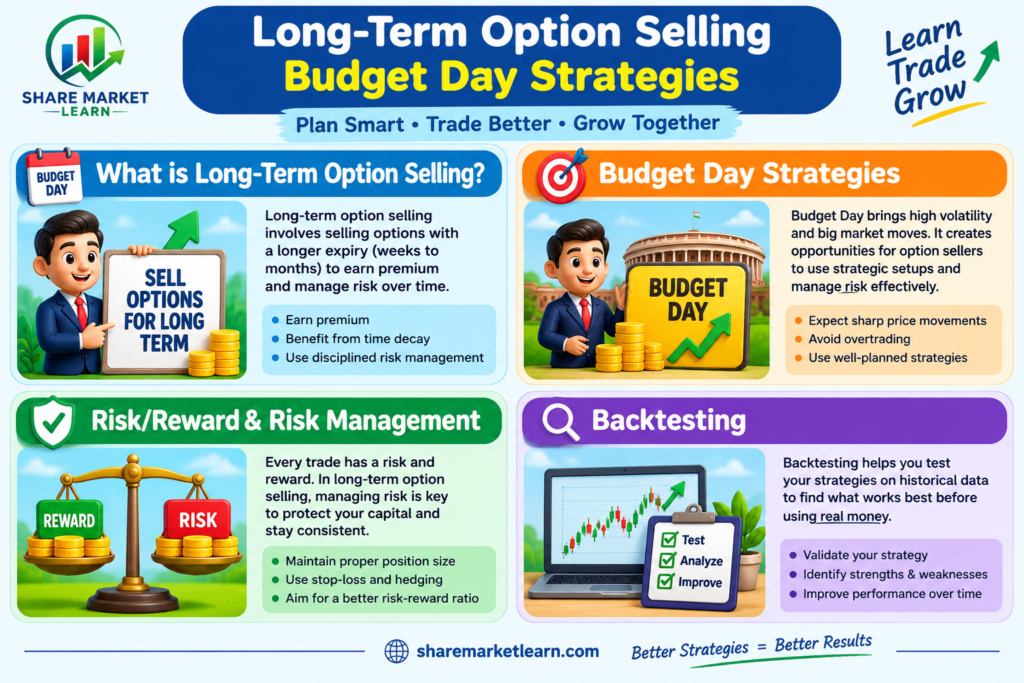
Options trading is often associated with quick trades and intraday activity. However, some traders also use options over longer periods with carefully planned positions, defined risk, and systematic monitoring. Long-term option selling is one such approach, where traders sell option premium while attempting to benefit from time decay.
For beginners, the important point is that option selling is not simply about collecting premium. A seller can face substantial losses when the underlying asset makes an unexpected or large move. Therefore, risk management, position sizing, risk-reward analysis, and back testing are important parts of any option-selling approach.
This article explains long-term option selling in simple language and covers budget-day strategies, strategies for working people, risk/reward, risk management, and back testing.
What Is Long-Term Option Selling?
Long-term option selling means maintaining option-selling positions for a longer period rather than opening and closing them within the same trading session.
An option seller receives a premium when selling an option. If the option expires with little or no intrinsic value, the seller may retain some or all of the premium, before transaction costs.
For example, suppose a trader sells an option for a premium of ₹100. If the option’s value later falls to ₹40, the trader could potentially buy it back at ₹40, creating a ₹60 gross difference.
However, the opposite can also happen. If the option value rises significantly, the seller may have to buy it back at a much higher price, resulting in a loss.
Therefore, premium collection should never be viewed as guaranteed income.
Why Do Traders Consider Long-Term Option Selling?
One reason traders study option selling is time decay, commonly represented by theta.
As an option approaches expiry, its time value generally declines, all else being equal. Option sellers may attempt to benefit from this decline.
Longer-duration positions may also reduce the need to monitor the market every minute. However, this does not mean they are risk-free or completely passive.
A long-term position still requires monitoring for:
- Large market movements
- Changes in volatility
- Margin requirements
- Corporate or economic events
- Position concentration
- Changes in the original trading thesis
Budget Day Strategies
Not every trader has a large amount of capital available. A budget-oriented strategy therefore focuses on controlling position size and limiting potential losses rather than simply selling more contracts.
1. Defined-Risk Option Strategies
Strategies such as credit spreads can provide a defined maximum loss.
A credit spread generally involves selling one option and buying another option at a different strike. The purchased option provides protection against an adverse move.
This structure can make the maximum risk easier to calculate before entering the trade.
2. Avoid Over sized Positions
A common mistake is using the entire available capital for option selling.
Instead, traders can determine how much capital they are willing to risk and select a position size accordingly.
The objective should be capital preservation first and return generation second.
3. Consider Liquidity
Budget strategies should not ignore liquidity. An option with a low premium may look attractive, but a wide bid-ask spread can make execution difficult.
Before entering a position, traders should examine:
- Trading volume
- Open interest
- Bid-ask spread
- Available strikes
- Contract specifications
Strategies for Working People
Working professionals may not have time to watch the market continuously.
For such traders, a strategy should focus on simplicity and predefined rules.
Weekly or Monthly Monitoring
Instead of continuously adjusting positions, a trader can establish predetermined checkpoints.
For example:
- Review the position at a fixed time.
- Check whether the underlying has moved beyond a predefined level.
- Review the remaining time to expiry.
- Check whether volatility has changed significantly.
- Decide in advance when the position should be closed or adjusted.
The exact frequency depends on the strategy and market.
Use Predefined Exit Rules
Working people can find it difficult to react quickly during sudden market movements.
A predefined exit plan can therefore be useful.
Before entering a trade, determine:
Entry → Maximum acceptable loss → Adjustment condition → Exit condition
This reduces dependence on emotional decisions during market volatility.
Understanding Risk and Reward
Risk/reward analysis is essential for option selling.
Suppose a trader receives ₹20 premium but potentially faces ₹80 of risk. The strategy may have a high probability of small gains while exposing the trader to occasional larger losses.
This is why looking only at the winning percentage can be misleading.
A strategy should be evaluated using several factors:
- Average profit
- Average loss
- Maximum loss
- Maximum draw-down
- Winning percentage
- Losing percentage
- Risk per trade
- Transaction costs
Expected Value
A simplified expected-value calculation can be written as:
Expected Value = (Probability of Win × Average Win) − (Probability of Loss × Average Loss)
This is not a guarantee of future results, but it provides a useful framework for evaluating a strategy.
Risk Management in Option Selling
Risk management is one of the most important parts of long-term option selling.
1. Define Maximum Loss
Know the potential loss before entering the position.
Defined-risk strategies can make this calculation easier.
2. Control Position Size
Avoid allowing one trade to have an outsizes effect on the overall portfolio.
3. Maintain Adequate Margin
Option-selling positions can require substantial margin. Traders should also consider the possibility of increased margin requirements and adverse price movements.
4. Diversification
Concentrating multiple positions around the same underlying or highly correlated assets can increase overall exposure.
Diversification should therefore consider correlation, not simply the number of trades.
5. Avoid Revenge Trading
If a position produces a loss, immediately increasing the position to recover the money can increase risk.
A systematic approach should follow predefined rules rather than emotional reactions.
What Is Back testing?
Back testing means testing a trading strategy against historical market data to see how the rules would have performed in the past.
For example, a trader could create rules such as:
- Sell an option at a particular distance from the underlying price.
- Enter at a specific time.
- Exit at a predefined profit.
- Exit when a maximum loss is reached.
- Hold until a certain number of days before expiry.
These rules can then be tested using historical data.
Why Is Back testing Important?
Back testing can help traders understand the behavior of a strategy before risking real money.
It may reveal:
- Historical winning percentage
- Average profit and loss
- Maximum draw-down
- Losing streaks
- Performance across different market conditions
- Effect of different stop-loss rules
However, back-testing has limitations.
A strategy that performed well historically may not perform similarly in the future.
Historical results can also be affected by assumptions about execution, slippage, liquidity, brokerage costs, taxes, and available historical option data.
Paper Trading Before Live Trading
After back-testing, traders can consider paper trading or simulated trading.
This provides an opportunity to observe whether the strategy’s rules can actually be followed in real-time market conditions.
Paper trading can also reveal practical issues that may not appear in a historical back test.
Common Mistakes in Long-Term Option Selling
Selling Options Without a Risk Plan
Collecting premium without knowing the maximum potential loss can expose traders to unnecessary risk.
Using Too Much Leverage
A small amount of capital can sometimes control a much larger notional exposure through derivatives. This can magnify losses.
Ignoring Volatility
Option premiums are influenced by implied volatility. Changes in volatility can affect positions even when the underlying has not moved significantly.
Focusing Only on Win Rate
A strategy with many small winning trades can still lose money if occasional losses are substantially larger.
Not Testing Different Market Conditions
A strategy should ideally be evaluated across rising, falling, sideways, and highly volatile periods.
FAQs
1. Is long-term option selling suitable for beginners?
Option selling involves significant risks and requires an understanding of options, margin, volatility, and risk management. Beginners should first learn the mechanics and practice with simulations before considering real-money trading.
2. Can option selling provide regular income?
Option selling can generate premium income, but the amount and consistency are not guaranteed. Losses can occur when market conditions move against the position.
3. What is a budget option-selling strategy?
A budget strategy generally focuses on using controlled position sizes and, where appropriate, defined-risk structures rather than taking large uncovered positions.
4. What is the benefit of back-testing?
Back testing helps traders evaluate how a set of predefined rules would have behaved using historical data. It can highlight potential draw downs, losing periods, and weaknesses in the strategy.
5. What is more important: risk or reward?
Both matter, but understanding and controlling potential risk is essential before focusing on potential returns. A strategy should be evaluated based on its complete risk/reward profile.
6. Can working professionals trade options?
Working professionals can study systematic approaches that do not require constant screen monitoring. However, they still need a clear plan for entries, exits, risk limits, and unexpected market movements.
Conclusion
Long-term option selling can be studied as a systematic approach rather than simply a method of collecting option premiums. Budget-day strategies can focus on controlled exposure, while working professionals may prefer clearly defined rules that reduce the need for constant monitoring.
The most important concepts are risk/reward, position sizing, risk management, and back testing. A strategy should be evaluated not only by how often it wins but also by the size of its losses, draw downs, transaction costs, and performance under different market conditions.
Before using real capital, traders should understand the complete payoff structure, test their rules using appropriate historical data, and consider paper trading. Options involve substantial risk, and past performance from a back test does not guarantee future results.