
If you are learning options trading, you may have heard the term Iron Condor. It sounds complicated at first, but the basic idea is quite simple.
An Iron Condor is an options trading strategy designed for a market that is expected to remain within a particular price range. Traders use four options contracts to create the strategy and aim to benefit when the underlying asset stays between two selected price levels.
In this article, we will understand what an Iron Condor is, how it works, how to construct one, its potential profit and loss, and the important risks beginners should know.
Note: Options trading involves substantial risk. This article is for educational purposes and should not be considered financial advice.
What Is an Iron Condor?
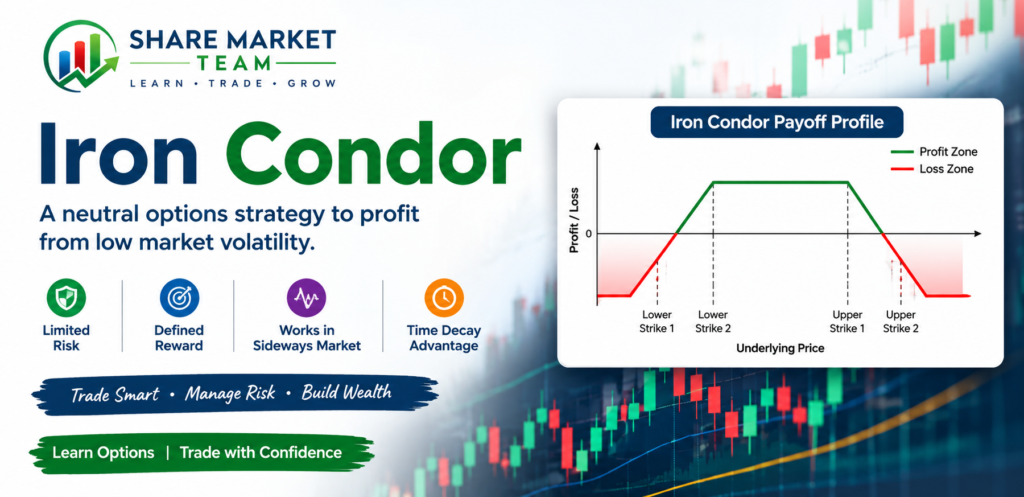
An Iron Condor is a four-leg options strategy that combines a bull put spread and a bear call spread.
It generally involves:
- Buying one lower-strike Put
- Selling one higher-strike Put
- Selling one lower-strike Call
- Buying one higher-strike Call
All four options usually have the same expiry date.
The strategy is generally used when a trader expects the underlying asset to remain within a specific range until expiry.
For example, suppose a stock is trading at ₹1,000. A trader may expect it to remain between ₹950 and ₹1,050.
The trader could construct an Iron Condor using strikes around this expected range.
The exact strikes, premiums, expiry, lot size, and transaction costs determine the actual risk and reward.
How Does an Iron Condor Work?
An Iron Condor has two important sides:
Put Side
The trader:
- Buys a lower-strike Put
- Sells a higher-strike Put
This creates a bull put spread.
Call Side
The trader:
- Sells a lower-strike Call
- Buys a higher-strike Call
This creates a bear call spread.
The two spreads are combined into one position.
The trader receives a net premium when the position is opened if the premiums received from the short options are greater than the premiums paid for the long options.
The goal is generally for the underlying price to stay between the two short strikes at expiry.
Simple Iron Condor Example
Let’s take a simplified example.
Assume a stock is trading at ₹1,000.
A trader expects the stock to remain between ₹950 and ₹1,050.
An example Iron Condor could be:
- Buy ₹900 Put
- Sell ₹950 Put
- Sell ₹1,050 Call
- Buy ₹1,100 Call
Suppose the trader receives a net premium of ₹20 per share.
If the stock remains between ₹950 and ₹1,050 at expiry, all the short options may expire worthless, depending on the exact settlement price, and the trader can potentially keep the ₹20 premium, before costs.
This is a simplified example. Actual option premiums and outcomes will vary based on volatility, time to expiry, liquidity, and market conditions.
Maximum Profit in an Iron Condor
The maximum profit is generally limited to the net premium received when entering the trade.
Using our simplified example:
- Net premium received = ₹20
- Maximum profit = ₹20 per share
If the lot size were 100 shares, the theoretical maximum profit would be:
₹20 × 100 = ₹2,000
Brokerage, taxes, exchange charges, and other costs would reduce the actual result.
Maximum Loss in an Iron Condor
Unlike the maximum profit, the maximum loss can be considerably larger than the premium received.
The maximum loss on either side is generally calculated as:
Spread Width − Net Premium Received
For example:
- Spread width = ₹50
- Net premium received = ₹20
Maximum loss:
₹50 − ₹20 = ₹30 per share
With a lot size of 100:
₹30 × 100 = ₹3,000
Therefore, understanding the maximum loss before entering an Iron Condor is extremely important.
Break-even Points
An Iron Condor generally has two break-even points.
They can be calculated as:
Lower Break-even
Lower Short Put Strike − Net Premium Received
Upper Break-even
Upper Short Call Strike + Net Premium Received
Using the example:
- Short Put = ₹950
- Short Call = ₹1,050
- Net premium = ₹20
Lower break-even:
₹950 − ₹20 = ₹930
Upper break-even:
₹1,050 + ₹20 = ₹1,070
So, in this simplified example, the position would generally be profitable at expiry if the underlying price finishes between approximately ₹930 and ₹1,070, before transaction costs.
When Do Traders Use an Iron Condor?
An Iron Condor is generally associated with a range-bound or relatively stable market outlook.
A trader may consider the strategy when they believe:
- The underlying asset may remain within a range.
- A large directional move is not expected.
- Time decay may benefit the position.
- Implied volatility may decrease after entering the trade.
However, these factors do not guarantee a profitable outcome.
A sudden market move can cause losses, especially when the underlying price approaches or moves beyond the short strikes.
Role of Time Decay
Time decay, also known as theta, can be important for an Iron Condor.
Options lose time value as expiration approaches, all else being equal.
Since an Iron Condor generally involves selling options, time decay can potentially work in favor of the position.
However, time decay is not the only factor affecting the trade.
Changes in the underlying price and implied volatility can have a significant impact on the position.
Iron Condor and Implied Volatility
Implied volatility (IV) represents the market’s expectation of future price movement as reflected in option prices.
An Iron Condor may benefit from a decline in implied volatility because the trader has sold options.
However, if implied volatility rises significantly, option prices can increase, potentially causing losses for the position even if the underlying asset has not moved dramatically.
This is why traders should not look only at the direction of the underlying asset.
Advantages of an Iron Condor
Some potential characteristics of the strategy include:
Limited Risk
An Iron Condor has defined maximum risk when constructed using standard long option protection.
This can make the potential loss easier to calculate before entering the trade.
Defined Profit
The maximum profit is generally known when the position is opened.
Range-Based Strategy
It can be useful when a trader expects the underlying asset to remain within a particular range.
Multiple Factors Can Help
Time decay and falling implied volatility may potentially benefit the position.
Risks of an Iron Condor
Iron Condors also have important risks.
Large Market Movement
A strong move beyond either side of the position can result in significant losses.
Limited Profit
The maximum profit is generally restricted to the premium received.
Volatility Risk
A sudden increase in implied volatility can negatively affect the position.
Expiry and Assignment Risks
Depending on the market and contract specifications, traders may need to understand exercise, assignment, settlement, and expiry rules.
Transaction Costs
Because an Iron Condor contains four option legs, brokerage and other trading costs can become important, particularly when positions are frequently adjusted.
Iron Condor vs. Strangle
An Iron Condor and a short strangle are both strategies that can be used when a trader expects limited movement.
However, there is an important difference.
A short strangle generally involves selling an out-of-the-money Call and Put without buying protective options.
An Iron Condor adds long options beyond the short strikes.
As a result, the Iron Condor has defined maximum risk, while a traditional short strangle can have much larger potential losses.
Iron Condor for Beginners
Beginners should understand the strategy mathematically before trading it with real money.
Before entering an Iron Condor, consider identifying:
- Entry price
- Four option strikes
- Expiry date
- Net premium
- Maximum profit
- Maximum loss
- Lower break-even
- Upper break-even
- Position size
- Transaction costs
- Adjustment or exit plan
Using an options payoff calculator or paper trading can also help beginners understand how the position behaves at different prices.
Final Thoughts
An Iron Condor is a four-leg options strategy that is generally designed for a market expected to stay within a specific range.
Its main attraction is that the potential profit and maximum loss can be defined before entering the trade. However, the maximum profit is limited, and a strong price movement can result in a significant loss.
For beginners, the most important step is not simply learning how to place an Iron Condor but understanding why the strategy works, where it can lose money, and how its payoff changes when the underlying price, time, and implied volatility change.
Always understand the risks and consider using paper trading before applying complex options strategies with real capital.
Frequently Asked Questions About Iron Condor
1. What is an Iron Condor in options trading?
An Iron Condor is a four-leg options strategy that combines a bull put spread and a bear call spread. It is generally used when a trader expects the underlying asset to remain within a particular price range.
2. Is an Iron Condor risky?
Yes. Although an Iron Condor has defined maximum risk when properly constructed, the position can still result in significant losses. Traders should calculate the maximum loss before entering the trade.
3. What is the maximum profit of an Iron Condor?
The maximum profit is generally the net premium received when entering the position, before brokerage, taxes, and other trading costs.
4. When is an Iron Condor generally used?
It is generally used when a trader expects the underlying asset to remain within a defined range rather than making a large directional move.
5. Does time decay help an Iron Condor?
Time decay can potentially benefit an Iron Condor because the strategy generally involves selling options. However, price movement and implied volatility can also significantly affect the position.
6. What happens if the stock moves strongly?
If the underlying asset moves beyond one of the short strikes, the position can move toward its maximum loss on that side. The exact result depends on the strikes, premiums, expiry, and settlement price.
7. Is an Iron Condor suitable for beginners?
It can be useful as a learning strategy, but beginners should understand the four option legs, payoff structure, break-even points, and maximum loss before trading it with real money.
8. What is the main idea behind an Iron Condor?
The basic idea is to collect premium while expecting the underlying asset to remain within a selected range until expiry.