
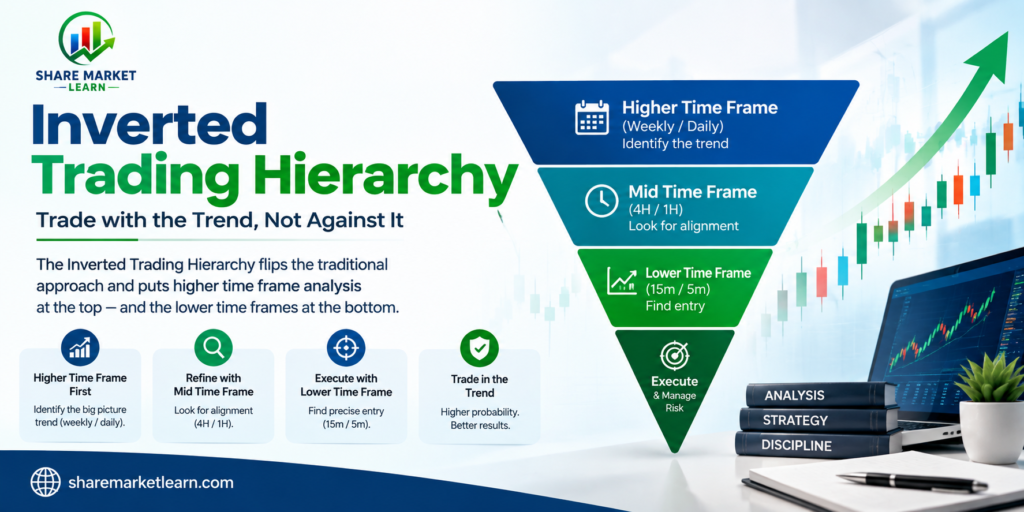
Trading is not just about finding the right indicator or entering a trade at the perfect price. A successful trading process usually involves several layers, such as market direction, strategy, risk management, trade setup, and execution.
Inverted Trading Hierarchy is a term used to describe a situation where a trader approaches these layers in the wrong order. Instead of starting with the broader market context and gradually moving toward execution, the trader may begin with a small or short-term signal and then try to justify the trade afterward.
This can create confusion, emotional decisions, and confirmation bias.
In this article, we will explain the meaning of an inverted trading hierarchy in simple language, how it can affect trading decisions, common mistakes, and how traders can develop a more structured approach.
What Is Inverted Trading Hierarchy?
An inverted trading hierarchy occurs when a trader starts the decision-making process from the bottom level rather than from the top.
For example, imagine a trader sees a bullish candlestick pattern on a 5-minute chart. They immediately decide to buy.
After entering the trade, they check the 1-hour chart and then the daily chart. The higher time-frames show resistance or a downtrend, but the trader has already developed a bullish opinion.
Instead of reconsidering the trade, the trader may search for reasons to support the original decision.
This is an example of an inverted approach.
A more structured approach generally works from the higher-level context toward the lower-level execution.
Understanding the Trading Hierarchy
A trading hierarchy can be thought of as a decision-making structure.
A simple version may look like this:
Market Context → Trend → Strategy → Setup → Entry → Risk Management → Trade Management
The exact structure can differ from trader to trader, but the basic idea is to understand the bigger picture before focusing on the entry.
1. Market Context
First, understand the overall market environment.
Ask questions such as:
- Is the market trending?
- Is it moving sideways?
- Is volatility high or low?
- Are important support or resistance areas nearby?
- Is there a major event that could affect volatility?
Market context provides the background for the trade.
2. Trend or Direction
The next step is identifying the broader direction.
Depending on the trading style, a trader might examine daily, weekly, 4-hour, or other relevant charts.
The purpose is not to predict the future with certainty. Instead, the trader is trying to understand the current market structure.
3. Strategy
Once the broader context is understood, the trader can determine whether a particular strategy fits the situation.
For example, a trend-following strategy may work differently in a strong trend compared with a sideways market.
The strategy should have predefined rules rather than being created after seeing the chart.
4. Trade Setup
Now the trader can look for a specific setup.
This might include:
- Breakout
- Pullback
- Support or resistance reaction
- Trend continuation
- Reversal pattern
- Moving-average setup
- Candlestick confirmation
The setup should meet the rules of the chosen strategy.
5. Entry
Only after the previous steps have been considered should the trader focus on the entry.
The entry may be based on a specific price level, candlestick confirmation, indicator signal, or another predefined condition.
6. Risk Management
Risk management should be considered before entering the trade, not after the position starts moving against you.
The trader should know:
- Where the stop-loss is
- How much capital is at risk
- What position size is appropriate
- Where the trade may be exited
- What happens if the setup fails
Risk management is an important part of the overall trading process.
How Does the Hierarchy Become Inverted?
The hierarchy becomes inverted when the trader starts at the execution level and works backward.
For example:
5-Minute Signal → Immediate Entry → Find a Strategy → Check Higher Timeframe → Create a Market Bias
This reverses the normal decision-making process.
The trader may see a small signal first and then search for information that supports it.
This can encourage confirmation bias, where a person gives more attention to information that supports an existing belief while overlooking conflicting information.
Example of Inverted Trading Hierarchy
Suppose a stock is trading below a major resistance zone on the daily chart.
The daily chart shows a broader downtrend.
However, on the 5-minute chart, the trader notices a bullish candlestick pattern.
The trader immediately buys.
After entering, they check the 1-hour chart and notice resistance. Then they look at the daily chart and realize the larger trend is also bearish.
Instead of accepting that the short-term bullish signal may not be enough, they start searching for more bullish indicators.
The problem is not necessarily the candlestick pattern.
The problem is the order in which the decision was made.
The trader started with the smallest piece of information and then tried to build a larger story around it.
Top-Down Analysis vs. Inverted Analysis
A useful way to understand the concept is to compare the two approaches.
| Top-Down Approach | Inverted Approach |
|---|---|
| Starts with broader context | Starts with a small signal |
| Checks higher timeframes first | Checks higher timeframes later |
| Defines a strategy before entry | May create a strategy around the trade |
| Searches for confirmation | Searches for justification |
| Entry comes after analysis | Analysis may come after entry |
| Encourages structured decisions | Can encourage emotional decisions |
A top-down process does not guarantee a profitable trade. Markets remain uncertain.
Its purpose is to create a more consistent decision-making framework.
Why Do Traders Fall Into an Inverted Hierarchy?
There are several reasons.
Focusing Too Much on Entry Signals
Many beginners spend most of their time searching for the perfect entry.
They may learn dozens of candlestick patterns and indicators but pay less attention to market context.
A good entry signal can still fail when the surrounding market conditions are unfavorable.
Short-Term Charts Feel More Exciting
Lower time-frames generate many signals.
A trader may see several opportunities on a 5-minute or 15-minute chart and feel the need to act quickly.
This can encourage impulsive trading.
FOMO
Fear of Missing Out (FOMO) can cause traders to enter as soon as they see a sudden price movement.
Instead of asking whether the trade fits their complete plan, they focus on not missing the move.
Emotional Attachment to a Trade
Once money has been committed, some traders naturally want their decision to be correct.
This can make them look for information supporting their position while ignoring contradictory evidence.
How to Avoid Inverted Trading Hierarchy
The good news is that traders can create simple rules to avoid this problem.
1. Start With the Higher Timeframe
If you are using multiple time-frames, start with the timeframe that provides your broader context.
For example:
Daily → 4-Hour → 1-Hour → 15-Minute
The exact time-frames depend on your trading style.
The important idea is to move from broader context toward execution.
2. Define Your Market Bias
Before looking for an entry, identify the current market condition.
You can classify it as:
- Bullish
- Bearish
- Sideways
- Unclear
If the market is unclear, there may be no need to force a trade.
3. Use a Trading Checklist
A checklist can help prevent emotional decisions.
Before entering, ask:
- What is the higher-time-frame trend?
- What is the market condition?
- Does my strategy fit this environment?
- Is there a valid setup?
- Where is my entry?
- Where is my stop-loss?
- What is my planned exit?
- Is the position size appropriate?
- Am I entering because of my strategy or because I am afraid of missing out?
If several answers are unclear, waiting may be better than forcing an entry.
4. Separate Analysis From Execution
Try to complete your analysis before taking the trade.
Once you have identified your important levels and conditions, wait for the market to reach your planned area.
This can reduce the temptation to change your analysis simply because the price is moving quickly.
5. Keep a Trading Journal
Record not only your profit or loss but also how you reached the decision.
Write down:
- Higher-time frame direction
- Trading setup
- Entry reason
- Risk
- Exit reason
- Emotional state
- Whether you followed your process
After several trades, you may notice whether you frequently enter trades before completing your broader analysis.
Is Inverted Trading Hierarchy Always Wrong?
Not necessarily.
Different trading styles use different methods and time-frames. A scalper, intraday trader, and swing trader may have very different workflows.
The important point is not that one particular timeframe must always be used first.
The main lesson is to avoid making an impulsive entry first and then constructing an explanation afterward.
A trader can use a short-term signal as the starting point for research, but the signal should still be evaluated within a defined strategy and risk framework.
Inverted Trading Hierarchy and Trading Psychology
Trading psychology plays an important role in this concept.
When traders become emotionally attached to a position, they may unconsciously change their analysis to support that position.
For example:
Signal → Entry → Emotional attachment → Search for confirmation
A disciplined process aims for:
Context → Strategy → Setup → Risk → Entry → Management
This difference may appear small, but it can significantly change how a trader approaches decisions.
Simple Inverted Trading Hierarchy Checklist
Before entering a trade, remember:
1. Context
Understand the broader market.
2. Direction
Identify the relevant trend or market condition.
3. Strategy
Decide whether your strategy fits the situation.
4. Setup
Wait for your predefined setup.
5. Risk
Know your stop-loss and position size.
6. Entry
Execute only when your conditions are met.
7. Management
Follow your predefined trade-management rules.
This approach helps put the pieces in the correct order.
Final Thoughts
Inverted Trading Hierarchy is essentially about getting the order of your trading decisions wrong.
When a trader begins with a small entry signal and then works backward to justify the trade, they may increase the risk of confirmation bias and emotional decision-making.
A more structured approach starts with the broader market context, moves toward strategy and setup selection, and finally reaches the entry and trade-management stage.
Remember that no hierarchy or trading process can guarantee profits. Financial markets are uncertain, and every trading strategy involves risk.
The goal is to create a repeatable process where decisions are made according to predefined rules rather than fear, greed, FOMO, or the desire to prove a trade correct.
Think first. Plan second. Execute third.
Frequently Asked Questions (FAQs)
1. What is an inverted trading hierarchy?
Inverted trading hierarchy refers to approaching a trade in reverse order, such as starting with a short-term entry signal and then looking for broader reasons to justify the trade.
2. What is the opposite of an inverted trading hierarchy?
A structured or top-down approach starts with broader market context and gradually moves toward strategy, setup, risk management, and entry.
3. Can inverted trading hierarchy cause losses?
It can contribute to poor decision-making, particularly when traders enter positions impulsively or use confirmation bias to justify an existing position. However, no single trading process determines whether a trade will make or lose money.
4. How can beginners avoid inverted trading?
Beginners can use a written trading plan and checklist. Start by reviewing market context, define the strategy, identify the setup, calculate risk, and only then execute the trade.
5. Is top-down analysis useful for trading?
Top-down analysis can provide a structured way to move from broader market conditions to a specific trade setup. Its usefulness depends on the trader’s strategy, timeframe, and rules.
6. What role does trading psychology play?
Trading psychology can influence how traders respond to uncertainty, losses, profits, and conflicting information. Emotional decisions can cause traders to abandon their predefined process.
7. Should traders always start with a daily chart?
Not necessarily. The appropriate timeframe depends on the trading style. A swing trader and a scalper may use different primary time-frames. The key is to have a consistent process that considers the appropriate market context.
8. What is the biggest lesson from inverted trading hierarchy?
The key lesson is to avoid entering a trade first and creating a reason for it afterward. A predefined process can help traders make decisions more systematically.