
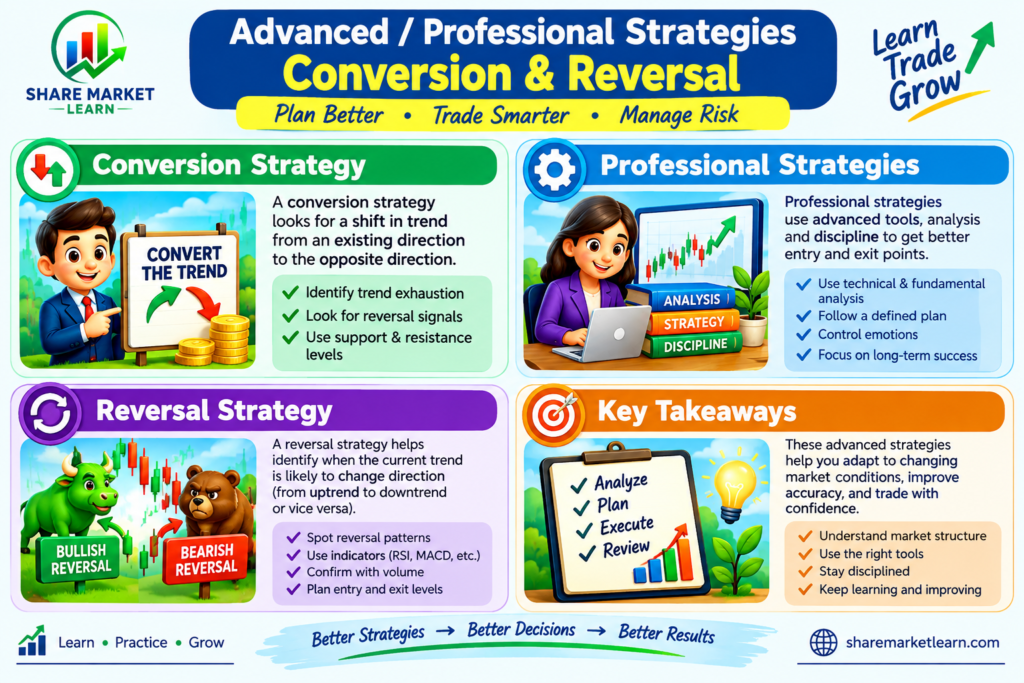
Options trading offers many strategies beyond simply buying calls or puts. As traders gain experience, they may come across advanced strategies such as conversion and reversal.
These strategies are often discussed in the context of options pricing, synthetic stock positions, hedging, and arbitrage. While the names may sound complicated, understanding the basic concept can make them much easier to follow.
In this article, we will explain conversion and reversal options strategies in simple language, how they work, when traders may use them, and the risks that should be understood before considering them.
Important: Conversion and reversal strategies involve multiple positions and can be complex. They should not be treated as simple beginner trades.
What Is a Conversion Strategy?
A conversion is an advanced options strategy that combines a long stock position with options to create a position that has characteristics similar to a synthetic position.
A traditional conversion generally involves:
- Buying the underlying stock
- Buying a put option
- Selling a call option
- Using the same strike price and expiration for the options
The three positions are designed to offset certain risks associated with the underlying stock.
For example, imagine a stock is trading at ₹1,000. A trader buys the stock and simultaneously uses a put and call with the same strike price and expiration.
The purpose is generally to construct a position where the stock exposure is combined with options in a way that can reduce directional risk.
Why Is It Called a Conversion?
The strategy effectively converts a stock position into an options-related payoff structure.
The relationship between the stock, call, and put is based on the well-known relationship between calls, puts, the underlying asset, and their strike price.
Professional traders may examine these relationships to identify pricing differences between the stock and options markets.
What Is a Reversal Strategy?
A reversal is closely related to a conversion, but the position structure is generally the opposite.
A traditional reversal may involve:
- Short-selling the underlying stock
- Selling a put option
- Buying a call option
- Using the same strike price and expiration
The objective is to create a position with a payoff relationship that is closely connected to a synthetic stock position.
The exact implementation depends on the market, available options, transaction costs, margin rules, and the trader’s strategy.
Conversion vs. Reversal
The easiest way to understand the difference is to compare their basic structures.
| Strategy | Stock Position | Put | Call |
|---|---|---|---|
| Conversion | Long Stock | Buy Put | Sell Call |
| Reversal | Short Stock | Sell Put | Buy Call |
These structures are simplified examples for educational purposes. Actual trading conditions can affect the economics of the strategy.
How Does a Conversion Work?
Let’s use a simplified example.
Suppose:
- Stock price = ₹1,000
- Strike price = ₹1,000
- Options have the same expiration date
- Trader buys the stock
- Trader buys the ₹1,000 put
- Trader sells the ₹1,000 call
The long stock position provides ownership of the shares.
The put provides downside protection at the selected strike, while the short call creates an obligation if the call is exercised or assigned.
Together, these positions create a structured payoff rather than simply holding the stock.
The important point is that the trader is managing the relationship between the three positions rather than making a simple bullish or bearish stock prediction.
How Does a Reversal Work?
A reversal uses the opposite stock exposure.
For example:
- Stock is short
- Put is sold
- Call is purchased
- Put and call use the same strike and expiration
The call can provide protection against a significant upward move, while the short stock and short put create the other side of the payoff relationship.
Again, this is not simply a directional bet. It is an advanced structure involving several positions that need to be managed together.
Why Do Professional Traders Use Conversion and Reversal?
One reason these strategies attract professional traders is their relationship with arbitrage.
In efficient markets, prices of related securities tend to maintain relationships with one another. When temporary pricing differences occur, sophisticated traders may investigate whether a conversion or reversal can exploit the difference.
However, finding a theoretical pricing difference does not automatically mean that a profitable opportunity exists.
Traders need to consider:
- Brokerage charges
- Bid-ask spreads
- Taxes and fees
- Interest costs
- Stock borrowing costs
- Dividends
- Margin requirements
- Exercise and assignment
- Liquidity
- Execution risk
A small pricing difference can disappear once all costs are included.
Understanding Put-Call Parity
To understand conversion and reversal strategies, it helps to know about put-call parity.
Put-call parity describes a theoretical relationship between:
- A call option
- A put option
- The underlying stock
- The strike price
- The time remaining until expiration
- The relevant financing or interest rate
For European-style options, the basic relationship can be represented as:
Call − Put = Stock − Present Value of Strike Price
The exact calculation can become more complicated when dividends, interest rates, and other market factors are included.
Conversion and reversal strategies are closely connected to this relationship.
Conversion as a Risk-Management Structure
A conversion can sometimes be used to reduce directional exposure.
Suppose a trader already owns shares and wants to create a more structured payoff using options.
A conversion-style position can combine the stock with a protective put and short call.
However, it is important to understand that reducing one type of risk does not mean eliminating every risk.
There can still be:
- Transaction costs
- Assignment risk
- Liquidity risk
- Financing costs
- Tax considerations
- Execution differences
Reversal and Synthetic Stock Exposure
Reversal strategies are also closely connected to synthetic stock positions.
A combination of buying a call and selling a put with the same strike and expiration can create a payoff similar to owning the underlying stock.
When combined with a short stock position, the overall structure can create a relationship that professional traders may analyze for pricing differences.
This is one reason reversals are often discussed in connection with arbitrage.
What Is Conversion-Reversal Arbitrage?
Conversion-reversal arbitrage refers to attempting to take advantage of pricing inconsistencies between the underlying stock and related options.
In theory, if the prices of the stock and options become inconsistent with their theoretical relationship, a trader may be able to construct offsetting positions.
The idea is not necessarily to predict whether the stock will rise or fall.
Instead, the focus is on the relative pricing of connected securities.
However, real-world markets are not friction less. A theoretical arbitrage opportunity may become unattractive after costs and execution risks are considered.
Important Risks to Understand
1. Transaction Costs
Multiple-leg strategies can involve several trades. Brokerage fees, exchange charges, taxes, and other costs can reduce potential returns.
2. Bid-Ask Spread
The quoted price of an option may not be the price at which you can actually execute a trade.
Wide spreads can make an apparent opportunity disappear.
3. Liquidity Risk
If an option has low trading volume, entering or exiting the position may be difficult.
4. Assignment Risk
American-style options can potentially be exercised before expiration. Traders need to understand the assignment rules applicable to their contracts.
5. Margin Requirements
Short options and short stock positions may require significant margin.
A trader should understand the broker’s margin rules before entering a multi-leg strategy.
6. Execution Risk
A conversion or reversal may require several transactions. If one leg executes at an unfavorable price while another does not execute, the trader can temporarily have unwanted market exposure.
Are Conversion and Reversal Suitable for Beginners?
These strategies are generally more complicated than basic stock investing or buying a single call or put.
Before considering them, a trader should understand:
- Calls and puts
- Strike prices
- Expiration dates
- Option premiums
- Intrinsic and time value
- Put-call parity
- Margin
- Assignment
- Bid-ask spreads
- Transaction costs
Paper trading or studying payoff diagrams can help build understanding before using real capital.
Conversion and Reversal: Key Takeaways
Conversion and reversal strategies are advanced options structures that connect stocks, calls, and puts.
A conversion generally combines long stock, a long put, and a short call.
A reversal generally combines short stock, a short put, and a long call.
Their importance comes from the relationship between these instruments and the principles of synthetic positions and put-call parity.
Professional traders may examine these structures for hedging or potential arbitrage opportunities. However, apparent opportunities need to be evaluated after considering costs, liquidity, margin, financing, and execution risks.
Understanding the mathematics behind the strategy is just as important as understanding the trade structure.
Frequently Asked Questions
1. What is a conversion in options trading?
A conversion is an advanced strategy generally involving long stock, a long put, and a short call with matching strike prices and expiration dates.
2. What is a reversal in options trading?
A reversal is generally the opposite structure, involving short stock, a short put, and a long call with matching strike prices and expiration dates.
3. Are conversion and reversal arbitrage strategies?
They can be used to examine or implement arbitrage opportunities when pricing relationships between stocks and options become inconsistent. However, transaction costs and execution risks must be considered.
4. What is put-call parity?
Put-call parity is a theoretical pricing relationship connecting a call, put, underlying asset, strike price, expiration, and financing factors.
5. Are conversion and reversal risk-free?
No. Although these strategies can be designed to offset certain forms of market exposure, they can still involve execution, liquidity, financing, margin, assignment, and transaction-cost risks.
6. Can beginners use conversion and reversal strategies?
Beginners should first develop a strong understanding of options, stock positions, margin, and payoff structures before considering advanced multi-leg strategies.
7. Why are these strategies important?
They help traders understand the relationship between stocks and options and provide a framework for analyzing synthetic positions, hedging, and potential pricing discrepancies.
Conclusion
Conversion and reversal strategies provide an interesting introduction to the more advanced side of options trading. Rather than simply predicting whether a stock will rise or fall, these strategies focus on the relationship between the underlying stock and its options.
The key concepts to remember are conversion, reversal, synthetic positions, put-call parity, and risk management.
If you are learning advanced options strategies, start by understanding the payoff of every individual position before combining them. A strategy may look simple on paper, but real-world costs, liquidity, margin, and execution can significantly affect the result.
Always understand the potential risks before using real money, and consider professional financial advice when appropriate.
Disclaimer: This article is for educational and informational purposes only and should not be considered financial, investment, or trading advice. Options and stock trading involve risk, and losses can occur. Make investment decisions based on your own research and risk tolerance or consult a qualified financial professional.