
Introduction
The stock market offers many opportunities for people who want to grow their wealth. Among the most popular trading methods are Intraday Trading and Swing Trading. Choosing the right trading style can help you match your financial goals, risk tolerance, and available time
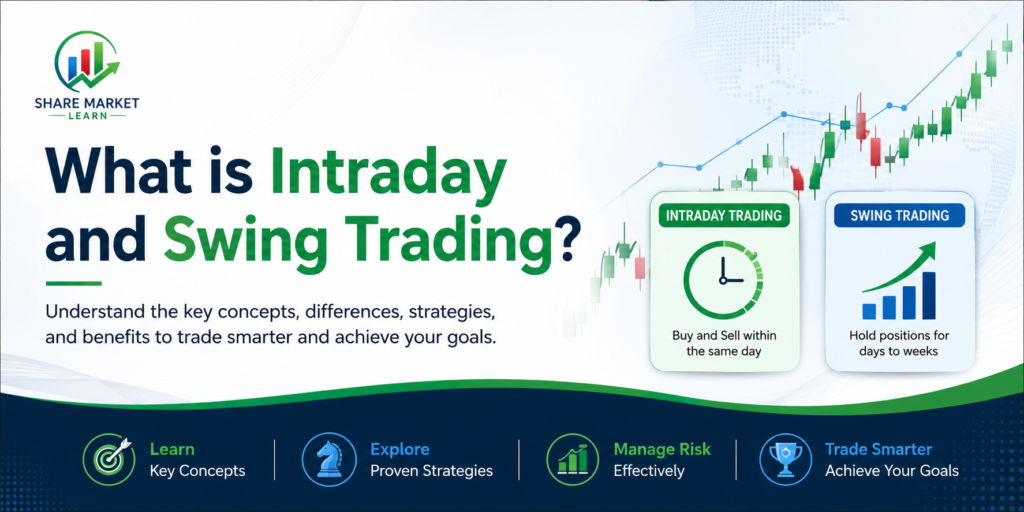
What is Intraday Trading?
Intraday trading, also known as day trading, refers to buying and selling stocks within the same trading day. Traders open and close their positions before the stock market closes, ensuring that no positions are carried overnight.
The main goal of intraday trading is to earn profits from small price movements during the day.
Example of Intraday Trading
Suppose a trader buys 100 shares of a company at ₹500 per share in the morning. During the day, the stock price rises to ₹510. The trader sells all 100 shares before the market closes.
Profit per share = ₹10
Total Profit = ₹10 × 100 = ₹1,000
Since both buying and selling happened on the same day, this is considered intraday trading.
Features of Intraday Trading
1. Same-Day Trading
All positions must be squared off before market closing time.
2. Short-Term Price Movements
Traders focus on small price changes occurring within a few minutes or hours.
3. High Market Monitoring
Intraday traders need to continuously watch the market throughout the trading session.
4. Use of Technical Analysis
Charts, indicators, support and resistance levels, and trading volume play a crucial role in decision-making.
Advantages of Intraday Trading
Quick Profit Opportunities
Traders can generate profits within a single day without waiting for weeks or months.
No Overnight Risk
Since positions are closed before the market closes, traders avoid risks caused by overnight news or global events.
Multiple Trading Opportunities
The stock market provides many opportunities every day across different sectors and stocks.
Efficient Use of Capital
Many brokers offer margin facilities, allowing traders to trade larger quantities with limited capital.
Disadvantages of Intraday Trading
High Risk
Price fluctuations can move quickly against a trader’s position.
Requires Constant Attention
Intraday trading demands regular market monitoring and quick decision-making.
Emotional Pressure
Rapid price changes can create stress and lead to impulsive decisions.
Learning Curve
Beginners need to understand charts, technical indicators, and risk management before trading successfully.
What is Swing Trading?
Swing trading is a trading style where traders hold stocks for several days, weeks, or sometimes a few months to capture larger price movements.
Unlike intraday trading, swing traders do not close their positions on the same day. Instead, they aim to profit from short- to medium-term market trends.
Example of Swing Trading
A trader buys a stock at ₹1,000 and believes it will rise over the next few weeks.
After 15 days, the stock reaches ₹1,100.
Profit per share = ₹100
The trader sells the stock and books the profit.
Since the position was held for multiple days, this is called swing trading.
Features of Swing Trading
1. Longer Holding Period
Trades may last from a few days to several weeks.
2. Trend-Based Trading
Swing traders focus on capturing significant price swings within a trend.
3. Less Screen Time
Unlike intraday trading, swing trading does not require continuous market monitoring.
4. Combination of Technical and Fundamental Analysis
Swing traders often use both chart analysis and company fundamentals to make decisions.
Advantages of Swing Trading
Less Stressful
Traders do not need to monitor the market every minute.
Suitable for Working Professionals
People with jobs or businesses can participate without spending the entire day trading.
Potential for Larger Gains
Swing traders aim to capture bigger price movements compared to intraday traders.
More Time for Analysis
Traders can carefully study stocks before making decisions.
Disadvantages of Swing Trading
Overnight Risk
Market-moving news can affect stock prices when markets are closed.
Capital Remains Blocked
Money remains invested for several days or weeks.
Requires Patience
Profits may take time to materialize.
Market Uncertainty
Trends can reverse unexpectedly, leading to losses.
Intraday Trading vs Swing Trading
Holding Period
Intraday trading involves buying and selling within the same day. Swing trading involves holding stocks for several days or weeks.
Time Requirement
Intraday trading requires constant attention during market hours. Swing trading requires less daily monitoring.
Risk Level
Intraday trading generally carries higher short-term risk due to rapid market fluctuations. Swing trading has overnight risk but is often less intense throughout the day.
Profit Potential
Intraday traders target smaller profits from daily price movements. Swing traders target larger profits from broader trends.
Suitable For
Intraday trading suits experienced traders who can dedicate time to the market. Swing trading is often better for beginners and working professionals.
Which Trading Style is Better for Beginners?
For most beginners, swing trading is often the better starting point.
Here are a few reasons:
- Less pressure and stress
- More time to analyze stocks
- Lower need for constant monitoring
- Easier learning process
- Better balance with work or studies
Intraday trading can be profitable, but it requires strong discipline, technical knowledge, and quick decision-making skills.
Many successful traders begin with swing trading before moving into intraday trading.
Tips for Successful Trading
Learn Before You Trade
Understand market basics, chart patterns, and risk management.
Use Stop-Loss Orders
A stop-loss helps limit potential losses when the market moves against your position.
Keep Learning
The stock market changes continuously. Regular learning can improve trading performance over time.