
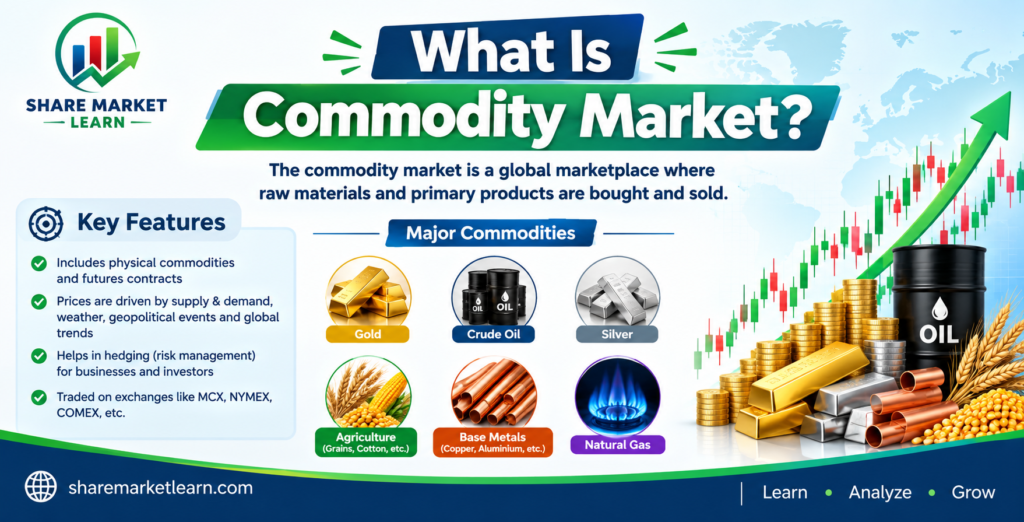
If you have started learning about the stock market, you may have also heard the term commodity market. But what exactly is a commodity market, and how does it work?
Unlike the stock market, where investors buy and sell shares of companies, the commodity market deals mainly with raw materials and essential goods such as gold, silver, crude oil, natural gas, agricultural products, and base metals.
The commodity market is an important part of the global financial system because commodities are used in everyday life and by businesses across different industries.
In this article, we will explain what a commodity market is, how it works, types of commodities, commodity trading in India, its benefits and risks, and important terms beginners should know.
What Is a Commodity Market?
A commodity market is a financial marketplace where commodities are bought and sold.
A commodity is a basic physical product that can be traded. Examples include:
- Gold
- Silver
- Crude oil
- Natural gas
- Copper
- Aluminum
- Zinc
- Wheat
- Cotton
- Soybean
Commodity trading can take place through spot markets, where commodities are bought or sold for immediate delivery, and derivatives markets, where contracts are traded for delivery or settlement at a future date.
In India, commodity derivatives are traded on recognized exchanges, subject to the applicable rules and regulations.
How Does the Commodity Market Work?
The basic concept is similar to other financial markets: buyers and sellers come together to trade.
For example, suppose a trader believes that the price of gold may increase. The trader may take a position in a gold futures contract.
If the price subsequently moves in the expected direction, the trader may make a profit. If the price moves in the opposite direction, the trader may incur a loss.
Commodity prices are influenced by several factors, including:
- Supply and demand
- Global economic conditions
- Currency movements
- Weather conditions
- Government policies
- Geopolitical events
- Interest rates
- Production levels
- Inventory levels
Because these factors can change quickly, commodity prices can be volatile.
What Are the Main Types of Commodities?
Commodities are generally divided into different categories.
1. Precious Metals
Precious metals are widely traded commodities.
Examples include:
- Gold
- Silver
- Platinum
Gold is particularly popular because it is used in jewellery, investment products, and certain industrial applications.
2. Energy Commodities
Energy commodities are important for transportation, manufacturing, electricity generation, and other economic activities.
Examples include:
- Crude oil
- Natural gas
Changes in global supply and demand can have a significant effect on energy prices.
3. Base Metals
Base metals are commonly used in construction, manufacturing, automobiles, electronics, and infrastructure.
Examples include:
- Copper
- Aluminum
- Zinc
- Lead
- Nickel
Copper, for example, is widely used in electrical equipment and infrastructure.
4. Agricultural Commodities
Agricultural commodities include products produced through farming.
Examples include:
- Wheat
- Cotton
- Soybean
- Sugar
- Corn
- Spices
Weather, crop production, seasonal demand, government policies, and international trade can influence agricultural commodity prices.
What Is Commodity Trading?
Commodity trading means buying and selling commodity-related contracts with the objective of managing risk or potentially earning a return from price movements.
Retail traders generally participate in commodity derivatives rather than physically buying and storing commodities such as crude oil or large quantities of metals.
One common instrument is a futures contract.
A futures contract is an agreement to buy or sell an underlying asset at a specified price according to the terms of the contract.
For traders, the important point is that they can gain or lose money as the market price changes.
What Is Commodity Futures Trading?
Commodity futures are contracts based on an underlying commodity.
For example, a gold futures contract is linked to gold. A crude oil futures contract is linked to crude oil.
Traders can take either:
Long position: A trader expects the price to rise.
Short position: A trader expects the price to fall.
If the market moves in the trader’s expected direction, the position may generate a profit. If it moves against the position, the trader can suffer a loss.
Because futures involve leverage and margins, losses can be substantial relative to the initial amount deposited.
Commodity Market in India
India has an active commodity derivatives market.
The Multi Commodity Exchange of India (MCX) is one of the major commodity derivatives exchanges in the country. It offers contracts across areas such as bullion, energy, and base metals.
Other recognized market infrastructure and exchanges may also offer commodity-related contracts, depending on the product and applicable regulations.
Indian commodity markets are regulated under the country’s financial-market framework, with SEBI playing a central regulatory role for commodity derivatives.
Commodity Market vs Stock Market
The commodity market and stock market are both financial markets, but the underlying assets are different.
| Commodity Market | Stock Market |
|---|---|
| Trades commodity-related instruments | Trades shares and other securities |
| Examples include gold, crude oil and copper | Examples include shares of listed companies |
| Prices depend heavily on supply and demand for commodities | Prices depend on company performance, expectations and market conditions |
| Futures are widely used | Equity shares can be held as investments |
| Global events can strongly affect prices | Company-specific news can strongly affect prices |
This does not mean one market is automatically better than the other. They serve different purposes and have different risk characteristics.
Why Do People Trade Commodities?
There are several reasons why commodities are traded.
Price Speculation
Some traders attempt to profit from short-term or medium-term price movements.
For example, a trader may take a position based on an expectation that crude oil prices could rise or fall.
Hedging
Businesses that produce or consume commodities may use derivatives to manage the impact of price changes.
For example, a business that depends heavily on a commodity may use appropriate derivative contracts as part of its risk-management strategy.
Portfolio Diversification
Some investors consider commodity exposure as one component of a diversified portfolio.
However, diversification does not eliminate investment risk.
Advantages of Commodity Trading
Commodity markets offer some potential benefits.
Exposure to Different Assets
Commodities provide exposure to assets that are different from company shares.
Multiple Trading Opportunities
Different commodities respond to different economic and seasonal factors, creating a range of market conditions.
Hedging Opportunities
Commodity derivatives can help eligible businesses manage certain price risks.
Global Market Influence
Many commodities are connected to international markets, allowing traders to follow global economic developments and trends.
Risks of Commodity Trading
Commodity trading is not risk-free. Beginners should understand the risks before entering the market.
High Volatility
Commodity prices can move sharply because of supply disruptions, geopolitical events, weather, economic data, or changes in demand.
Leverage Risk
Futures trading generally involves margin. Leverage can increase both potential gains and potential losses.
Market Timing Risk
Correctly predicting short-term commodity prices is difficult. A market can move unexpectedly even when the underlying economic story appears clear.
Global Events
International events can have an immediate effect on commodities such as crude oil, gold, and natural gas.
Contract-Specific Risk
Every futures contract has specifications such as lot size, expiry date, margin requirements, and settlement terms. Traders should understand these details before trading.
Important Commodity Market Terms
If you are a beginner, learning a few basic terms can make commodity trading easier to understand.
Spot Price
The current market price of a commodity for immediate delivery.
Futures Price
The price specified in a futures contract for a future settlement or delivery date.
Expiry
The date on which a futures contract reaches the end of its trading or settlement period.
Margin
The amount required to take and maintain a futures position according to exchange and broker requirements.
Lot Size
The standard quantity represented by one contract.
Contract
A standardized agreement traded according to exchange specifications.
Tips for Commodity Market Beginners
If you are planning to learn commodity trading, start with the basics.
- Understand the commodity before trading it.
- Learn how futures contracts work.
- Understand margin and leverage.
- Check contract specifications and expiry dates.
- Use proper risk management.
- Avoid risking money you cannot afford to lose.
- Do not trade solely on social-media tips or rumors.
- Keep learning about global economic and commodity-market factors.
Beginners may find it useful to study the market through paper trading or a simulated environment before using real money.
Conclusion
The commodity market is a marketplace where commodities and commodity-related financial contracts are traded. It includes important products such as gold, silver, crude oil, natural gas, metals, and agricultural commodities.
Commodity markets play an important role in the economy because businesses use commodities as raw materials and energy sources. Traders and businesses can also use commodity derivatives for speculation or risk management.
For beginners, the most important thing is to understand that commodity trading involves risk. Futures and leveraged products can result in significant losses, so proper knowledge, risk management, and an understanding of contract specifications are essential.
If you are new to financial markets, learn the fundamentals first and understand how the commodity market differs from the stock market before considering any trade.
Frequently Asked Questions (FAQs)
What is a commodity market in simple words?
A commodity market is a marketplace where commodities such as gold, silver, crude oil, natural gas, metals, and agricultural products are traded.
What are examples of commodities?
Common commodities include gold, silver, crude oil, natural gas, copper, aluminum, wheat, cotton, sugar, and soybean.
Can beginners trade in the commodity market?
Beginners can learn about commodity markets, but trading requires an understanding of futures, margins, leverage, volatility, and risk management.
Is commodity trading risky?
Yes. Commodity prices can be highly volatile, and leveraged futures trading can magnify both profits and losses.
What is MCX?
MCX stands for Multi Commodity Exchange of India. It is a recognized exchange in India that provides a platform for trading commodity derivatives.
What is the difference between stocks and commodities?
Stocks represent ownership or an interest in a company, while commodities are physical raw materials or products. Commodity derivatives allow market participants to trade contracts based on commodity prices.
Can I trade gold in the commodity market?
Yes. Gold is one of the major commodities traded through commodity derivatives markets. Investors and traders should understand the specific contract size, expiry, margin, and settlement rules before trading.
What is a futures contract?
A futures contract is a standardized agreement to buy or sell an underlying asset according to specified terms at a future date or through a specified settlement mechanism.
Disclaimer: This article is for educational and informational purposes only. It is not investment advice or a recommendation to buy or sell any security or commodity. Commodity trading involves market risk, and investors should conduct their own research and consider consulting a qualified financial professional before making investment decisions.