
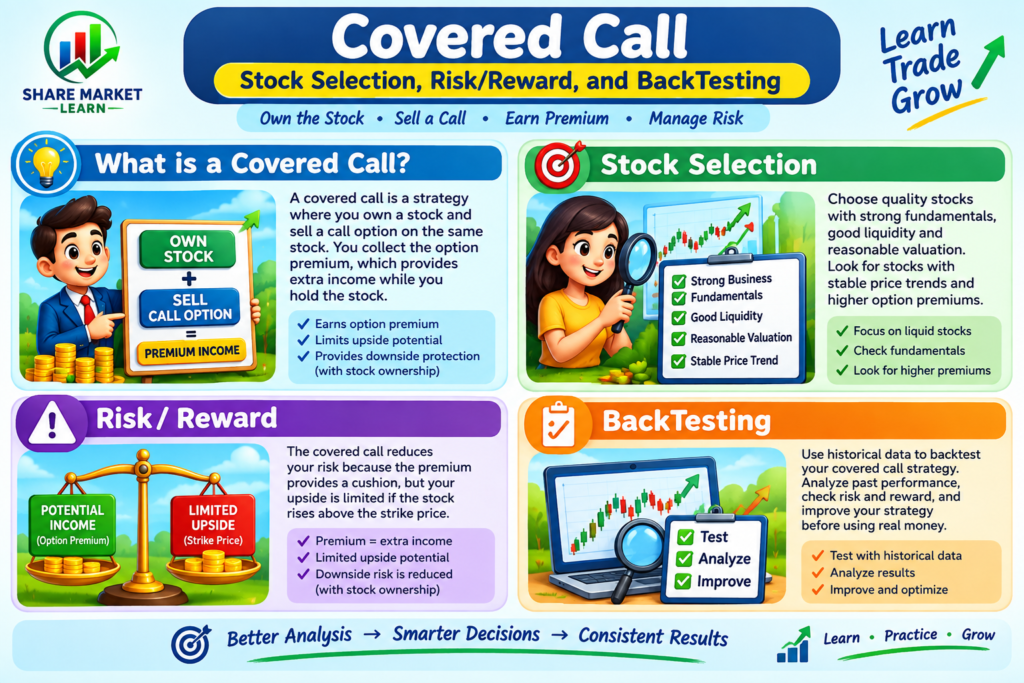
The Covered Call is one of the most commonly discussed options strategies for investors who already own shares and want to generate additional income from those holdings. It combines a long stock position with the sale of a Call Option on the same stock.
The strategy may look simple, but understanding stock selection, strike price, risk/reward, and back testing is important before using it.
In this article, we will explain the Covered Call strategy in simple language, with practical examples.
Note: This article is for educational purposes only and should not be considered financial advice.
What Is a Covered Call?
A Covered Call involves two positions:
- Buying or already holding shares of a stock.
- Selling a Call Option against those shares.
The investor receives an option premium for selling the Call.
For example, suppose you own 100 shares of a stock trading at ₹1,000. You sell a Call Option with a strike price of ₹1,050 and receive a premium of ₹20 per share.
Your premium received is:
₹20 × 100 = ₹2,000
The premium provides additional income, but the strategy also creates an obligation. If the Call is exercised or settled according to the contract terms, the investor may have to deliver the underlying shares at the specified strike price.
How Does a Covered Call Work?
Let’s understand it with a simple example.
Suppose:
- Stock price = ₹1,000
- Shares owned = 100
- Call strike price = ₹1,050
- Call premium received = ₹20 per share
The value of the shares is:
₹1,000 × 100 = ₹1,00,000
The premium received is:
₹20 × 100 = ₹2,000
Now consider three possible outcomes.
Scenario 1: Stock Rises Moderately
Suppose the stock reaches ₹1,030 at expiry.
The Call may expire worthless if it remains out of the money. You continue to hold the shares and keep the ₹2,000 premium, subject to the contract’s settlement rules.
Scenario 2: Stock Rises Above the Strike
Suppose the stock rises to ₹1,100.
The Call Option has moved in the money. Depending on the contract and settlement mechanism, the short Call position can create an obligation related to the shares.
The investor benefits from the premium and the stock’s movement up to the relevant strike, but the short Call limits the benefit from further upside beyond the strike.
Scenario 3: Stock Falls
Suppose the stock falls to ₹900.
The Call premium provides some income that offsets part of the decline, but it does not fully protect the stock from losses.
This is a very important point: a Covered Call is not a downside-protection strategy.
Why Is Stock Selection Important?
Stock selection plays a major role in a Covered Call strategy because the investor already owns the underlying shares.
Before considering a Covered Call, investors may examine:
1. Liquidity
Stocks and their options should have sufficient trading activity. Better liquidity can make it easier to enter and exit positions.
2. Volatility
Option premiums are influenced by volatility. Higher expected volatility can result in higher option premiums, although it also means the underlying stock may experience larger price movements.
3. Stock Price Trend
Investors may consider whether the stock is trending upward, moving sideways, or showing weakness.
A Covered Call is often studied in situations where the investor is willing to give up some potential upside in exchange for receiving premium income.
4. Company and Sector Factors
Investors may also review earnings, company developments, sector conditions, and other fundamental information.
Stock selection should follow predefined criteria rather than simply choosing a stock because its option premium appears attractive.
Choosing the Call Strike Price
The strike price is an important part of the Covered Call.
For example, if a stock is trading at ₹1,000, an investor could consider a Call with a strike of ₹1,020, ₹1,050, or ₹1,100, depending on the strategy rules and available contracts.
A strike closer to the current stock price may provide a higher premium but can also create a greater possibility of the Call becoming in the money.
A strike farther above the current price may provide more room for the stock to rise before reaching the strike, but the premium may be lower.
There is therefore a trade-off between premium income and potential upside.
Understanding Risk and Reward
The Covered Call has two main components:
- Potential stock appreciation
- Premium received from the Call
The premium can increase the effective income from the position, but it does not eliminate the risk of a falling stock price.
Maximum Profit
A simplified calculation is:
Maximum profit per share = (Call strike price − Stock purchase price) + Call premium
For example:
Stock purchase price = ₹1,000
Call strike = ₹1,050
Premium received = ₹20
Maximum profit, ignoring transaction costs, is:
₹50 + ₹20 = ₹70 per share
For 100 shares:
₹70 × 100 = ₹7,000
This simplified calculation assumes the Call finishes in the relevant settlement condition at or above the strike.
Downside Risk
If the stock falls significantly, the investor can still experience a substantial loss.
For example, if the stock falls from ₹1,000 to ₹800, the ₹20 premium only offsets ₹20 of the ₹200 decline, before costs and other factors.
Therefore, the Covered Call should not be viewed as a substitute for a stop-loss or protective Put.
Covered Call Risk/Reward Example
| Stock Price at Expiry | General Result |
|---|---|
| ₹800 | Stock loss partly offset by premium |
| ₹950 | Stock loss partly offset by premium |
| ₹1,000 | Premium may provide a positive return before costs |
| ₹1,050 | Stock gain + premium, subject to settlement |
| ₹1,100 | Upside above the strike is generally limited by the short Call |
This table is a simplified illustration. Actual results can differ based on option pricing, contract specifications, settlement procedures, costs, and the timing of exit.
What Is Back testing?
Back testing means applying a defined trading strategy to historical market data to study how it would have performed in the past.
For a Covered Call, a back test could examine:
- Which stocks were selected
- Stock entry price
- Call strike selection
- Option premium
- Expiry period
- Entry and exit rules
- Transaction costs
- Total profit or loss
- Maximum draw-down
- Number of profitable and losing trades
Back testing can help identify how a strategy behaved across different market conditions.
However, past performance does not guarantee future results.
How to Back test a Covered Call
A simple back testing process can include these steps.
Step 1: Create Clear Rules
Define exactly when a stock qualifies for the strategy.
Step 2: Define the Call Selection
Specify how you will choose the strike price and expiry.
Step 3: Collect Historical Data
Use appropriate historical stock and option data.
Step 4: Calculate the Combined Result
Calculate the stock’s movement together with the Call premium and the outcome of the short Call.
Step 5: Include Trading Costs
Brokerage, taxes, exchange charges, and other applicable costs should be included where relevant.
Step 6: Test Different Market Conditions
A strategy should ideally be tested during rising, falling, and sideways market periods.
Step 7: Review the Results
Important measurements may include total return, draw-down, average return, losing periods, and consistency.
Common Covered Call Mistakes
Selling Calls Without Understanding the Obligation
A short Call creates an obligation that investors should understand before entering the trade.
Focusing Only on Premium
A high premium does not automatically mean a better trade. It may reflect higher volatility or greater expected price movement.
Ignoring Upside Limitation
The investor should understand that selling a Call can limit potential gains above the strike.
Ignoring Stock Risk
The premium does not eliminate losses if the underlying stock falls significantly.
Poor Back testing
Using unrealistic assumptions, ignoring costs, or testing only one market period can make historical results misleading.
Final Thoughts
The Covered Call strategy combines stock ownership with the sale of a Call Option. It can provide option premium income while allowing continued ownership of the stock, but the trade-off is that potential upside can be limited above the Call’s strike price.
For anyone studying this strategy, four areas deserve particular attention: stock selection, Call strike selection, risk/reward, and back testing.
A well-defined set of rules and realistic historical testing can help you understand how the strategy behaves. At the same time, it is important to remember that back testing is a study of historical conditions—not a guarantee of future performance.
Frequently Asked Questions
1. What is a Covered Call?
A Covered Call involves holding shares of a stock and selling a Call Option against those shares.
2. Does a Covered Call generate income?
The seller receives an option premium when selling the Call. However, the overall investment can still lose money if the stock declines.
3. Does a Covered Call protect against a stock market crash?
No. The premium provides only limited offset to a decline. A major fall in the stock can still result in a substantial loss.
4. What happens if the stock rises above the Call strike?
The short Call becomes in the money. Depending on the contract and settlement mechanism, the investor may have an obligation connected to the underlying shares, and gains above the strike may be limited.
5. Why is stock selection important in a Covered Call?
Because the investor holds the underlying stock, its price movement has a major impact on the overall result.
6. What is Covered Call back testing?
It is the process of applying predefined Covered Call rules to historical stock and options data to study past performance.
7. Can back testing guarantee profits?
No. Historical results cannot guarantee future performance because market conditions can change.