
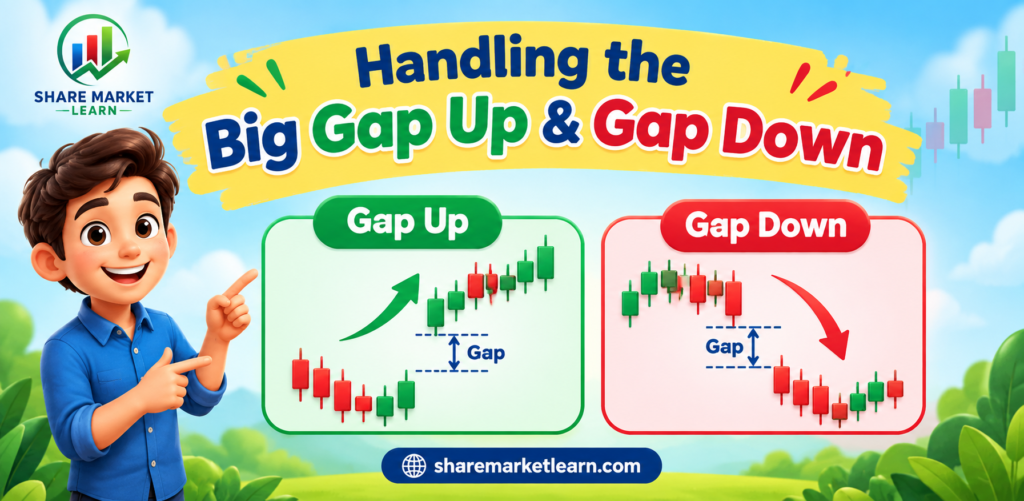
When the stock market opens significantly higher or lower than the previous day’s closing price, traders often see a Gap Up or Gap Down. These large price gaps can create exciting opportunities, but they can also bring higher risk and unexpected price movements.
Understanding how to handle a big gap is important for traders because the market may behave very differently after a large gap. Sometimes the gap continues in the same direction, while in other situations, the price quickly reverses and fills the gap.
In this article, we’ll understand what big gap ups and gap downs are, why they happen, how traders can analyze them, common mistakes to avoid, and practical ways to manage trades.
What Is a Gap Up?
A Gap Up occurs when a stock or index opens significantly above its previous day’s closing price.
For example:
- Previous Close: ₹1,000
- Next Day Open: ₹1,080
The stock has opened ₹80 higher, creating a gap up.
A gap up can happen because of positive news, strong global market sentiment, company announcements, earnings results, or heavy buying interest.
Why Does a Gap Up Happen?
Some common reasons include:
- Positive company news
- Strong quarterly results
- New business announcements
- Positive global market trends
- Government policy announcements
- Strong institutional buying
- Positive sector news
- Unexpected overnight developments
A large gap up generally indicates that buyers are willing to pay a much higher price than the previous day’s closing level.
What Is a Gap Down?
A Gap Down occurs when a stock or index opens significantly below its previous day’s closing price.
For example:
- Previous Close: ₹1,000
- Next Day Open: ₹920
The stock has opened ₹80 lower, creating a gap down.
Gap downs can occur because of negative news, weak earnings, global market weakness, geopolitical events, or heavy selling pressure.
Why Does a Gap Down Happen?
Common reasons include:
- Poor company results
- Negative company announcements
- Weak global markets
- Economic concerns
- Unexpected negative news
- Heavy institutional selling
- Sector weakness
- Overnight market developments
A large gap down can create panic among traders, but it does not automatically mean that the price will continue falling throughout the day.
How to Identify a Big Gap
There is no single percentage that defines a “big gap” for every stock. A 2% gap may be significant for one stock but normal for another.
Traders can compare the opening price with:
- Previous day’s close
- Average daily movement
- Recent volatility
- Important support and resistance levels
- Previous gap zones
- Volume
For example, if a stock normally moves 1–2% in a day but suddenly opens 6% higher, that can be considered a significant gap relative to its usual movement.
What Should You Do After a Big Gap Up?
One common mistake is immediately buying because the stock has opened strongly.
Instead, wait and observe the initial price action.
1. Don’t Chase the Opening Move
A stock that opens 5–10% higher can sometimes experience profit booking soon after the opening.
Instead of entering immediately, watch how price behaves around important levels.
2. Mark the Previous Day’s High and Low
The previous day’s high and low can provide useful reference points.
For example, if the stock opens above the previous day’s high and continues to hold above it, this may show strong buying interest.
However, if the price quickly falls below the previous day’s high, traders may want to reassess the situation.
3. Watch the First Few Candles
The first 5-minute, 15-minute, or 30-minute candles can provide information about early buying and selling pressure.
Avoid making a decision based only on the opening price.
4. Check Volume
Volume can help traders understand whether the move is supported by strong participation.
A big gap with strong volume may indicate significant market interest, while a gap with relatively weak volume may require additional confirmation.
What Should You Do After a Big Gap Down?
The same principle applies to gap downs.
A large gap down does not automatically mean that traders should immediately sell or take a short position.
1. Avoid Panic Selling
If you already own a stock and it opens sharply lower, avoid making an emotional decision.
First understand why the stock has fallen and identify important support levels.
2. Observe Support
Previous swing lows, major support zones, and important technical levels can help traders understand where buyers may potentially appear.
3. Watch Price Recovery
If the stock initially gaps down but starts recovering strongly, the market may be showing buying interest.
On the other hand, if the price continues making lower highs and lower lows, selling pressure may still be strong.
Understanding Gap Fill
One important concept associated with gaps is the Gap Fill.
A gap is considered filled when the price moves back through the previous day’s closing area and covers the gap created at the opening.
For example:
Previous Close: ₹1,000
Opening Price: ₹1,100
If the stock later falls toward ₹1,000, traders may describe this movement as filling the gap.
However, not every gap gets filled immediately. Some gaps may remain open for days, weeks, or much longer.
Therefore, traders should not assume that every gap must be filled.
Breakaway Gap vs Exhaustion Gap
Not all gaps have the same meaning.
Breakaway Gap
A breakaway gap can occur when price moves strongly out of an established trading range or consolidation zone.
It may indicate the beginning of a new price movement.
For example, a stock trading between ₹900 and ₹950 for several days may suddenly open at ₹980 with strong volume.
The gap may indicate that the previous trading range has been broken.
Exhaustion Gap
An exhaustion gap can occur after a strong and extended price movement.
For example, if a stock has already risen significantly for several weeks and then suddenly gaps higher, traders may watch carefully for signs of profit booking or reversal.
The gap itself does not confirm an exhaustion move. Price action and volume should also be considered.
A Simple Strategy for Handling Big Gaps
A beginner-friendly approach can be:
Step 1: Mark the previous day’s high, low, and close.
Step 2: Identify the opening gap.
Step 3: Mark important support and resistance levels.
Step 4: Wait for the initial market volatility to settle.
Step 5: Observe volume and price action.
Step 6: Look for confirmation instead of entering only because of the gap.
Step 7: Define your stop-loss before entering the trade.
Step 8: Keep position size appropriate for the level of volatility.
This approach can help reduce emotional decisions.
Common Mistakes Traders Make During Big Gaps
Chasing the Price
Buying after a large gap up simply because the stock is moving quickly can expose traders to sudden reversals.
Assuming Every Gap Will Fill
A gap may fill, but there is no guarantee that it will happen on the same day.
Ignoring Stop-Loss
Large gaps can create significant volatility. A predefined risk level can help traders manage potential losses.
Trading Without Understanding the News
A gap caused by major company news may behave differently from a technical gap.
Taking Large Positions
Big gaps often mean increased volatility. Taking an unnecessarily large position can increase risk.
Final Thoughts
Big gap ups and gap downs can make the market exciting, but they also require discipline.
Instead of immediately reacting to a large opening move, traders can focus on price action, volume, support, resistance, market conditions, and risk management.
The most important lesson is simple: a gap is information, not a trading signal by itself.
Use the gap as a starting point for analysis and wait for additional confirmation before making a trading decision.
Remember that technical analysis cannot guarantee profits, and every trading strategy carries risk. Proper position sizing and risk management are essential.
Frequently Asked Questions
1. What is a big gap up?
A big gap up occurs when a stock or index opens substantially above its previous closing price. The size considered “big” depends on the stock’s normal volatility.
2. What is a big gap down?
A big gap down occurs when a stock or index opens substantially below its previous closing price.
3. Does every gap get filled?
No. Some gaps may fill quickly, while others can remain open for a long period.
4. Should I buy immediately after a gap up?
Not necessarily. It can be useful to wait for price-action and volume confirmation before making a trading decision.
5. Should I sell immediately after a gap down?
Not automatically. Traders should consider the reason for the gap, support levels, volume, and overall market conditions.
6. Which time frame is best for gap trading?
There is no single best time frame. Intraday traders may use 5-minute or 15-minute charts, while positional traders may focus on daily charts.
7. Is gap trading risky?
Yes. Large gaps can be accompanied by high volatility and fast price movements. Proper risk management is important.