
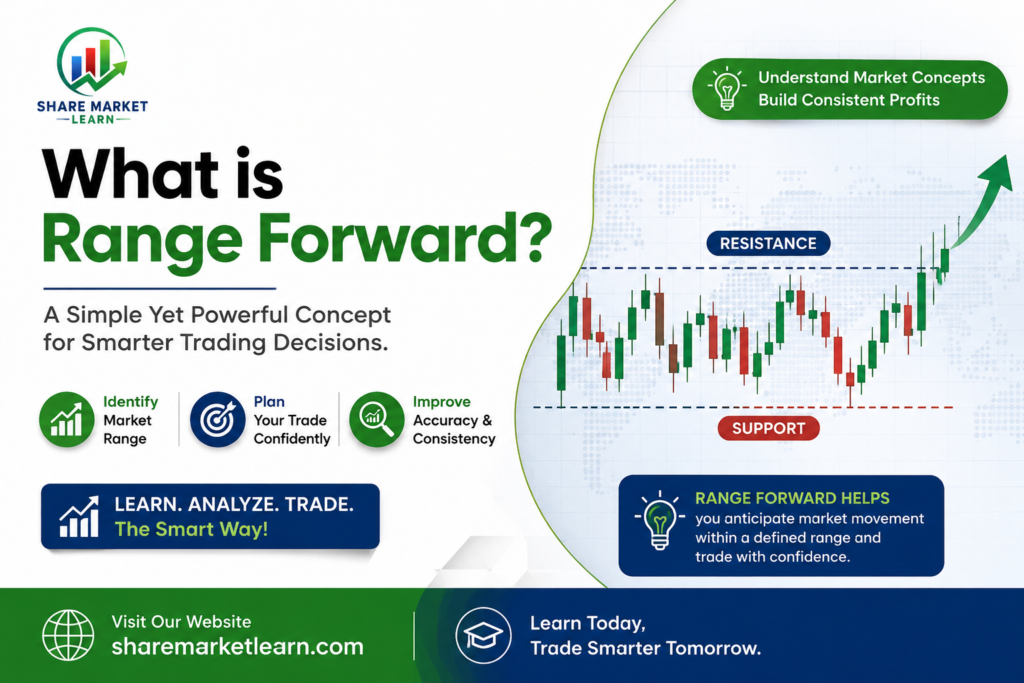
If you are involved in international trade, foreign exchange, or business payments, you may come across the term Range Forward. At first, it can sound complicated, but the basic idea is quite simple.
A Range Forward is a type of foreign exchange (forex) hedging strategy that helps businesses protect themselves against unfavorable currency movements while still giving them some flexibility if exchange rates move in their favor.
For companies that regularly receive or make payments in foreign currencies, managing exchange-rate risk can be important. A sudden movement in the currency market can change the actual value of an invoice, payment, or business profit.
In this article, we will explain what a Range Forward is, how it works, its advantages and disadvantages, and when businesses might consider using one.
What Is a Range Forward?
A Range Forward is a foreign exchange contract that allows a business to manage currency risk within a predetermined exchange-rate range.
Unlike a traditional forward contract, where you agree to exchange currency at one fixed rate on a future date, a Range Forward generally establishes two exchange-rate levels:
- A lower rate
- An upper rate
The arrangement is designed to provide protection against unfavorable exchange-rate movements while allowing some benefit from favorable movements within the agreed range.
It is commonly used by companies involved in importing, exporting, international payments, and cross-border business transactions.
How Does a Range Forward Work?
Let’s understand it with a simple example.
Imagine an Indian company expects to receive USD 100,000 from a customer in the United States after three months.
The company is worried that the USD/INR exchange rate could move significantly during those three months.
Instead of simply waiting and accepting whatever exchange rate exists on the payment date, the company may use a Range Forward arrangement with a financial institution.
Suppose the agreed range is approximately:
₹82 to ₹86 per USD
The exact structure and rates depend on the contract and market conditions.
The idea is that the company has established a predefined currency-rate range for the future transaction.
If the exchange rate moves dramatically in an unfavorable direction, the hedge can provide protection according to the terms of the contract.
If the exchange rate remains within the agreed range, the business can have greater certainty about its potential currency conversion rate.
Range Forward vs. Traditional Forward
A traditional forward contract is relatively straightforward.
For example, a company may agree today to exchange USD at a fixed rate of ₹84 after three months.
Whether the market rate later becomes ₹80 or ₹88, the company is generally committed to the agreed forward rate, subject to the contract terms.
A Range Forward is different because it uses a range rather than simply one fixed exchange rate.
This can give businesses more flexibility, but the contract structure is also more complicated.
| Feature | Traditional Forward | Range Forward |
|---|---|---|
| Exchange-rate structure | Usually one fixed rate | Uses a predefined range/structured levels |
| Currency protection | Yes | Yes, according to contract terms |
| Flexibility | Lower | Potentially higher |
| Complexity | Relatively simple | More complex |
| Suitable for | Businesses wanting rate certainty | Businesses wanting structured protection and flexibility |
Why Do Businesses Use Range Forwards?
Currency exchange rates can change because of many factors, including:
- Interest-rate changes
- Inflation
- Economic conditions
- Central-bank policies
- Political developments
- Global trade conditions
- Market sentiment
For an international business, even a small currency movement can have a meaningful impact on profit.
For example, an exporter expecting to receive $500,000 may calculate its expected profit using today’s exchange rate. If the currency moves significantly before payment is received, the company’s actual revenue in local currency may be very different.
A Range Forward can be considered as one tool for managing this uncertainty.
Simple Example of a Range Forward
Suppose an Indian exporter will receive $100,000 in three months.
The company expects the dollar to remain relatively stable but is concerned about a major adverse movement.
It enters into a structured Range Forward arrangement.
For illustration, assume the relevant exchange-rate range is:
₹83–₹87 per USD
The business now has a predefined framework for managing its future currency conversion.
If the market moves significantly, the contract’s specific terms determine what happens.
This is important: a Range Forward is not simply a guarantee that you will always receive the best exchange rate. It is a financial contract with specific conditions, and those conditions should be understood before entering into it.
Advantages of Range Forward
1. Helps Manage Currency Risk
The biggest advantage is risk management.
Businesses can reduce the uncertainty associated with future foreign-currency payments or receipts.
This can make financial planning easier.
2. Can Provide More Flexibility
Compared with a basic fixed-rate forward, certain Range Forward structures can provide businesses with more flexibility around currency movements.
The exact benefit depends on how the contract is structured.
3. Better Financial Planning
When a business knows the approximate framework within which its currency exposure will be managed, it can prepare budgets and cash-flow forecasts more effectively.
4. Useful for Importers and Exporters
Both importers and exporters can potentially use structured currency hedging strategies.
An exporter may be concerned about the value of foreign currency receipts, while an importer may be concerned about the rising cost of foreign currency needed to pay overseas suppliers.
5. Can Reduce the Impact of Unexpected Currency Movements
Foreign exchange markets can move quickly.
A properly designed hedge can help reduce the financial impact of unfavorable movements.
Disadvantages and Risks
Although Range Forwards can be useful, they are not suitable for every business.
1. More Complicated Than a Basic Forward
The contract may include several conditions, rates, and scenarios.
A business should understand exactly what happens under different market conditions.
2. Limited Benefit From Favorable Currency Movements
Depending on the structure, the company may not receive the full benefit if the currency moves significantly in its favor.
This is one of the key trade-offs of structured hedging.
3. Contractual Obligations
A Range Forward is a financial contract.
The business may have obligations even if market conditions change after the contract is entered into.
4. Counterparty Risk
The company is generally dealing with a bank or financial institution. There is therefore a counterparty relationship that needs to be considered.
5. Professional Advice May Be Necessary
Because structured foreign-exchange products can have complex terms, businesses should carefully review the contract and consider advice from a qualified financial professional.
Who Can Use a Range Forward?
A Range Forward may be relevant to businesses that have predictable foreign-currency exposure.
For example:
Exporters:
Companies receiving payments in USD, EUR, GBP, or other currencies may use currency hedging to manage the value of their future receipts.
Importers:
Businesses that need to pay overseas suppliers may hedge against an increase in the cost of foreign currency.
International Service Companies:
IT companies, consultants, agencies, and other service providers receiving international payments may also have currency exposure.
Multinational Businesses:
Companies operating across several countries may use different hedging strategies to manage their foreign-exchange risk.
Range Forward in International Trade
For import-export businesses, currency management can be particularly important.
Imagine an Indian exporter agrees to sell goods worth $200,000 to an overseas buyer.
The buyer will make the payment after 90 days.
The exporter has costs in Indian rupees, such as:
- Employee salaries
- Manufacturing costs
- Packaging
- Transportation
- Warehousing
- Taxes and other expenses
The exporter therefore needs to convert the future dollar receipt into rupees.
If the USD/INR exchange rate changes significantly during those 90 days, the company’s expected profit could change.
A currency hedge, such as a Range Forward or another suitable forex product, can be considered as part of the company’s risk-management strategy.
Is a Range Forward the Same as a Range-Bound Currency?
No.
These terms can sound similar but are different.
A range-bound currency describes a currency whose exchange rate is trading within a particular market range.
A Range Forward is a financial hedging contract designed to manage foreign-exchange exposure.
Understanding this difference is important when researching currency markets.
Things to Check Before Entering a Range Forward
Before signing a Range Forward agreement, a business should carefully understand:
- The currencies involved
- The transaction amount
- The settlement date
- The agreed exchange-rate levels
- What happens if the market moves above or below the range
- Any fees, premiums, or other costs
- Whether the contract can be cancelled or changed
- The company’s obligations under different market scenarios
Never assume that a structured product works exactly like a simple forward contract.
Conclusion
A Range Forward is a foreign-exchange hedging strategy that uses predetermined exchange-rate levels to help businesses manage currency risk.
It can be useful for exporters, importers, international service providers, and other companies that have future foreign-currency payments or receipts.
The main benefit is that it can provide a structured way to manage uncertainty in the currency market. However, the trade-off is that Range Forwards can be more complicated than traditional forward contracts and may limit some benefits from favorable currency movements, depending on the structure.
If your business regularly deals in foreign currencies, understanding tools such as forward contracts, options, and Range Forwards can help you make better currency-risk management decisions.
Before entering any Range Forward contract, carefully review the terms and consider obtaining advice from a qualified foreign-exchange or financial professional.
Frequently Asked Questions (FAQs)
1. What is a Range Forward in simple words?
A Range Forward is a currency hedging contract that establishes predetermined exchange-rate levels to help a business manage the risk of future currency movements.
2. Who uses Range Forwards?
Exporters, importers, multinational companies, and businesses receiving or making international payments may use Range Forwards to manage foreign-exchange risk.
3. Is a Range Forward the same as a normal forward contract?
No. A normal forward generally locks in one exchange rate for a future transaction. A Range Forward uses a structured range or multiple predetermined levels and therefore can have more complex conditions.
4. Can a Range Forward protect against currency losses?
It can help manage or reduce currency risk, depending on the exact structure of the contract. It does not necessarily eliminate every type of financial loss.
5. Are Range Forwards risky?
Like other financial contracts, Range Forwards involve risks. The terms can be complex, and favorable currency movements may not always provide the full benefit to the business.
6. Can exporters use Range Forwards?
Yes. Exporters receiving foreign currency in the future may consider Range Forwards as one possible method of managing exchange-rate risk.
7. Can importers use Range Forwards?
Yes. Importers with future foreign-currency payment obligations may also use currency hedging strategies, including structured products, depending on their requirements.
8. Should a small business use a Range Forward?
It depends on the company’s foreign-currency exposure, transaction size, risk tolerance, and understanding of the product. A small business should carefully evaluate the costs and contractual obligations before entering into one.
9. What is the main purpose of a Range Forward?
The main purpose is to manage foreign-exchange risk and improve predictability around future currency transactions.
10. Is professional advice recommended?
Yes. Because Range Forwards can contain detailed conditions and financial obligations, businesses should understand the contract fully and consider professional financial advice before using one.