
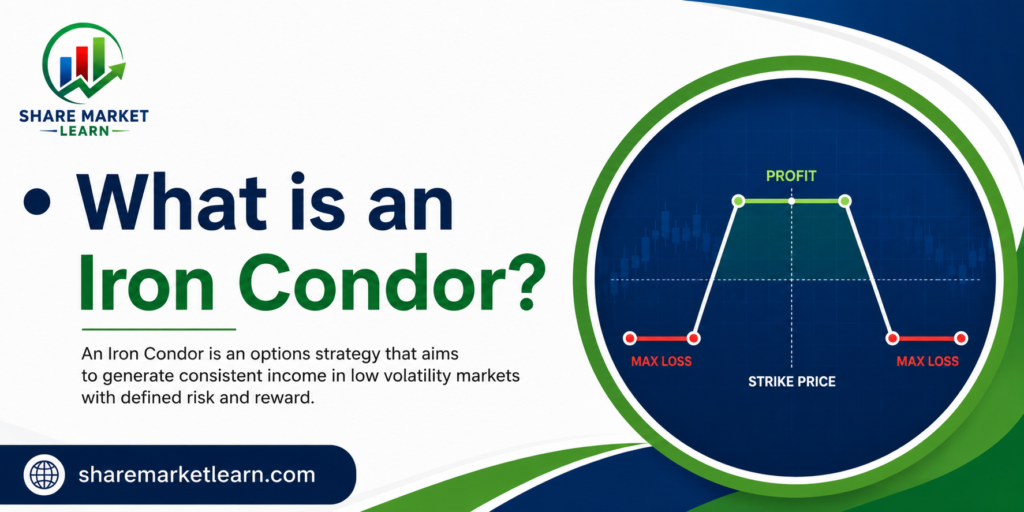
If you are learning options trading, you may have come across the term Iron Condor. At first, it can sound complicated because it involves four different option contracts. But once you understand the basic idea, an Iron Condor is actually one of the more structured options strategies.
An Iron Condor is generally used when a trader expects an underlying asset—such as a stock or index—to remain within a particular price range for a specific period. Instead of betting on a large upward or downward move, the trader creates a strategy that can potentially profit when the price stays between two levels.
In this article, we will explain what an Iron Condor is, how it works, its profit and loss potential, advantages, risks, and a simple example.
Important: Options trading involves substantial risk. The examples below are for educational purposes and are not financial advice.
What Is an Iron Condor?
An Iron Condor is a four-leg options strategy that combines two credit spreads:
- A bull put spread
- A bear call spread
The strategy normally involves the same underlying asset and the same expiration date, but uses four different strike prices.
A basic Iron Condor consists of:
- Buying one lower-strike put
- Selling one higher-strike put
- Selling one lower-strike call
- Buying one higher-strike call
The trader receives a net premium (credit) when establishing the position.
The main idea is simple:
You want the underlying price to remain between the two short strikes at expiration.
How Does an Iron Condor Work?
Let’s use a simple example.
Imagine an index is currently trading around ₹22,000.
Suppose you believe that by expiration, the index is likely to stay between ₹21,500 and ₹22,500.
You could create an Iron Condor such as:
- Buy ₹21,000 Put
- Sell ₹21,500 Put
- Sell ₹22,500 Call
- Buy ₹23,000 Call
These four options create the Iron Condor.
If the index remains between ₹21,500 and ₹22,500 at expiration, the strategy can achieve its maximum profit.
The trader is essentially saying:
“I don’t expect the market to move too far in either direction.”
The Four Legs of an Iron Condor
Understanding the four components makes the strategy much easier.
1. Buy a Lower-Strike Put
This is the protective put on the downside.
It limits the maximum potential loss if the underlying price falls sharply.
2. Sell a Higher-Strike Put
This generates premium income.
The short put is one of the main components responsible for the strategy’s profit.
3. Sell a Lower-Strike Call
This generates additional premium income.
It represents the trader’s expectation that the underlying will not rise significantly above this strike.
4. Buy a Higher-Strike Call
This protects the position if the underlying price rises sharply.
Together, the bought options help define the maximum risk of the strategy.
Iron Condor Example
Let’s look at a simplified numerical example.
Assume an index is trading at ₹22,000.
You create this Iron Condor:
| Option | Strike | Action |
|---|---|---|
| Put | ₹21,000 | Buy |
| Put | ₹21,500 | Sell |
| Call | ₹22,500 | Sell |
| Call | ₹23,000 | Buy |
Suppose you receive a total net premium of ₹200 per unit.
Your maximum potential profit is therefore approximately:
₹200 × lot size
If the lot size were 50 units, the maximum profit would be:
₹200 × 50 = ₹10,000
This is only an illustration. Actual option premiums, lot sizes, brokerage, taxes, and other costs can vary.
When Does an Iron Condor Make Maximum Profit?
The maximum profit generally occurs when the underlying asset finishes between the two short strikes at expiration.
In our example:
- Short Put = ₹21,500
- Short Call = ₹22,500
Therefore, if the index expires anywhere between ₹21,500 and ₹22,500, all four options can expire in a way that allows the trader to retain the maximum credit, subject to transaction costs.
This is why Iron Condors are commonly associated with range-bound markets.
Maximum Profit
The maximum profit of an Iron Condor is generally:
Net Premium Received
For example:
- Premium received = ₹200
- Lot size = 50
Maximum profit:
₹200 × 50 = ₹10,000
Again, this excludes trading costs and assumes the position is held to expiration.
Maximum Loss
An Iron Condor also has a defined maximum loss.
For a standard equal-width Iron Condor:
Maximum Loss = Spread Width − Net Premium Received
For example, suppose:
- Spread width = ₹500
- Net premium received = ₹200
Then:
Maximum loss = ₹500 − ₹200 = ₹300
For a lot size of 50:
₹300 × 50 = ₹15,000
This defined-risk characteristic is one reason traders may consider Iron Condors instead of strategies with theoretically unlimited losses.
What Is the Breakeven Point?
An Iron Condor generally has two breakeven points.
They are approximately:
Lower breakeven = Short Put Strike − Net Premium
Upper breakeven = Short Call Strike + Net Premium
Using our example:
- Short Put = ₹21,500
- Short Call = ₹22,500
- Net premium = ₹200
Lower breakeven:
₹21,500 − ₹200 = ₹21,300
Upper breakeven:
₹22,500 + ₹200 = ₹22,700
So, before considering costs, the strategy may be profitable at expiration if the underlying finishes between approximately ₹21,300 and ₹22,700.
When Do Traders Use an Iron Condor?
An Iron Condor is generally considered when a trader expects:
- Low or moderate volatility
- A range-bound market
- The underlying to remain between certain price levels
- Time decay to work in favor of the position
For example, if a trader believes an index will remain within a relatively narrow range until expiration, an Iron Condor may be considered.
However, market conditions can change quickly, and an Iron Condor can lose money if the underlying makes a sufficiently large move.
Advantages of an Iron Condor
1. Defined Risk
The maximum potential loss is known when the position is established, assuming a standard defined-risk structure.
2. Defined Profit
The maximum potential profit is also known upfront.
3. Can Benefit From Time Decay
Because the strategy involves selling options, time decay (theta) can potentially benefit the position, especially when the underlying remains within the expected range.
4. Suitable for Range-Bound Expectations
The strategy is designed around the idea that the underlying will stay within a particular price zone.
Risks of an Iron Condor
Iron Condors are not risk-free.
Large Market Movement
If the underlying moves strongly upward or downward, the position can approach its maximum loss.
Volatility Increase
A significant increase in implied volatility can hurt the position before expiration because the options sold may become more expensive.
Limited Profit
The maximum profit is limited to the premium received.
Requires Active Understanding
Although the risk is defined, managing an Iron Condor requires understanding option prices, implied volatility, Greeks, expiration, and position adjustments.
Iron Condor vs. Straddle
Both strategies can be used around expectations about volatility, but their structures are very different.
A straddle involves buying or selling a call and put at the same strike.
An Iron Condor uses four options and generally targets a range-bound market.
In simple terms:
- Iron Condor: Often used when expecting the market to stay within a range.
- Long Straddle: Often used when expecting a large move but uncertain about direction.
Is an Iron Condor Good for Beginners?
Iron Condors can be useful to learn, but beginners should not assume that defined risk means low risk.
Before trading one with real money, it is important to understand:
- Calls and puts
- Strike prices
- Expiration dates
- Option premiums
- Implied volatility
- Time decay
- Maximum profit and loss
- Breakeven points
- Position sizing
Paper trading or simulated trading can be a useful way to understand how the strategy behaves.
Frequently Asked Questions
What is an Iron Condor in options trading?
An Iron Condor is a four-leg options strategy consisting of two calls and two puts. It generally aims to profit when the underlying asset remains within a defined price range.
Is an Iron Condor bullish or bearish?
An Iron Condor is generally considered neutral. The trader typically expects the underlying to remain within a particular range rather than make a strong move in either direction.
What is the maximum profit in an Iron Condor?
The maximum profit is generally the net premium received when establishing the position, before transaction costs.
What is the maximum loss in an Iron Condor?
The maximum loss is generally limited by the width of the wider spread minus the net premium received, assuming a standard defined-risk Iron Condor.
Does an Iron Condor benefit from time decay?
Generally, yes. Because the strategy involves selling options, time decay can work in its favor if other factors remain reasonably supportive.
Can an Iron Condor lose money?
Yes. A significant move outside the expected range can result in a loss, potentially approaching the strategy’s maximum defined loss.
Conclusion
An Iron Condor is a popular options strategy designed primarily for situations where a trader expects an underlying asset to remain within a particular range.
It combines four option positions and provides both a defined maximum profit and defined maximum loss. The strategy can potentially benefit from time decay when the underlying remains within the expected range.
However, options trading involves significant risks. Understanding the strategy on paper is very different from managing a live position. Before using an Iron Condor with real money, traders should understand its payoff structure, breakeven levels, volatility exposure, and risk management.
For beginners, the best approach is to learn the mechanics first, practice with examples or paper trading, and clearly understand the maximum possible loss before considering a live trade.