
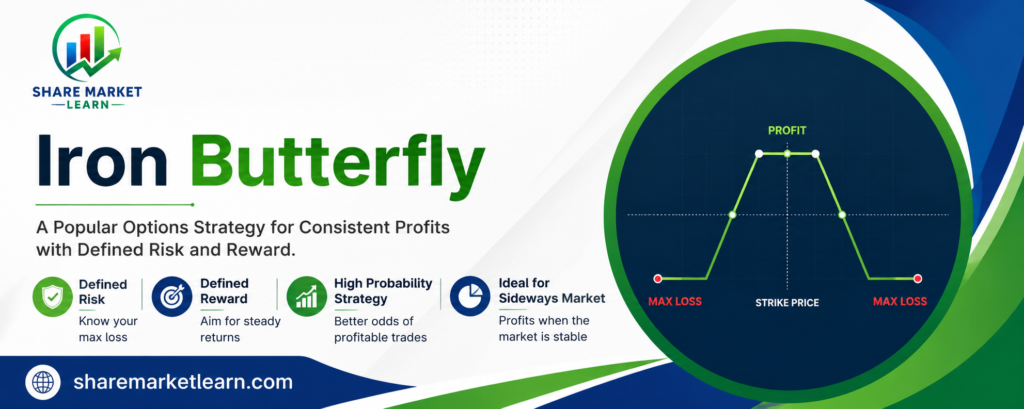
If you are learning options trading, you may come across strategy names that sound complicated at first. Iron Butterfly is one such strategy. But once you understand its structure, it becomes much easier to see how it works and when traders might consider using it.
The Iron Butterfly is an options strategy designed for a market that is expected to stay within a relatively narrow range. Instead of trying to predict whether the market will go strongly up or down, the trader is essentially saying, “I expect the price to remain around a particular level.”
This makes the strategy particularly interesting for traders who have a neutral market outlook.
In this article, we will explain the Iron Butterfly in simple language, including its structure, how it works, maximum profit and loss, advantages, disadvantages, and some frequently asked questions.
What Is an Iron Butterfly?
An Iron Butterfly is a four-leg options strategy that combines a bull put spread and a bear call spread.
It generally involves:
- Buying one lower-strike put
- Selling one higher-strike put
- Selling one call at the central strike
- Buying one higher-strike call
All four options normally have the same expiration date.
The middle strike is usually the most important part of the strategy because the trader generally wants the underlying asset to finish close to this strike at expiration.
For example, imagine a stock is trading around ₹1,000.
A trader could construct an Iron Butterfly around the ₹1,000 strike:
- Buy ₹950 Put
- Sell ₹1,000 Put
- Sell ₹1,000 Call
- Buy ₹1,050 Call
The exact strikes and premium received will depend on market conditions.
How Does an Iron Butterfly Work?
The basic idea is relatively simple.
The trader receives a net premium when establishing the position, assuming the premiums received from the short options are greater than the premiums paid for the long options.
The trader hopes that the underlying asset stays near the middle strike price until expiration.
If the stock expires exactly at the middle strike, both short options can expire worthless while the purchased options also provide protection against a large price move.
This is where the strategy can potentially produce its maximum profit.
However, if the market moves significantly above or below the outer strikes, the strategy can experience its maximum loss.
Iron Butterfly Example
Let’s take a simple example.
Suppose a stock is trading at ₹1,000.
A trader creates the following position:
| Option | Action | Strike |
|---|---|---|
| Put | Buy | ₹950 |
| Put | Sell | ₹1,000 |
| Call | Sell | ₹1,000 |
| Call | Buy | ₹1,050 |
Suppose the trader receives a net premium of ₹20 per share.
The maximum profit would generally be the premium received.
So:
Maximum Profit = ₹20 per share
The distance between the middle strike and either outer strike is ₹50.
Therefore:
Maximum Loss = ₹50 − ₹20 = ₹30 per share
This is a simplified example. Brokerage, taxes, transaction costs, and actual option pricing can affect the real result.
Maximum Profit in an Iron Butterfly
The maximum profit occurs when the underlying asset finishes at the short strike at expiration.
In our example, the short strike is ₹1,000.
If the stock expires at ₹1,000, the trader can potentially keep the entire net premium received.
The basic formula is:
Maximum Profit = Net Premium Received
For traders using the strategy, this is an important concept because the profit potential is limited from the beginning.
Maximum Loss in an Iron Butterfly
One of the attractive features of an Iron Butterfly is that the potential loss is defined.
The purchased outer options provide protection if the market moves strongly.
For an equally spaced Iron Butterfly:
Maximum Loss = Strike Width − Net Premium Received
For example:
- Strike width = ₹50
- Premium received = ₹20
Therefore:
Maximum Loss = ₹30 per share
This makes it easier to calculate the risk before entering the trade.
Breakeven Points
An Iron Butterfly generally has two breakeven points.
They can be calculated as:
Lower Breakeven = Middle Strike − Net Premium
Upper Breakeven = Middle Strike + Net Premium
Using our example:
- Middle strike = ₹1,000
- Net premium = ₹20
Therefore:
Lower Breakeven = ₹980
Upper Breakeven = ₹1,020
So, at expiration, the strategy can potentially be profitable when the underlying price remains between these two breakeven levels.
When Is an Iron Butterfly Used?
The Iron Butterfly is generally considered when a trader has a neutral or range-bound market outlook.
A trader may consider the strategy when they believe:
- The market will remain relatively stable
- The underlying asset may trade around a specific price
- Volatility may decrease
- There is limited expectation of a major price movement
For example, if an index is trading around a particular level and a trader believes it may remain near that level until expiry, an Iron Butterfly may be considered.
However, market conditions can change quickly, so having a neutral outlook does not guarantee a profitable trade.
Iron Butterfly and Implied Volatility
Implied volatility (IV) plays an important role in options pricing.
Since an Iron Butterfly involves selling options around the central strike and buying options farther away, changes in implied volatility can affect the position.
Generally, traders who use this strategy often prefer conditions where volatility is expected to fall after entering the trade.
However, this does not mean every volatility decline will automatically produce a profit.
The effect of volatility depends on factors such as:
- Time to expiration
- Strike prices
- Option premiums
- Distance from the central strike
- Changes in the underlying price
Iron Butterfly vs Iron Condor
The Iron Butterfly and Iron Condor are both popular neutral options strategies, but there is an important difference.
In an Iron Butterfly, the two short options generally have the same strike price.
In an Iron Condor, the short put and short call have different strike prices.
This means the Iron Butterfly has a narrower profit zone around the central strike.
An Iron Condor generally provides a wider range in which the trader can potentially make a profit, but the premium received may also be different.
In simple terms:
Iron Butterfly: Narrower profit zone, centered around one strike.
Iron Condor: Wider profit zone, with separate short strikes.
Advantages of an Iron Butterfly
There are several reasons traders may find this strategy interesting.
1. Defined Risk
The maximum potential loss can be calculated before entering the trade.
2. Defined Profit
The maximum profit is also limited and generally equal to the net premium received.
3. Neutral Strategy
It can be useful when the trader expects the market to remain around a particular price.
4. Can Benefit From Time Decay
Because the strategy contains short options, theta decay can potentially work in the trader’s favor when the underlying remains near the target area.
5. Structured Risk Management
Unlike an uncovered short straddle, the long outer options provide protection against extreme price movements.
Disadvantages of an Iron Butterfly
The strategy also has risks.
1. Limited Profit
The maximum profit is capped at the premium received.
2. Limited Profit Zone
The market generally needs to remain close to the central strike for the best outcome.
3. Large Market Moves Can Hurt
A strong move in either direction can push the position toward its maximum loss.
4. Requires Options Knowledge
Understanding Greeks, premiums, expiration, and strike selection is important before trading this strategy.
5. Transaction Costs
Four option legs can result in higher brokerage and transaction costs compared with simpler strategies.
Important Greeks to Understand
Before trading an Iron Butterfly, it helps to understand the basic option Greeks.
Delta: Shows how sensitive the option price is to changes in the underlying asset.
Theta: Measures the effect of time decay. Short options generally benefit from time passing, all else being equal.
Vega: Measures sensitivity to changes in implied volatility.
Gamma: Measures how quickly delta changes as the underlying price moves.
Understanding these Greeks can help traders evaluate how an Iron Butterfly may behave before and after entering a position.
Is Iron Butterfly Suitable for Beginners?
The Iron Butterfly can look attractive because its risk is defined, but that does not mean it is automatically suitable for beginners.
New traders should first understand:
- Call and put options
- Strike prices
- Expiration dates
- Option premiums
- Intrinsic and extrinsic value
- Implied volatility
- Option Greeks
- Position sizing
- Risk management
It can also be useful to study the strategy using paper trading or historical examples before risking real money.
Final Thoughts
The Iron Butterfly is a structured options strategy designed primarily for a neutral market outlook. It combines four options and aims to generate a limited profit if the underlying asset remains close to the central strike.
Its biggest advantages are defined risk, defined profit, and the potential benefit from time decay. At the same time, the strategy requires the underlying price to stay within a relatively specific range, and a strong market move can result in losses.
The key is not simply knowing how to create an Iron Butterfly. Traders should also understand why they are using it, where their breakeven points are, how much they can lose, and how the position may behave as expiration approaches.
Options trading involves substantial risk, and examples in this article are for educational purposes only—not financial advice.
Frequently Asked Questions (FAQs)
What is an Iron Butterfly in options trading?
An Iron Butterfly is a four-leg, defined-risk options strategy that is generally used when a trader expects the underlying asset to remain close to a specific price.
Is an Iron Butterfly bullish or bearish?
Neither. It is generally considered a neutral strategy because it benefits most when the underlying price stays near the central strike.
What is the maximum profit?
The maximum profit is generally the net premium received when establishing the position.
What is the maximum loss?
For an equally spaced structure, maximum loss is generally the distance between strikes minus the net premium received.
How many options are used in an Iron Butterfly?
An Iron Butterfly normally uses four option contracts or four option legs: two puts and two calls.
Is an Iron Butterfly risky?
Yes. Although the risk is defined, the strategy can still result in a significant loss if the underlying asset moves sharply away from the central strike.
What is the difference between an Iron Butterfly and an Iron Condor?
The key difference is the placement of the short strikes. An Iron Butterfly normally has the short call and short put at the same strike, while an Iron Condor uses different short strikes.
Can an Iron Butterfly benefit from time decay?
Yes. Since the strategy includes short options, time decay can potentially benefit the position, particularly when the underlying remains near the central strike.