
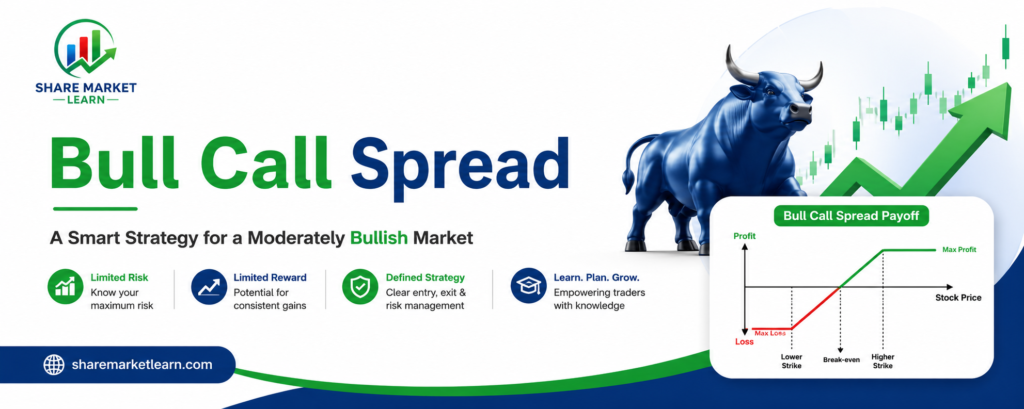
If you believe a stock or index is likely to rise but don’t want to take unlimited risk by simply buying a call option, a Bull Call Spread can be an interesting options trading strategy.
It is a beginner-friendly bullish strategy that combines two call options with different strike prices. The strategy aims to benefit from a moderate increase in the underlying asset while keeping the maximum potential loss limited.
In this article, we’ll explain what a Bull Call Spread is, how it works, how to calculate profit and loss, and when traders may consider using it.
What Is a Bull Call Spread?
A Bull Call Spread is an options strategy used when a trader expects the price of an underlying asset to increase moderately.
It involves:
- Buying one Call Option at a lower strike price.
- Selling one Call Option at a higher strike price.
- Both options normally have the same expiry date and the same underlying asset.
Because you buy one call and sell another call, the cost of the strategy is usually lower than buying a call option alone.
The trade-off is that your potential profit is also limited.
Simple Example
Suppose a stock is currently trading at ₹100.
You expect it to move toward ₹115 over the next few weeks.
You could:
- Buy ₹100 Call for ₹8
- Sell ₹115 Call for ₹3
Your net premium paid is:
₹8 − ₹3 = ₹5
So, the maximum amount you can lose is generally ₹5 per share, excluding brokerage, taxes, and other trading costs.
If the stock rises significantly above ₹115, your profit is capped because the call you sold limits your upside.
How Does a Bull Call Spread Work?
The strategy has a straightforward structure.
You purchase a call option with a lower strike price and simultaneously sell a call option with a higher strike price.
The lower-strike call gives you bullish exposure to the underlying asset. The short higher-strike call helps reduce the initial cost of the trade.
For example:
| Position | Strike Price | Premium |
|---|---|---|
| Buy Call | ₹100 | ₹8 |
| Sell Call | ₹115 | ₹3 |
| Net Debit | — | ₹5 |
The trader pays a net premium of ₹5 to establish the spread.
There are three important levels to understand:
- Maximum loss
- Break-even point
- Maximum profit
Understanding these levels is essential before entering the trade.
Maximum Loss in a Bull Call Spread
The maximum loss is limited to the net premium paid to create the spread.
In our example:
- Premium paid for ₹100 Call = ₹8
- Premium received from ₹115 Call = ₹3
- Net debit = ₹5
Therefore, the maximum loss is:
₹5 per share
This maximum loss occurs if the underlying asset finishes at or below the lower strike price at expiry, assuming the options are held until expiry.
This limited-risk feature is one reason traders may prefer a Bull Call Spread over simply buying a call.
Maximum Profit in a Bull Call Spread
The maximum profit is also limited.
The basic formula is:
Maximum Profit = Strike Price Difference − Net Premium Paid
In our example:
- Higher strike = ₹115
- Lower strike = ₹100
- Strike difference = ₹15
- Net premium = ₹5
Therefore:
Maximum Profit = ₹15 − ₹5 = ₹10 per share
The maximum profit occurs when the underlying asset finishes at or above the higher strike price at expiry.
So the trade has:
- Maximum loss: ₹5 per share
- Maximum profit: ₹10 per share
Remember that actual trading results can differ because of transaction costs, taxes, bid-ask spreads, and changes in the position before expiry.
Break-Even Point
The break-even point tells you the underlying price at which the strategy neither makes nor loses money at expiry, before trading costs.
The formula is:
Break-Even = Lower Strike Price + Net Premium Paid
Using our example:
₹100 + ₹5 = ₹105
Therefore, the break-even price is ₹105.
At expiry:
- Below ₹105 → potential loss
- At ₹105 → approximately break-even
- Above ₹105 → potential profit
- At or above ₹115 → maximum profit
Bull Call Spread Payoff Example
Let’s make the example even simpler.
Suppose you create the following spread:
Buy ₹100 Call @ ₹8
Sell ₹115 Call @ ₹3
Net premium = ₹5
Now consider different expiry prices.
| Stock Price at Expiry | Approx. Result |
|---|---|
| ₹95 | Maximum loss |
| ₹100 | Maximum loss |
| ₹105 | Break-even |
| ₹110 | Profit |
| ₹115 | Maximum profit |
| ₹120 | Maximum profit |
Notice something important: once the stock reaches ₹115, your profit doesn’t continue increasing.
That’s because the short ₹115 call offsets further gains from the long ₹100 call.
When Should You Use a Bull Call Spread?
A Bull Call Spread may be considered when you have a moderately bullish outlook.
For example, you believe an index currently at 20,000 could move toward 20,500, but you don’t necessarily expect a huge rally.
Instead of buying a call option outright, you could construct a Bull Call Spread using two different strike prices.
The strategy can be useful when:
- You expect a moderate price increase.
- You want defined maximum risk.
- You want to reduce the cost of buying a call.
- You are comfortable with limited maximum profit.
However, no options strategy guarantees a profit.
Advantages of a Bull Call Spread
1. Limited Risk
Your maximum loss is generally known when you enter the trade: the net premium paid.
2. Lower Cost Than a Long Call
Selling the higher-strike call generates premium income, reducing the upfront cost.
3. Suitable for Moderate Bullish Views
You don’t need an unlimited rally. You need the underlying asset to move sufficiently upward for the spread to become profitable.
4. Defined Profit and Loss
Before entering the trade, you can calculate the maximum potential profit and maximum potential loss.
Disadvantages of a Bull Call Spread
The strategy also has some limitations.
1. Profit Is Limited
Even if the stock rises dramatically, your maximum profit remains capped at the difference between the strikes minus the net premium paid.
2. The Underlying Must Move Enough
If the price doesn’t rise above the break-even point by expiry, the trade may lose money.
3. Options Pricing Can Change
Before expiry, the value of the spread can be affected by factors such as implied volatility, time decay, and changes in the underlying price.
4. Requires Understanding of Two Options
Beginners need to understand both the bought call and the sold call, including their strike prices and expiry.
Bull Call Spread vs Buying a Call
The biggest difference is the balance between risk, cost, and potential reward.
Buying a Call:
- Usually higher upfront premium
- Potentially much larger upside
- Maximum loss is the premium paid
- Simpler structure
Bull Call Spread:
- Usually lower upfront cost
- Maximum profit is limited
- Maximum loss is limited to the net debit
- Uses two call options
A Bull Call Spread can therefore be attractive when you are bullish but expect a controlled or moderate upward move rather than an explosive rally.
Common Mistakes Beginners Should Avoid
One common mistake is choosing strike prices without calculating the maximum profit, maximum loss, and break-even point first.
Another mistake is focusing only on the probability of profit while ignoring the potential reward-to-risk relationship.
Traders should also remember that options can behave differently before expiry than they do at expiry. Changes in implied volatility and time remaining can affect the value of the spread.
Always understand the complete payoff structure before placing an options trade.
Frequently Asked Questions About Bull Call Spread
Is a Bull Call Spread bullish?
Yes. It is generally used when a trader expects the underlying asset to rise moderately.
Is a Bull Call Spread risky?
It carries risk, but the maximum loss is generally limited to the net premium paid when the spread is established for a debit.
What is the maximum profit?
Maximum profit equals the difference between the two strike prices minus the net premium paid, before transaction costs.
What is the maximum loss?
Maximum loss is generally the net premium paid to establish the spread.
Is a Bull Call Spread good for beginners?
It can be easier to manage than some multi-leg strategies because the maximum profit and loss can be calculated in advance. However, beginners should understand options pricing and risk before trading with real money.
What happens if the stock stays below the lower strike?
If held until expiry, both calls can expire worthless and the trader generally loses the net premium paid.
What happens if the stock goes above the higher strike?
At expiry, the spread reaches its maximum profit because gains on the long call are offset by losses on the short call beyond the higher strike.
Conclusion
A Bull Call Spread is a defined-risk options strategy designed for traders who expect an underlying asset to move higher, but not necessarily dramatically higher.
By buying a lower-strike call and selling a higher-strike call with the same expiry, traders can reduce the upfront cost compared with buying a call outright. In exchange, they accept a limit on their maximum profit.
The most important numbers to calculate before entering the trade are the maximum loss, maximum profit, and break-even price.
If you’re learning options trading, understanding these three numbers is a great starting point. Always consider your risk tolerance, trading costs, and market conditions before entering any options position.