
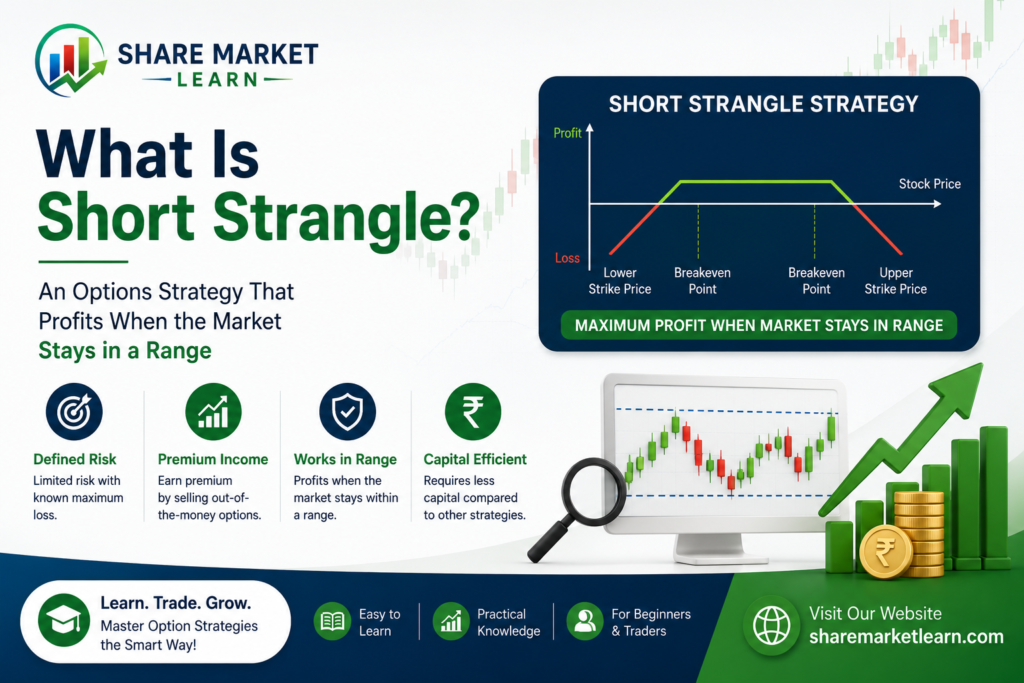
Options trading offers many strategies designed for different market conditions. Some strategies are used when traders expect a strong price movement, while others are designed for markets that are expected to remain within a particular range.
The Short Strangle is one such options strategy. It is generally used when a trader expects the underlying asset to remain within a certain range until expiry and wants to benefit from the option premiums received.
In simple terms, a Short Strangle involves selling an out-of-the-money call option and an out-of-the-money put option with the same expiry date but different strike prices.
It can generate premium income, but it also carries significant risk if the underlying asset makes a large move.
Let’s understand the Short Strangle strategy step by step.
What Is a Short Strangle?
A Short Strangle is an options strategy that involves selling two options:
- One out-of-the-money (OTM) call option
- One out-of-the-money (OTM) put option
Both options generally have:
- The same underlying asset
- The same expiry date
- Different strike prices
The trader receives premiums for selling both options.
The strategy generally works best when the underlying asset remains between the two strike prices and does not make a large move before expiry.
For example, suppose an index is trading at ₹20,000.
A trader might sell:
- ₹20,300 Call
- ₹19,700 Put
The trader receives premiums from both options.
If the index remains between ₹19,700 and ₹20,300 at expiry, both options could potentially expire worthless, allowing the trader to keep the premiums, before transaction costs.
How Does a Short Strangle Work?
The basic idea is straightforward.
The trader believes that the underlying asset will not move too far in either direction.
Instead of predicting exactly where the market will finish, the trader creates a range.
For example:
Upper strike: ₹20,300
Lower strike: ₹19,700
The trader wants the underlying to stay between these levels.
If the price remains within this range, both options may lose value as expiry approaches.
This is where time decay, or theta, can benefit the option seller.
However, if the market moves sharply beyond one of the strikes, the position can start generating losses.
Simple Short Strangle Example
Let’s take a simple example.
Suppose an index is trading at ₹20,000.
You sell:
- ₹20,300 Call for ₹50
- ₹19,700 Put for ₹40
Total premium received:
₹50 + ₹40 = ₹90
This ₹90 is the maximum potential profit per unit before transaction costs if both options expire worthless.
The approximate break-even levels are:
Upper Break-Even = Upper Strike + Total Premium
₹20,300 + ₹90 = ₹20,390
Lower Break-Even = Lower Strike − Total Premium
₹19,700 − ₹90 = ₹19,610
So, at expiry, the position can potentially be profitable if the underlying remains between approximately ₹19,610 and ₹20,390, before transaction costs.
What Is the Maximum Profit?
The maximum profit in a Short Strangle is generally limited to the total premium received.
Using the example above:
- Call premium = ₹50
- Put premium = ₹40
- Total premium = ₹90
Maximum profit = ₹90 per unit
This maximum profit occurs if both options expire worthless.
The underlying must finish between the two short strikes at expiry for both options to expire out of the money.
What Is the Maximum Loss?
This is one of the most important things to understand about a Short Strangle.
The potential loss can be very large.
The short call can create potentially unlimited losses if the underlying price rises significantly.
For example, if the index suddenly rises far above the call strike, the short call can become deeply in the money.
On the downside, the short put can also create substantial losses if the underlying falls sharply.
Therefore:
Maximum profit = Limited
Potential loss = Very large
This makes risk management extremely important when using a Short Strangle.
Short Strangle and Time Decay
One of the major reasons traders use a Short Strangle is time decay.
Options have a time component known as time value. As the expiry date gets closer, that time value generally decreases, assuming other factors remain unchanged.
This process is called theta decay.
For an option seller, time decay can work in their favor.
If the underlying asset stays relatively stable, the premiums of the sold options may decrease as expiry approaches.
A trader may then be able to buy back the options at a lower price or allow them to expire worthless, depending on the situation.
However, time decay does not eliminate the risk of a sudden market movement.
Short Strangle and Implied Volatility
Another important concept is implied volatility (IV).
Implied volatility reflects the market’s expectations about potential future price movement and is an important factor in option pricing.
When implied volatility is high, option premiums may be relatively expensive.
An option seller may receive a larger premium when selling options in a high-IV environment.
But there is a catch.
High implied volatility often means the market expects larger price movements. If the market makes a sharp move, the Short Strangle can suffer significant losses.
Therefore, traders should never look at premium income alone.
Short Strangle vs. Short Straddle
The Short Strangle is often compared with a Short Straddle.
Both strategies involve selling a call and a put.
The key difference is the strike prices.
Short Strangle
- Sell OTM call
- Sell OTM put
- Different strike prices
- Wider profit range
- Generally lower premium than a comparable short straddle
- Large risk if the market moves strongly
Short Straddle
- Sell ATM call
- Sell ATM put
- Same strike price
- Higher premium potential
- Narrower profit range
- Very high risk if the underlying moves sharply
In simple terms:
Short Strangle = Wider range, usually lower premium
Short Straddle = Narrower range, usually higher premium
Short Strangle vs. Iron Condor
A Short Strangle involves selling only the call and put.
An Iron Condor adds protective long options beyond those short strikes.
For example:
Short Strangle:
- Sell 20,300 Call
- Sell 19,700 Put
Iron Condor:
- Buy 20,500 Call
- Sell 20,300 Call
- Sell 19,700 Put
- Buy 19,500 Put
The additional long options can limit the maximum loss of the Iron Condor.
Therefore, an Iron Condor generally has defined risk, while a traditional Short Strangle has much greater potential risk.
When Do Traders Use a Short Strangle?
A trader may consider a Short Strangle when they expect:
- Low or moderate volatility
- The underlying to remain within a range
- Option premiums to decrease
- Time decay to work in their favor
Some traders may use the strategy around periods when they expect the market to remain relatively stable.
However, unexpected events can cause sudden price movements.
Examples include:
- Major economic announcements
- Central bank decisions
- Company results
- Elections
- Geopolitical events
- Unexpected company news
Because of these risks, traders need a clear plan before entering the trade.
Advantages of Short Strangle
1. Premium Income
The trader receives premiums from both the call and put.
2. Wider Profit Range
Compared with a short straddle, the Short Strangle generally has a wider range within which the position can remain profitable at expiry.
3. Benefits From Time Decay
If the underlying remains within the expected range, time decay can benefit the option seller.
4. Flexible Strike Selection
Traders can choose strike prices based on their expected trading range and risk tolerance.
Disadvantages of Short Strangle
1. Significant Risk
A large market movement can create substantial losses.
2. Margin Requirement
Selling options usually requires margin, and the requirement can change depending on the broker, exchange, volatility, and position.
3. Sudden Volatility
A sudden increase in volatility can increase option prices and hurt a short position.
4. Risk Management Is Essential
Without appropriate risk controls, losses can grow quickly.
Is Short Strangle Suitable for Beginners?
A Short Strangle is generally not an ideal first options strategy for beginners because it involves selling uncovered options and can expose the trader to significant losses.
Before considering this strategy, a beginner should understand:
- Call and put options
- Strike prices
- Option premiums
- Expiry
- Time decay
- Implied volatility
- Margin
- Break-even points
- Position sizing
- Risk management
Beginners may first study the strategy through paper trading or simulations before considering real-money trading.
Frequently Asked Questions About Short Strangle
What is a Short Strangle in options?
A Short Strangle involves selling an out-of-the-money call and an out-of-the-money put with the same expiry but different strike prices.
Is a Short Strangle bullish or bearish?
A Short Strangle is generally considered a neutral strategy. The trader expects the underlying to remain within a particular range.
What is the maximum profit?
The maximum profit is generally limited to the total premiums received from selling the call and put.
Can a Short Strangle have unlimited loss?
Yes. The short call can create potentially unlimited losses if the underlying price rises sharply. The short put can also create substantial losses if the underlying falls sharply.
Is Short Strangle better than Short Straddle?
Neither is automatically better. A Short Strangle generally provides a wider range for the underlying to remain profitable at expiry, while a Short Straddle generally collects more premium but has a narrower profit range.
How does time decay affect a Short Strangle?
Time decay can benefit the option seller because the time value of the sold options generally decreases as expiry approaches, assuming other factors remain unchanged.
Can beginners trade Short Strangle?
Beginners should be cautious. Because of the significant potential risk, it is important to understand option selling, margin requirements, volatility, and risk management before trading a Short Strangle.
Conclusion
The Short Strangle option strategy is a neutral options strategy designed for situations where a trader expects an underlying asset to remain within a specific range.
It involves selling an out-of-the-money call and an out-of-the-money put with the same expiry date but different strike prices. The trader receives premiums from both options and can potentially profit if the underlying remains between the break-even levels.
The biggest advantage is the wider profit range compared with a Short Straddle. The biggest disadvantage is the significant potential loss if the market makes a strong move.
The easiest way to remember it is:
Short Strangle = Sell OTM Call + Sell OTM Put + Expect a Range-Bound Market.
Before using this strategy, always calculate your break-even levels, maximum potential loss, margin requirement, and transaction costs. Most importantly, never assume that a stable market will remain stable until expiry.