
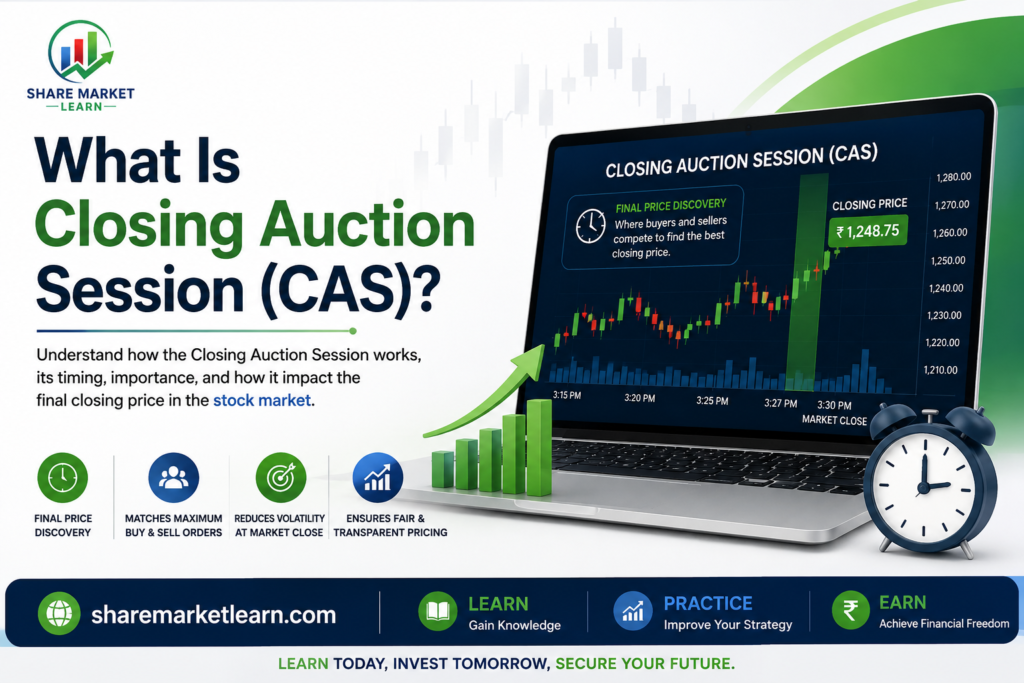
If you follow the stock market, you may have noticed that trading does not always simply stop at the end of regular market hours. Before the market officially closes, exchanges may use a special process to determine the closing price of securities.
This process is commonly known as the Closing Auction Session (CAS) or closing auction.
But what exactly is a Closing Auction Session? How does it work? Why is it important? And how is the closing price calculated?
In this simple guide, we will explain what Closing Auction Session (CAS) is, how the auction process works, why exchanges use it, and what investors and traders should know.
Important: This article is for educational purposes only and should not be considered financial or investment advice.
What Is Closing Auction Session (CAS)?
Closing Auction Session (CAS) is a special trading mechanism used by a stock exchange near the end of the regular trading session to determine a fair and representative closing price for a security.
Instead of matching every order continuously as in normal trading, an auction collects eligible buy and sell orders and uses them to determine a price at which the greatest possible quantity can be matched.
In simple words:
Closing Auction = A process used to determine the closing price by matching eligible buy and sell orders at a single auction price.
The closing price is important because it is used for many purposes, including calculating daily returns, portfolio values, and certain index-related calculations.
Why Is the Closing Price Important?
You may wonder why exchanges need a special process to determine the closing price.
The closing price is used by investors, brokers, fund managers, analysts, and financial institutions for many calculations.
For example, suppose a stock trades throughout the day between ₹490 and ₹510.
The final traded price before the regular session ends may be ₹505.
However, if there are many buy and sell orders around different prices, simply using the last transaction may not always represent the market’s overall closing interest.
An auction mechanism can help establish a more representative closing price based on available orders.
How Does the Closing Auction Session Work?
The exact rules and timings of a closing auction vary between stock exchanges.
Generally, the process can be understood in several stages.
1. Orders Are Collected
During the auction period, eligible buy and sell orders are collected.
These orders may include different quantities and prices.
For example:
Buy Orders
- ₹500 — 1,000 shares
- ₹499 — 2,000 shares
- ₹498 — 1,500 shares
Sell Orders
- ₹500 — 1,200 shares
- ₹501 — 2,000 shares
- ₹502 — 1,000 shares
The exchange collects this information before determining the auction price.
2. The Exchange Determines the Auction Price
The exchange evaluates the available buy and sell orders.
The goal is generally to determine an auction price that allows the maximum possible quantity of shares to be matched, subject to the exchange’s rules.
3. Orders Are Matched
Once the auction price is determined, eligible orders are matched according to the exchange’s rules.
The resulting price becomes the relevant closing price for the security.
What Is an Auction Price?
The auction price is the price determined through the auction process at which eligible buy and sell orders can be matched.
One of the key principles of an auction mechanism is to maximize the quantity of securities that can be traded at the determined price.
The exchange may also use additional rules to resolve situations where more than one price could result in similar trading quantities.
Because these rules differ between exchanges, traders should always check the relevant exchange’s official specifications.
Closing Auction vs Normal Trading
There is an important difference between continuous trading and an auction.
Continuous Trading
During normal market hours, buy and sell orders can be matched continuously when compatible prices are available.
For example:
A buyer is willing to pay ₹500.
A seller is willing to sell at ₹500.
The orders may be matched immediately.
Closing Auction
During a closing auction, eligible orders are collected during a specific auction period.
The exchange then determines a single auction price based on the available orders and its matching methodology.
This creates a more structured process for establishing the closing price.
What Is the Purpose of Closing Auction?
The main purpose of a closing auction is to create a fair and transparent mechanism for determining the closing price.
Some important objectives include:
Better Price Discovery
An auction allows multiple buy and sell orders to participate in determining the closing price.
Reduced Impact of a Single Trade
Instead of relying only on one final transaction, the auction can consider a broader set of eligible orders.
Improved Market Efficiency
The auction mechanism can help bring together buyers and sellers around the end of the trading session.
Reference Price for Investors
The resulting closing price becomes an important reference point for investors and financial calculations.
Why Traders Should Understand Closing Auctions
Even if you are a long-term investor, understanding closing auctions can be useful.
For traders, the closing auction may be particularly important because significant orders can enter the market near the end of the session.
This can sometimes create noticeable changes in the price or trading volume around the close.
For example, institutional investors may need to execute large transactions related to portfolio rebalancing, benchmark tracking, or other requirements.
This can contribute to increased activity near the market close.
Closing Auction and Market Volatility
The closing auction does not necessarily mean that the market will become more volatile.
However, when there is a significant imbalance between buying and selling interest, the auction price can differ from the price seen immediately before the auction.
For example, suppose a stock is trading around ₹1,000 before the closing auction.
If there is strong buying interest at the end of the session, the final auction price could be higher than ₹1,000.
Similarly, strong selling interest could result in a lower auction price.
The final outcome depends on the orders participating in the auction and the exchange’s matching rules.
What Is Order Imbalance?
Order imbalance occurs when there is significantly more buying interest than selling interest, or vice versa.
For example:
Buying interest: 100,000 shares
Selling interest: 60,000 shares
This indicates a greater quantity of buy-side interest at the relevant prices.
An imbalance can influence the eventual auction price as the exchange determines the price at which orders can be matched.
Some trading platforms may display auction-related information, but the availability and format depend on the exchange and broker.
Is Closing Auction the Same as Closing Price?
Not exactly.
The Closing Auction Session is the process.
The closing price is the price determined through the exchange’s prescribed closing-price methodology, which may involve the closing auction.
Therefore:
Closing Auction = Process
Closing Price = Result/reference price
The exact definition of the official closing price can vary by exchange and security.
Closing Auction in the Indian Stock Market
In India, exchanges such as the National Stock Exchange of India (NSE) and BSE Ltd. have specific procedures governing their closing processes.
The exact timings, eligible securities, order types, matching rules, and closing-price methodology can change based on exchange regulations.
For this reason, investors should refer to the latest official exchange rules rather than relying on a generic explanation of auction timings.
This is especially important if you are actively trading during the final part of the session.
Can Retail Investors Participate in a Closing Auction?
Whether a retail investor can participate, and which orders are eligible, depends on the exchange, security, trading segment, broker, and applicable rules.
Some exchanges allow eligible orders from market participants to participate in the closing auction.
However, traders should check their broker’s platform and the relevant exchange’s current rules before placing an order specifically for an auction session.
Do not assume that an order placed near market close will automatically participate in the closing auction.
Important Things Beginners Should Remember
If you are new to the stock market, keep these points in mind:
1. Check Exchange Rules
Auction procedures differ between exchanges and markets.
2. Don’t Confuse Auction With Regular Trading
The order-matching mechanism during an auction is different from continuous trading.
3. Understand Your Order Type
Not every order may be eligible for every auction mechanism.
4. Watch the Closing Price Carefully
The final closing price may differ from the last price you saw during continuous trading.
5. Avoid Unnecessary Last-Minute Trading
If you do not understand the auction process, avoid placing trades simply because the market is about to close.
Example of a Closing Auction
Let’s use a simplified example.
Suppose a stock is trading around ₹250 before the closing process.
During the auction, the exchange receives the following eligible orders:
Buyers
- ₹250 — 10,000 shares
- ₹249 — 8,000 shares
- ₹248 — 5,000 shares
Sellers
- ₹250 — 7,000 shares
- ₹251 — 10,000 shares
- ₹252 — 6,000 shares
The exchange evaluates the order book according to its auction rules and determines the price that provides the best possible match.
Suppose the resulting auction price is ₹250.
The eligible orders that can be matched at that price are executed according to the exchange’s rules, and ₹250 becomes the relevant closing price.
This is a simplified example. Actual exchange calculations can involve more complex rules and order types.
Advantages of Closing Auction Sessions
Closing auctions can offer several benefits:
- More structured closing-price discovery
- Participation from multiple orders
- Greater transparency around the closing process
- Reduced dependence on a single final transaction
- Useful reference price for investors and institutions
The effectiveness of the mechanism depends on the exchange’s rules, market liquidity, and participation.
Conclusion
So, what is Closing Auction Session (CAS)?
A Closing Auction Session is a special mechanism used near the end of a trading session to help determine a fair and representative closing price for eligible securities.
Instead of matching orders continuously, the auction collects eligible buy and sell orders and determines a price based on the exchange’s prescribed methodology.
For beginners, the most important thing to understand is that the closing auction is a price-discovery process, not simply another name for the final few minutes of normal trading.
Understanding CAS can help traders and investors better understand why the closing price may sometimes differ from the last price seen during continuous trading.
Before participating in any closing auction, always check the latest rules of the relevant stock exchange and your broker’s order-entry system.
Frequently Asked Questions (FAQs)
1. What does CAS stand for in the stock market?
CAS can refer to Closing Auction Session, a mechanism used to determine a closing price through an auction process.
2. What is the purpose of a Closing Auction Session?
Its main purpose is to provide a structured mechanism for price discovery and determination of the closing price.
3. Is Closing Auction the same as normal trading?
No. Normal trading generally matches compatible orders continuously, while a closing auction collects eligible orders and determines an auction price according to specific rules.
4. Can the closing auction price differ from the last traded price?
Yes. The auction price can differ from the price of the last transaction during continuous trading because the auction considers eligible orders participating in the closing process.
5. Why is the closing price important?
The closing price is used as an important reference for daily market performance, portfolio valuation, returns, indices, and other financial calculations.
6. Can retail investors participate in a closing auction?
Participation depends on the exchange, security, broker, order type, and applicable rules. Investors should check the latest requirements before placing an auction-related order.
7. Does a closing auction increase volatility?
Not necessarily. However, significant buying or selling imbalances near the close can cause the auction price to differ from the price observed immediately beforehand.
8. Is Closing Auction important for day traders?
It can be important because trading activity and order flow near the market close can affect the final price. Day traders should understand the relevant exchange and broker rules.
9. What is order imbalance?
Order imbalance occurs when buying and selling interest differs significantly in quantity or price. Such imbalances can influence the price determined through an auction.
10. Is Closing Auction useful for long-term investors?
Yes. Long-term investors may not actively trade during the auction, but understanding how the official closing price is determined can help them interpret daily price movements and portfolio values.