
Introduction
One such reliable bullish reversal pattern is the Three Inside Up Candle Pattern. It is widely used by traders to identify the potential end of a downtrend and the beginning of an upward move.
In this article, you will learn what the Three Inside Up pattern is, how it forms, what it indicates, how to trade it, its advantages and limitations, and practical tips to improve your trading decisions.
What Is the Three Inside Up Candle Pattern?
The Three Inside Up Candle Pattern is a bullish reversal candlestick pattern that appears after a downtrend. It consists of three candles and signals that buyers may be gaining control over sellers.
Traders often use this pattern to identify potential buying opportunities when a falling market starts showing signs of strength.
The pattern combines the principles of the Harami pattern with confirmation from a third bullish candle, making it more reliable than many single-candle patterns.
Structure of the Three Inside Up Pattern
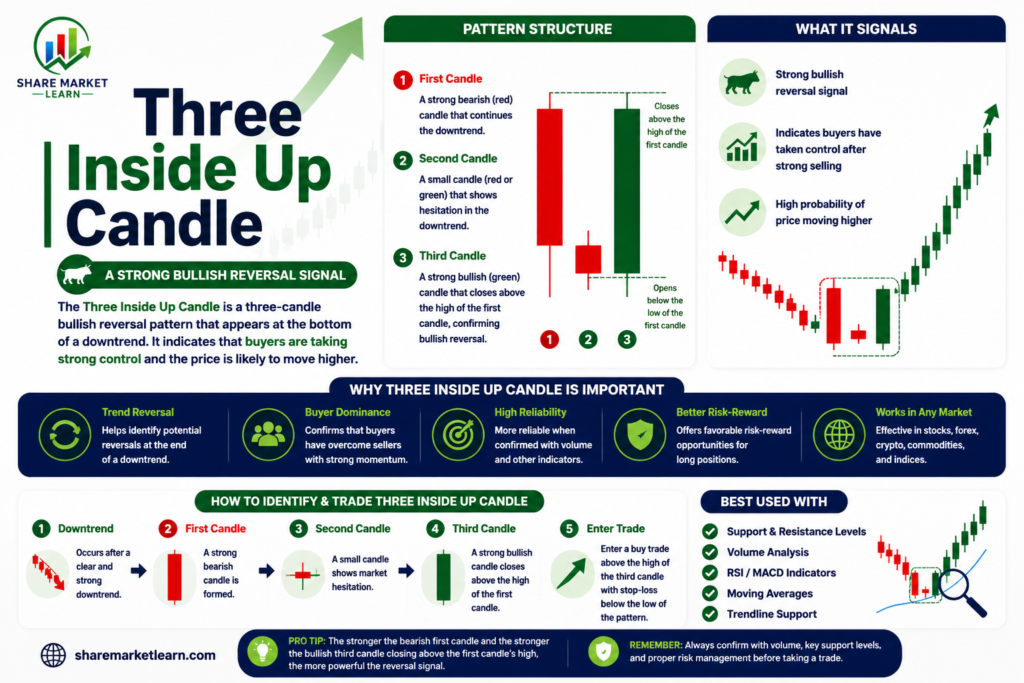
The pattern consists of three candles:
First Candle
The first candle is a large bearish candle.
- It appears during an existing downtrend.
- It reflects strong selling pressure.
- Sellers dominate the market during this phase.
Second Candle
The second candle is a smaller bullish candle.
- It opens and closes within the body of the first bearish candle.
- This candle indicates that selling pressure is weakening.
- Buyers begin to enter the market.
Third Candle
The third candle is a bullish confirmation candle.
- It closes above the closing price of the second candle.
- Ideally, it closes above the high of the first candle.
- This confirms that buyers have taken control.
How Does the Three Inside Up Pattern Work?
The Three Inside Up pattern reflects a gradual shift in market sentiment.
Initially, sellers control the market and push prices lower. However, the second candle suggests that the bearish momentum is losing strength. The appearance of the third bullish candle confirms that buyers are becoming more aggressive.
This transition from fear to confidence often signals a potential reversal from a downtrend to an uptrend.
Psychology Behind the Pattern
Understanding the psychology behind candlestick patterns can improve trading decisions.
Stage 1: Strong Bearish Sentiment
The first candle shows that sellers are confident. Most traders believe prices will continue to fall.
Stage 2: Market Uncertainty
The smaller second candle indicates hesitation. Sellers are losing momentum, and buyers begin testing the market.
Stage 3: Buyer Control
The third candle demonstrates renewed buying interest. Market participants gain confidence that the downtrend may be ending.
This shift in sentiment creates a bullish reversal signal.
How to Identify the Three Inside Up Pattern
Use the following checklist:
- A clear downtrend should exist before the pattern forms.
- The first candle must be a long bearish candle.
- The second candle should be bullish and remain within the first candle’s body.
- The third candle should be bullish and close above the second candle’s close.
- Increased trading volume can strengthen the signal.
If these conditions are met, traders may consider the possibility of a trend reversal.
How to Trade the Three Inside Up Pattern
Entry Point
Many traders enter a buy position after the third candle closes.
Some conservative traders wait for the next candle to move above the third candle’s high before entering.
Stop Loss Placement
Risk management is essential.
Common stop-loss locations include:
- Below the low of the third candle.
- Below the low of the entire pattern.
- Based on personal risk tolerance.
Profit Target
Profit targets can be determined using:
- Previous resistance levels.
- Risk-to-reward ratios such as 1:2 or 1:3.
- Technical indicators.
- Trailing stop-loss methods.
Example of the Three Inside Up Pattern
Imagine a stock declining for several trading sessions.
- Day 1: The stock closes significantly lower, creating a large bearish candle.
- Day 2: A small bullish candle forms within the first candle’s body.
- Day 3: A strong bullish candle closes higher and confirms buyer strength.
A trader observing this setup may decide to initiate a buy trade after confirmation while placing an appropriate stop loss.
Importance of Confirmation
Although the Three Inside Up pattern is considered reliable, confirmation is important.
Additional confirmation methods include:
Volume Analysis
Higher trading volume during the third candle indicates stronger buying participation.
Support Levels
Patterns forming near major support zones often have better success rates.
Technical Indicators
Indicators such as:
- Relative Strength Index (RSI)
- Moving Averages
- MACD
- Stochastic Oscillator
can support the bullish outlook.
Using multiple confirmations can improve the probability of successful trades.
Advantages of the Three Inside Up Pattern
Easy to Recognize
The three-candle structure makes it relatively simple for beginners to identify.
Strong Confirmation
Unlike some reversal patterns, the third candle provides additional confirmation.
Applicable Across Markets
The pattern can be used in:
- Stocks
- Commodities
- Forex
- Cryptocurrencies
- Indices
Suitable for Different Time Frames
Traders can use it on:
- Intraday charts
- Swing trading charts
- Daily charts
- Weekly charts
Limitations of the Pattern
Despite its usefulness, the pattern is not perfect.
False Signals
No candlestick pattern guarantees success. False breakouts can occur.
Requires Confirmation
Relying solely on the pattern without supporting analysis can increase risk.
Market Conditions Matter
During highly volatile or sideways markets, the pattern may produce less reliable signals.
Risk Management Is Essential
Even high-probability setups can fail. Proper position sizing and stop-loss placement remain critical.
Tips for Trading the Three Inside Up Pattern
To use this pattern more effectively, consider the following tips:
- Always identify the prevailing trend before acting.
- Wait for the third candle to close for confirmation.
- Use support and resistance levels.
- Combine the pattern with technical indicators.
- Follow a disciplined risk management strategy.
- Avoid emotional decision-making.
- Practice using historical charts before trading with real money.
Consistency and patience often matter more than finding perfect setups.
Three Inside Up vs Three Outside Up
Many beginners confuse these two patterns.
Three Inside Up
- Second candle forms inside the first candle’s body.
- Indicates a bullish reversal.
- Based on the Harami structure.
Three Outside Up
- Second candle completely engulfs the first candle.
- Also signals a bullish reversal.
- Based on the Bullish Engulfing pattern.
Both patterns can be effective when supported by confirmation signals.
Is the Three Inside Up Pattern Reliable?
The Three Inside Up pattern is generally considered a dependable bullish reversal pattern because it includes confirmation from three candles rather than a single candle.
However, its effectiveness depends on several factors:
- Market context.
- Volume confirmation.
- Support levels.
- Proper risk management.
- Trader discipline.
Experienced traders rarely depend on one indicator alone. Instead, they combine candlestick patterns with broader market analysis.
Conclusion
The Three Inside Up Candle Pattern is a valuable tool for traders seeking to identify potential bullish reversals after a downtrend. Its three-candle structure provides insight into changing market sentiment, moving from strong selling pressure to renewed buying interest.
While the pattern offers a higher degree of confidence through its built-in confirmation, it should not be used in isolation. Combining it with support levels, volume analysis, and technical indicators can significantly improve trading decisions.
Whether you are a beginner exploring candlestick patterns or an experienced trader refining your strategy, understanding the Three Inside Up pattern can help you make more informed decisions and approach the market with greater confidence.