
Introduction
Candlestick patterns play a vital role in technical analysis and help traders identify potential market reversals. Among the various bullish reversal patterns, the Bullish Piercing Candle Pattern, also known as the Piercing Line Pattern, is one of the most reliable signals that a downtrend may be coming to an end.
This pattern is widely used by stock market traders, forex traders, and cryptocurrency investors to spot potential buying opportunities. When identified correctly and combined with other technical indicators, the Bullish Piercing Candle Pattern can help traders make more informed decisions.
In this article, you’ll learn what the Bullish Piercing Candle Pattern is, how it forms, the psychology behind it, its advantages and limitations, and how to trade it effectively.
What Is a Bullish Piercing Candle Pattern?
The Bullish Piercing Candle Pattern is a two-candlestick bullish reversal pattern that appears after a downtrend. It indicates that buyers are beginning to gain control after a period of strong selling pressure.
The pattern consists of:
- A large bearish candle on the first day.
- A bullish candle on the second day that opens below the previous candle’s low and closes above the midpoint of the first candle’s body.
This strong recovery during the second candle suggests that buyers are stepping into the market and may trigger a trend reversal.
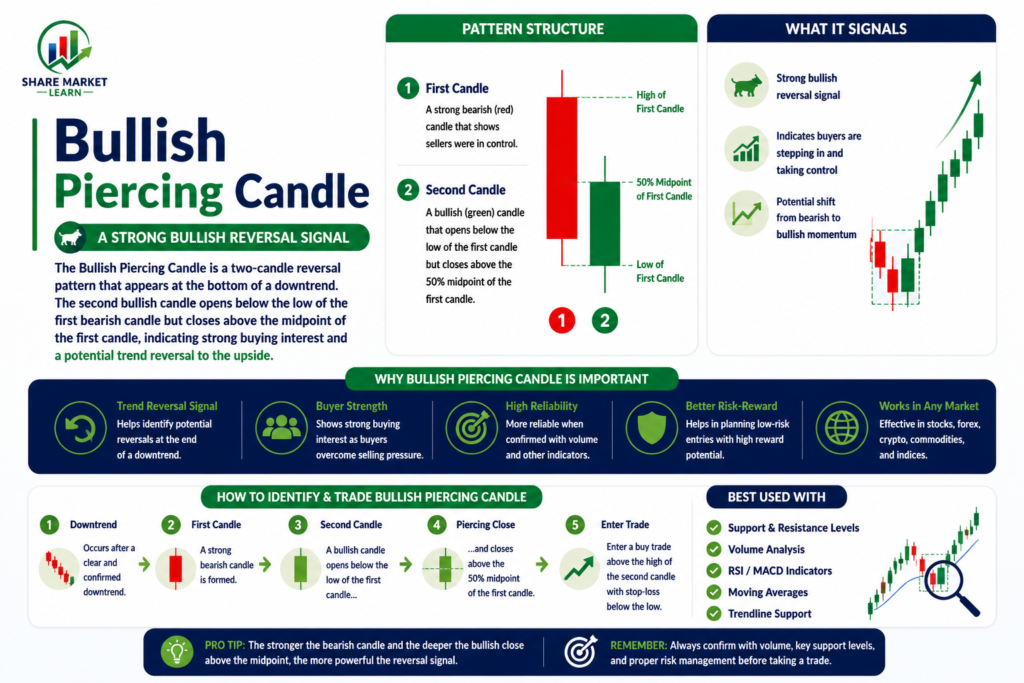
Structure of the Bullish Piercing Pattern
To identify a Bullish Piercing Pattern, traders should look for the following characteristics:
First Candle
- A long bearish candle.
- Appears during an existing downtrend.
- Demonstrates strong selling pressure.
Second Candle
- Opens below the previous candle’s low or near it.
- Closes above the midpoint of the first bearish candle.
- Forms a strong bullish body.
The deeper the second candle penetrates into the first candle’s body, the stronger the bullish signal is considered.
Psychology Behind the Bullish Piercing Pattern
Understanding market psychology is important when trading candlestick patterns.
During the first trading session, sellers dominate the market and push prices significantly lower. This reinforces the bearish sentiment.
On the following session, the market opens lower, suggesting that sellers still have control. However, buyers suddenly enter the market with strength and push prices higher throughout the day.
By the close, the bullish candle recovers more than half of the previous day’s losses. This dramatic shift in sentiment indicates that sellers are losing momentum and buyers are gaining confidence.
The pattern reflects a battle between buyers and sellers where buyers begin taking control, potentially leading to a bullish reversal.
How to Identify a Bullish Piercing Pattern
Follow these steps to identify the pattern correctly:
Step 1: Look for a Downtrend
The pattern should appear after a noticeable downward price movement.
Step 2: Find a Strong Bearish Candle
The first candle should be large and bearish, showing strong selling pressure.
Step 3: Observe the Gap Down Opening
The second candle should open below or near the low of the previous candle.
Step 4: Check the Closing Price
The second candle should close above the midpoint of the first candle’s body.
Step 5: Confirm the Signal
Wait for the next candle to move higher before entering a trade.
Confirmation helps reduce the risk of false signals.
Example of a Bullish Piercing Pattern
Suppose a stock has been falling for several days.
- Day 1 closes with a large bearish candle.
- Day 2 opens lower than Day 1’s close.
- Buyers enter aggressively and push the stock higher.
- Day 2 closes above the midpoint of Day 1’s body.
This formation creates a Bullish Piercing Pattern and suggests a possible reversal from bearish to bullish sentiment.
Bullish Piercing Pattern vs Bullish Engulfing Pattern
Many traders confuse the Bullish Piercing Pattern with the Bullish Engulfing Pattern.
Bullish Piercing Pattern
- Two-candle pattern.
- Second candle closes above the midpoint of the first candle.
- Does not completely engulf the first candle.
Bullish Engulfing Pattern
- Two-candle pattern.
- Second candle completely engulfs the first candle’s body.
- Generally considered a stronger bullish signal.
While both patterns indicate bullish reversals, the Bullish Engulfing Pattern often carries greater strength.
Advantages of the Bullish Piercing Pattern
Easy to Spot
The pattern’s two-candle structure makes it simple for beginners to identify.
Early Reversal Signal
It can provide an early indication that a downtrend may be ending.
Works Across Multiple Markets
The pattern is effective in:
- Stocks
- Forex
- Commodities
- Cryptocurrency
- Indices
Suitable for Different Time Frames
It can be used on:
- Intraday charts
- Daily charts
- Weekly charts
- Swing trading setups
Limitations of the Bullish Piercing Pattern
Like all trading patterns, it is not perfect.
False Signals
Not every Bullish Piercing Pattern results in a successful reversal.
Requires Confirmation
Entering immediately after the pattern forms can increase risk.
Market Conditions Matter
The pattern performs best when combined with additional technical tools.
Weak Volume Can Reduce Reliability
A lack of buying volume may reduce the strength of the signal.
Best Indicators to Use with the Bullish Piercing Pattern
Combining the pattern with technical indicators can improve accuracy.
Relative Strength Index (RSI)
An oversold RSI reading below 30 can strengthen the reversal signal.
Support Levels
Patterns forming near major support zones often have higher reliability.
Moving Averages
A bullish move above a key moving average can provide additional confirmation.
Volume Analysis
Higher trading volume during the bullish candle suggests stronger buyer participation.
Trading Strategy Using the Bullish Piercing Pattern
Entry Point
Many traders enter after the next candle confirms the bullish move.
Stop Loss
Place the stop loss below the low of the pattern.
Profit Target
Possible targets include:
- Previous resistance levels
- Key price zones
- A favorable risk-reward ratio such as 1:2 or 1:3
Risk Management
Always manage risk carefully and avoid risking a large portion of your trading capital on a single trade.
Common Mistakes Traders Make
Ignoring the Existing Trend
The pattern works best after a downtrend.
Trading Without Confirmation
Waiting for confirmation can improve the probability of success.
Ignoring Volume
Strong volume often validates the bullish reversal.
Overlooking Support Levels
The pattern becomes more effective when it forms near important support zones.
Tips for Beginners
- Practice identifying the pattern on historical charts.
- Combine it with RSI and support levels.
- Wait for confirmation before entering a trade.
- Use stop losses on every trade.
- Focus on risk management.
- Avoid relying on a single indicator.
Conclusion
The Bullish Piercing Candle Pattern is a powerful bullish reversal signal that helps traders identify potential buying opportunities after a downtrend. Its simple structure and strong market psychology make it one of the most valuable candlestick patterns in technical analysis.
However, no pattern guarantees success. The Bullish Piercing Pattern should always be combined with confirmation signals, support levels, volume analysis, and proper risk management. By understanding how the pattern works and applying it correctly, traders can improve their ability to identify trend reversals and make more confident trading decisions.